Happy Halloween! As you can gather I’ve had something of an explosion of productivity this past week. Please enjoy part five, which takes its inspiration from one of my favorite stories.
Update: Content removed.
Hope you are enjoying this tale! It seems to be sprawling a bit beyond what I had originally thought, but hey, as long as one derives fulfillment from crafting it, there is surely no reason to stop. Unless, you know, it becomes boring, but I’m sure you’ll advise me of that. Roll on Part Six…
The following is brought to you by the letter V, the number 3 and a soulless multinational defense conglomerate that may or may not have been responsible for the MK-Ultra program. Hope you like it. If you’re new to this tale, Parts One and Two are just a scroll down away.
Update: Content removed. Hopefully to reappear in paper form in the future.
This will be unlike any post you’ve read here before. A brief digression by way of preamble – this is a concept that has been kicking around my brain for a while. My fiction muscles are a bit rusty and they need flexing, so I thought it might be worthwhile to try them out on you, my cherished and loyal readers. Mostly, I need to prove to myself I’ve still got the chops. This piece is tangentially related to my novel in that it is a side story, set in the same world (i.e. same rules), though a thousand miles removed, in a different country, maybe not even at the same time. And the tone is significantly different, as is the protagonist, the style and so on. My thought is posting this as an ongoing saga, with new chapters released periodically (shamelessly cribbing the strategy from Amira Makansi with her wonderful “Porous” tale); a story unfolding in real time, witnessed by you, evolving as it goes. I’m eager to hear what you think. So, without further ado, here is VINTAGE.
Update (8/24/2021): Well, after mulling it over for a long time, I have decided to try to pursue having this professionally published, so I will be removing the copy from my site. I will leave the comments up however, because I really did appreciate the feedback way back when.
This is going to be one of those posts predicated on an entirely inexperienced and likely uninformed premise, so feel free to take it or leave it as you choose. But I’m just gonna throw it out there and see what you guys think. And that premise is: there is far too much explaining going on in fiction, especially as regards characters with supernatural abilities. I skim through people on Twitter glorifying “highly developed, intricate magic systems” in fantasy novels, and have seen, distressingly, a great number of others complain that Elsa’s powers were never explained in Frozen. I guess the seven-year-old in me is wondering where the magic in magic has gone. Why does every paranormal situation in fiction have to be scienced up with midichlorians? What happened to taking magic on faith?
Magic and other supernatural abilities should never be the raison d’etre of a story; they should be an angle by which a dramatic human conflict is examined. When authors and screenwriters get bogged down in the “why” of magic, the human element is lost. Stan Lee gave an interview around the time the first X-Men movie came out where he explained the genesis of those characters thus: having exhausted the idea of superpowers acquired through gamma ray bursts, radioactive spider bites and the like, labeling the new characters “mutants” eliminated the need to craft complex origins for each of the hundreds heroes and villains who would populate his fictional world. He could just get on with the story. Likewise, though crippled by a low budget forced upon it by a nervous studio unconvinced of the potential of comic book movies at the time, the first X-Men is by and large better than the dozens of other adaptations that followed simply because it doesn’t waste an hour telling you where everybody came from and how they got their powers. They’re mutants, they can do things humans can’t, let’s go already.
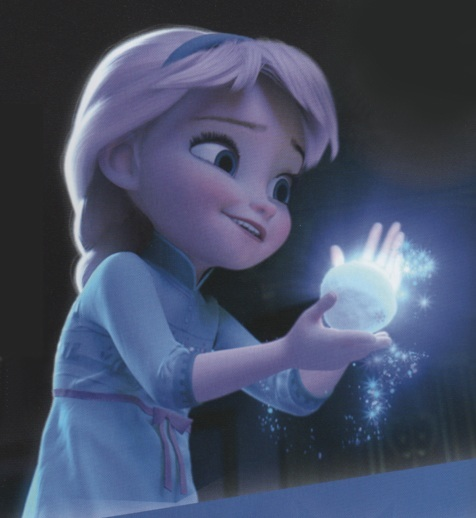
In the first Star Wars, the entirety of the Force is explained in one line: “It’s an energy field created by all living things; it surrounds us and penetrates us, it binds the galaxy together.” We didn’t need Obi-Wan going into ten pages of dialogue about the different castes of Force-wielders, the innumerable versions of the specific powers and how Jedi Trance Remix can only be used on Hoth in a Wampa cave by an 18th-level adept wearing green trousers on alternate Thursdays. If you look at the original drafts of Star Wars, George Lucas had included that extraneous crap, but he wisely cut it to improve the story’s pace. (As we know to our eternal lament, he put it all back in for the prequels.) In Frozen, Elsa’s magic also gets one line of explanation, and it’s delivered in a moment of urgency at the beginning of the movie. (If you missed it, the head troll asks her parents, “born with, or cursed?” They answer, “born with.”) What more did the story need? Nothing – because the story was never about Elsa’s powers. They were only a catalyst for a human conflict. The story was about the bond between the sisters, and that’s why it resonated so deeply with audiences everywhere. Emotions are the key, not technical papers about the chemical processes that make fireworks sparkle and go boom.
The obvious, worst case scenario for the inevitable Frozen 2/Frozen Again/Refrozen is that the writers decide to explain Elsa, by revealing that she was actually rescued/adopted from a family of ice sorcerers/arctic spirits/frost giants/magic penguins who return to claim her, and force her to choose between her birth family and “adopted sister” Anna. (Wanna take bets as to whether this is the direction they go in? It’s not one I offer with enthusiasm.) And once you start explaining, you can’t stop. The narrative becomes less a story and more a Wikipedia, where each hyperlinked word leads to another page of definitions and explanations. That’s what wrecked the latter incarnations of the Star Trek series, where crises could be solved over and over with plodding explanations of made-up technology – reconfigured electroplasma conduit taps emitting verteon particles through phased quantum inducers and so on.
Apart from George R.R. Martin’s A Song of Ice and Fire series, the latest of which I struggled to get through, I haven’t read any fantasy novels in a long time, mainly because I grew tired of wading through elaborately constructed and meticulously explained worlds in which nothing interesting ever happened. (I am open to recommendations, author friends, especially if it’s your book.) I understand that world-building can be a consuming exercise, but constructors should remain mindful that the world will only be as compelling as the characters within it. It’s a bit like visiting a foreign country – you don’t conduct a thorough review of its civil and criminal code before sprinting out of your hotel room to hit the sights. Tell us just enough so that we don’t get lost, and not a solitary syllable more. Let us discover the world on our own, hand in hand with the locals.
When a mystery is explained, it loses its ability to compel our interest. Remember how an X-Wing flying through the Death Star trench looked so much cooler before you knew it was a small model filmed and optically composited against a background plate of another small model, and another layer of black velvet curtain with sequins representing the stars? So too is the wonder of magic diminished when we’re told it’s caused by a specific ancient Petrifying Spell developed by the archwizard Grumblethorn during the seventh Marcovian Age, requiring equal portions of Skirbian tree lizard earwax and Boltan’s Smoogrifying Powder, gathered beneath a two-thirds waning crescent moon. I know some readers glom on to that level of detail; I find it tedious. When I’m describing the use of magic in my book, I try to picture it cinematically, as if I was sitting in a theater watching it unfold before me, and imagining the awe I would experience in that moment. What difference does it make how it happens? It’s enough that it does, and that it can be both beautiful and terrifying. And as always, the emotional impact of the spell on both the user and the witness (and/or victim, as befits the scene) is what’s more dramatically interesting – both to write, and to read.
That’s my take, anyway. Could be completely off base in terms of what’s grabbing people’s interest these days. Your thoughts?
You can emerge from a great movie in any number of frames of mind: stirred to action, moved to tears, smiling ear to ear or even enraged beyond words. And then there are those movies that have a different and in some ways, more profound effect. They come along at just the right moment, when you’re a bit discouraged by a recent course of events, when the well is drying out and replenishing itself with doubt instead. Movies that embrace your simmering creativity and stoke your desire to tell stories, because they remind you of the possibilities inherent in the blank canvas by pushing the limits of what can be done with it. They disarm and enchant the cynic and turn him into a dreamer again, fingers twitching to fill hard drives with a wealth of new words. Frozen, Disney’s magnificent animated retelling of Hans Christian Andersen’s The Snow Queen, did that for me.
The story of a bond of sisterhood tested by fate, magic, misunderstanding and a heck of a lot of snow and ice, Frozen is visually sumptuous, befitting the pedigree of its studio, and uncommonly emotionally profound. The two princesses of the vaguely Nordic realm of Arendelle are the playful young Anna (voiced by Kristen Bell) and her elder sister Elsa (Idina Menzel), who possesses the power to create ice and snow. They are inseparable until Elsa accidentally injures Anna with her magic, at which point their well-meaning royal parents decide that the two would be better off kept apart, for their own safety, and Anna’s memory altered to remove her awareness of her sister’s abilities. Years later, after the girls have been orphaned, Elsa is poised to be named Queen of Arendelle until a confrontation with Anna over a rash decision to marry a handsome prince she’s just met results in Elsa’s long-suppressed powers bursting forth and blanketing Arendelle in eternal winter. Shunned by her people, Elsa flees to the distant mountains, pursued by Anna who has faith that her sister can be convinced to bring summer back to the realm. I’d prefer not to say more at the risk of being spoilery, but despite some red herrings dropped early on that suggest you’re in for the typical schmaltz about princesses in towers and the conveniently available square-jaws they always fall for, and despite the prominence in advertising of the goofy living snowman Olaf (Josh Gad), the story goes in a much more mature and welcome direction, keeping the relationship between the sisters as the emotional linchpin – while dazzling your eyes with some breathtaking animation work, especially in any scene involving Elsa’s magic.
Given what I’ve discussed at length here before in terms of the onscreen portrayal of women, how refreshing indeed to find a story that both passes the Bechdel testand gives depth and complexity to a female character with supernatural powers! The clip I’ve linked above is my absolute favorite moment in the movie, because not only is it a terrific song belted out by a sublimely talented Broadway veteran at the top of her game (even calling back a little to her famous interpretation of Wicked‘s “Defying Gravity”), but it’s a scene of a young woman embracing everything about who she truly is and reveling in the wonders of what she can do with her amazing gifts. A triumphant coming out of a sorceress, if you will, and a scene of unbridled joy. We don’t get to see that very often, if ever. Women with powers in movies are usually punished for them – they have to give them up to attain the life they really want, or, they choose to use them for evil and must therefore be destroyed (usually by… sigh, a virtuous man). While Elsa does cause some inadvertent mayhem that must be undone, the resolution of the story thankfully doesn’t require her to abandon what makes her unique. She adds to her life instead of taking something away.
As a man writing a novel in first-person from a woman’s point of view (a fantasy about a woman with magical powers, no less), those issues are always top of mind for me. It’s too easy to venture down the well-trodden, familiar path at the end of which lies the execrable Mary Sue; the collection of cliches guaranteed to please no one, least of all the author. Experiencing Frozen, though, shows me that it can be done, and done extremely well, and the positive response to the movie by both audiences and critics proves that these kinds of characters can touch hearts. Magic has always had a lingering visceral appeal, and too often literature and cinema adhere to the conservative religious view that there is something fundamentally wrong about it, forever at odds with how the world is supposed to function. Yet it’s something that we all still seem to want in our lives – in the first encounter with a new love, in the twinkle in the eye of a child waiting for Santa, in the wish made on the shooting star. Why can’t the world be magical? Why can’t we make it that way?
Writers have our own magic to offer. We have these crazy ideas and wild emotions that we are somehow able to transmogrify into a collection of permutations of 26 letters that cast spells upon those who read them, with the very effects I mentioned off the top. When we’ve suppressed that nature for too long, because day jobs and other obligations have gotten in the way, or we’ve just been too downright lazy to keep doing what we’re supposed to be doing, we risk not a catastrophic explosion like Elsa, but a gradual withering away of our spirit. We get mopey and find little to be happy about in what should be fulfilling lives. What we need to do is have a “Let It Go” moment instead and revel in what we love and what we know we’re meant to be. Sometimes it takes a reminder; a movie like Frozen that assures you that storytellers are capable of some wondrous things. And then you want to get back to your own fictional universes and start pushing your own limits again, typing until your fingers fall off and you’ve created magical palaces of skyscraping prose. Hoping somewhere in the back of your mind that one day your story will have the same impact on somebody else – and the cycle of creativity will continue, forever unfrozen.
I’ve never been good at self-promotion. Perhaps you can chalk it up to formative years surrounded by people telling me keep quiet, don’t boast and give someone else a turn. Like most people, I enjoy attention, but excessive notice tends to turn my stomach inside out. It’s why I had to stop reading the comments on the stuff I submit to Huffington (that and the occasional threat from a pissed off Tea Partier). The problem is that these aren’t qualities that serve one well if one is attempting to establish a writing career. Publishing firms are tightening their belts and seem to expect their authors to do most of the legwork in marketing themselves. You see the results often on Twitter – writers following other writers in hopes of a follow-back, and relentlessly pushing their tomes through tweet after tweet. Seems to work for some; I follow a few who haven’t published a thing yet have managed to build up their own expectant and admiring fanbases. My attitude has always been that quality will find its own audience, but, after blogging for almost two years to a relatively stable but small (yet tremendously awesome) group of supportive readers, it’s clear that my modest approach isn’t working. I need to give you more.
If you’ve been reading my stuff for a while you’ll know I’ve made some periodic and cryptic references to a finished novel that has been sitting on my hard drive for far too long. A few years back I sent out some queries for it, received polite rejections all around, and then set it aside for a while. (I had a nice one from a literary agent who represents a very famous series of books, who said that her decision to pass was not a statement on the quality of the writing, which, though it may have been a form letter, was still encouraging to a fragile ego.) About two years ago I went back and rewrote large portions of it while painfully hacking out almost 60,000 words to get it to a publishable length. Perhaps a dozen family & friends have read it from cover to cover; dozens more have seen excerpts and offered suggestions, some of which have been incorporated, while others have been welcomed but disregarded (you have to use your judgement after all). Long and the short of it is that at this point it’s in the best shape I can possibly get it into, at least from my perspective. And I have started sending queries out again. So why have I not shared more about it here?
Well, in a strange way, I have. There is a lot here about the book. And no, you haven’t missed it. Let me explain a little.
We live in a spoiler-addicted culture. Everybody wants their appetite sated immediately; we all want to flip to the last page to see who did it. I went through that phase myself – because I am fascinated by the process of film production (an interest that probably stems from wishing in idle moments that it’s what I did for a living) I devour news about scriptwriting, casting, principal photography, and yes, spoilers. I had to give myself an intervention of sorts this past summer when I ruined The Dark Knight Rises for myself by reading the Wikipedia plot summary before seeing the movie. I realized I’d become what I despised – I’d often railed about being able to figure out the ending of rom-coms simply by looking at the two stars featured on the poster. For Skyfall, I purposely kept myself spoiler-free, and as a result I enjoyed that movie a lot more than I would have had I known how it was going to end. Trekkers have been driven up the wall over the last several by J.J. Abrams’ refusal to offer specifics on the identity of the villain “John Harrison” played by Benedict Cumberbatch in the upcoming Star Trek Into Darkness. Is it Khan? Gary Mitchell? Robert April? Harry Mudd? Ernst Stavro Blofeld? In promoting his projects, Abrams has always embraced the idea of the “mystery box,” never showing his hand until the night of the premiere. And controlling the conversation by keeping it where he wants it, in the realm of speculation, is, if managed properly, a great way to keep interest high. It’s a dance though – give away too much and you spoil it, but say nothing, or remain stubbornly evasive, and people grow bored and move on to the next thing. My more introspective nature simply lends itself better to Abrams’ way of thinking.
I’ll crack open the mystery box a little: My novel is a fantasy. It’s the first part of what will hopefully be a trilogy. The main character is a woman with magical abilities. She encounters a mortal man. An adventure ensues.
Whoa, you’re saying. Back up a sec. This is basically Beautiful Creatures, right?
Argh. As writers we need to support each other and rejoice in each other’s successes, so I’m very happy for Kami Garcia and Margaret Stohl. We all dream of seeing our epics translated to the big screen and I’m sure they’re bursting with joy at their enviable accomplishment, as would I. But privately I’m suffering a few gutfuls of agita. You can’t help feeling like the guy who was late to the patent office when Alexander Graham Bell released the first telephone, even though our stories are completely different. Theirs takes place in the modern day; mine is set in the past in a fictional world. Their lead characters are teenagers discovering themselves; mine are world-weary adults. And of course the supporting characters and indeed the plot bear no resemblance to one another. But to the casual observer, they’re treading similar boards, and even though I could have written a story about a lawyer or a doctor or cop without garnering so much as a whisper of comparison, I have no doubt that someone will now accuse me of trying to cash in on a trend, particularly if Beautiful Creatures does become “the next Twilight” and thousands of lesser imitators flood literary agents’ inboxes (I’m fortunate I didn’t choose to write about vampires. Luckily, I find them tiresome.) Indeed, witches are all the rage in pop culture at the moment – we had Hawkeye and Strawberry Fields hacking their heads off a few weeks ago and we’ve got Mrs. James Bond, Meg Griffin and Marilyn Monroe bandying their magical wiles with James Franco coming up in March.
Well, it is what it is and no sense sulking about it now.
I’m going to sidestep into politics for a moment. My beloved federal Liberals are conducting a leadership race right now, and candidate and former astronaut Marc Garneau has recently fired a shot across presumptive favorite Justin Trudeau’s bow by accusing him of failing to offer up concrete plans. But Garneau (and those who are praising this as a brilliant strategic move) should understand that people don’t respond to plans, they respond to ideas – the why, not the what. Our current PM came to power not because he had a thoroughly researched and scored eighteen-point economic agenda, but because his campaign message was that the previous government was corrupt and he wasn’t. It worked. His two subsequent election wins have been based on similar themes – I’m reliable, the other guys are scary unknowns. I go back to Simon Sinek’s brilliant observation that people don’t buy what you do, they buy why you do it. It was the “I have a dream” speech, not the “I have a plan” speech. The trick, when it comes to trying to pitch a book through a query letter, is that you’re required to try and hook the agent through what is more or less a 250-word encapsulation of the basic plot. But the plot isn’t why I wrote the book and it’s not why I want people to read it.
For argument’s sake, and I’m certainly not trying to make a comparison here, but let’s quickly summarize the life of Jesus Christ: A baby is born to a virgin mother and grows up to become a carpenter, lead a vast group of followers and spread a message of love to his fellow men. This offends the ruling powers who condemn him to torture and death, after which he is miraculously resurrected. If you had no knowledge of Christianity or the substance of Jesus’ message, you would never believe based on what you just read that these events would inspire a worldwide religious movement that would endure over two thousand years and counting. The plot doesn’t make you want to read the book. You get no sense of the why.
After an enormous detour, we now come back to my novel and its why. The why is here, all around you, in the archives of this site. It’s in my values, the things that matter to me and that I ponder as I type, post and share. My opinions on politics, conservatism, the Tea Party, faith, spirituality, organized religion, charity, economics, ecology, literature, women, love, the loss of our parents, the shifting nature of good and evil, even James Bond, the Beatles and the writing of Aaron Sorkin as a part of the entire human experience – they are all represented in some form or another in my novel. Gene Roddenberry taught me that a great story can’t just be a journey from A to B to C, it has to be about something more. So mine is an adventure story that is as much an exploration of my personal philosophy and observations on the human condition as it is sorcery, chases, narrow escapes, explosions and witty repartee.
It is written in first person, from the point of view of the sorceress. Why did I choose to write as a woman? Part of it was for the challenge, I suppose, to see if I could do it without falling into chick-lit clichés about designer shoes, the appeal of sculpted abs and struggles with mothers-in-law and PMS. But more to the point, if the story is to connect with an audience, its themes must be universal, as must its emotions. Men and women both know what it is like to feel alone, to be consumed by a longing for something or someone you cannot have, and to make any kind of connection, no matter how meagre. We can both crave intimacy so deeply that we don’t care who we receive it from – even if we know we are asking for it from a person who is absolutely wrong for us. My fictional leading lady has tremendous powers, yet she remains vulnerable to the stirrings of a long-closed-off heart and the desire to be accepted, even by a man who despises everything she represents – a married man, to complicate matters further. The evolution of their relationship is the absolute center of the plot, their interactions the driver of all the events that follow. I avoid a lot of the external mechanisms common to fantasy like endless prophecies, quests, magical objects, creatures, specific rules about the casting of spells and complicated mythologies. Sorry, no Diagon Alley or Avada Kedavra or Quidditch or even white walkers, folks. The progression of my story hinges on emotions, personal choices and consequences, not getting the Whatsit of Whatever to the Mountain of Something Else before the next full moon. The people are what matter and everything else to me is background noise.
Does it sound like something you’d like to read? I hope so. I hope if you’ve come with me this far you’ll want to come a little further, and maybe invite a few friends along. Over the next few months I’ll post periodic updates on how we’re doing submission-wise, and maybe a few more details like character names, excerpts of scenes, even (gasp!) the title. We’ll see if we can get a couple more folks interested to the point where we reach critical mass and something truly amazing happens. It’s a story I’ve put a lot of heart into and really want to share in its completed form. But as I said, if you’ve been following this site and listening to what I have to say, you already know much of what you’re in for. Think of it as a buffet table of themed appetizers leading to a sumptuous main course – one that I promise won’t leave you with indigestion.
As they used to say on the late night talk shows, More to Come…
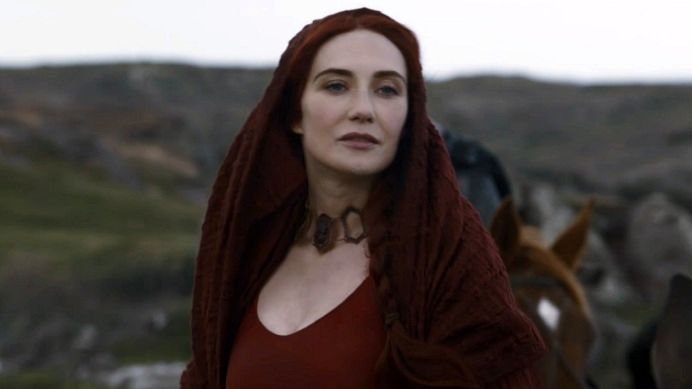
Carice van Houten as Melisandre, warning of darkness and horror and the return of the smoke monster from Lost.
Maiden, mother, crone; child, witch, whore; the meek and the bold, the submissive and the dominant, the loving and the cruel. The infinite and mesmerizing complexity of the feminine was embodied by the incredible women of Game of Thrones in this week’s episode, “Garden of Bones.” While the show can come off as a man’s world in which kings, knights, lords, gentlemen and brutes alike vie for power, “Garden of Bones” reminded the audience that even as they strut in their armor and proclaim their mastery of all they survey, the men are but pieces in this grand game, and that the women are holding the board up – with a flick of their elegant wrists this precarious world will collapse. That they have not yet done so speaks to the quiet bemusement with which they allow the boys to go about their manly and yet hollow pursuits.
That the men of Westeros are ultimately servants to the other half of the sky is evident in several scenes in the episode where men attempt to assert their dominance only to see their egos undercut by feminine power. The arrogant Littlefinger, his very moniker a comment on his masculine limitations, waltzes into Renly Baratheon’s camp, first confronting Margaery Tyrell about Renly’s love that dare not speak its name, then presenting his unrequited crush Catelyn with Ned’s remains and dangling a chance to reunite her with her captive daughters. In both instances the women will have none of it.
Margaery knows well that her marriage is a sham designed to secure a political alliance and is content to act her role, and Catelyn is not so naïve that a shameless appeal to her maternal instincts will excuse Littlefinger’s betrayal of her late husband. Robb Stark is struck speechless by the simple healer Talisa when his proud military victory is utterly diminished by her simple comments to him in the battle’s aftermath, as she accuses him of massacring a bunch of innocents and having no greater plan for the future of the Seven Kingdoms.
Where Littlefinger and Robb respond to their encounters with powerful women with silence, a more sinister path is taken by another profoundly insecure man attempting to assert his dominance over the female – in the skin-crawling scene where petulant King Joffrey commands one prostitute to beat another bloody. He cannot master them with his questionable masculinity, so he uses the coward’s fallback of fear and brutal violence instead. Joffrey’s understanding that he can never equal Robb Stark as a military commander, the more traditional masculine role, leads him to mistreat Sansa instead. Interestingly, while the delicate, virginal Sansa appears to be displaying battered woman syndrome in her continual proclamations of love for Joffrey despite his abuse, she is doing so not out of misplaced devotion but self-preservation – biding her time until she is freed of this monster. Her sister, Arya, utterly defeminised by circumstance (even commenting to Lord Tywin that being a boy made it easier) is likewise still a reserve of indomitable strength, going to sleep each night muttering, like a mantra, the name of each man she means to see dead.
Indeed, the only male character who seems not intimidated by the power of women (at least in this episode) is the one whose masculinity has always been dismissed by his fellow men: Tyrion Lannister. In fact, it is his knowledge of his cousin’s weakness for Queen Cersei’s feminine wiles and his ability to manipulate that awareness that allows him to gain a spy against his scheming sister.
The two sides of motherhood, giving nurturer and ferocious protector, are also on display with the “Mother of Dragons” Daenerys when she is petitioning for entrance to the desert city of Qarth, first pleading that a refusal to admit her people would condemn them to death, then threatening to use her dragons to burn the city to the ground when she is rebuffed. She is the mother of her clan of ragtag Dothraki as much as Catelyn finds herself mother and counselor not only to the Starks but to the men who would be King (treating the battling brothers Baratheon as if they were her own misbehaving children). Where her gilded sibling Viserys was an entitled prat cut from the same unearned royal cloth as Joffrey, Dany’s leadership qualities are being forged through fire.
And speaking of fire, there is Melisandre, the enchantress, trying to tempt grizzled old Davos Seaworth with the secrets beneath her robe. When he finally beholds her stunning (and very pregnant) naked self, the Onion Knight comes face to face with a depiction of the primal fear of all men, what they cannot understand and have never been able to control since the Garden of Eden: the magical temple of life and sexuality that is the woman’s reproductive system, from which emerges in a Freudian ecstasy of smoke and shadow the darkness and horror that Melisandre had cautioned Renly about earlier. To see this sheer force step forth and take shape as the sorceress smiles, at once incomprehensible and weirdly compelling, is the final affirmation in an episode already packed with revelations that the women have written the rules of the Game of Thrones, and they are its referees. For all the talk of the old gods, even Melisandre’s repeated comments about the “Lord of Light,” it is the Goddess, in all her magnificence, elegance, vulnerability, bravery, mystery and cruelty, all her many forms, young and old, beautiful and ugly, wise and foolish, who is running the show.

 Graham's Crackers