The original blog of writer Graham Milne – content published from 2011-2017

Graham's Crackers

    • Ten Things Amateurs Do To Annoy Literary Agents (That Seem Like Easily Avoided Mistakes)

      March 21st, 2012

      Writers can’t live in a vacuum.  You have to know your industry:  keep abreast of trends, understand how things operate and who the players are.  Twitter can be a great resource for passive solicitation of the wisdom of literary agents.  I follow more than a few myself.  To an unpublished writer, an agent is a mythical figure; unicorn-like in elusiveness, keepers of the keys to the magical kingdom of the printed word (and the accompanying royalty cheques), their reputation for granting lifelong dreams rocketed to the heights of Midas or the Fairy Godmother by tales of the agent who plucked the hausfrau from obscurity and made her a million-dollar book deal.  Yet the vast majority of agents are ordinary working folks like you and I, who need copious ventis to make it through the 9-to-5 slog.  Still, they love reading and can be enchanted by a wonderful story as much as any person out there.  One erroneous assumption I think a lot of beginners proceed under is that agents are embittered, failed authors predisposed to hate 99% of what they’re submitted.  Gene Roddenberry once said that a TV producer would stand in the driving rain for days in exchange for one decent script to shoot, and the same mentality applies to agents.  They want the next big thing as much as you want to be the next big thing.  The difference is, they know the business.  It’s their job.

      Securing a literary agent really is like landing a job.  It has to be a good fit for both of you.  The agent isn’t just a one-off middleman who is sending your book to publishers for a cut of the profits, it’s someone with whom you’ll be forming a partnership, working with them for a long time to develop your career and hopefully carry you to that second, third, fourth book and far beyond.  So I must admit I’m surprised to see agents complaining with resigned regularity about the same mistakes made by people who submit manuscripts and proposals to them.  You have to think of your submission as a resume, and the agent as HR.  They are getting thousands of applications a year, and there has to be a way to winnow that behemoth of an in-box as rapidly as possible, lest a plunge over the Cliffs of Insanity result.  As the applicant, you have to do your damnedest to ensure there are as few reasons to toss yours from the pile as possible.  And there are a few “don’ts” that no one who’s serious about writing professionally should ever succumb to, which I don’t believe you need to be a professional to figure out – they’re just common sense.  I’m not an agent, I don’t have an agent, I don’t know any agents.  But based on my observations, here are my Ten Things You Should Never Do When Pitching An Agent, and the reasons why they should be self-evident:

      1.  Lie

      The first and most obvious, but again, you’d be surprised how many agents complain about this.  Lying about yourself may work on the hot girl in the skinny jeans after she’s had a few tequila shots, but again, think of what you’re aiming for here – long-term relationship, not one-night stand.  In the age of Google it’s even harder to get away with Catch Me If You Can-esque deceptions.  If you’ve never been published, don’t claim otherwise.  The agent will appreciate your honesty more than they will a couple of made up credits which they’ll be able to find out are B.S. in less time than it’s taking you to read this sentence.  You won’t get away with it.

      2.  Exaggerate Your Awesomeness

      “My mashup of The Da Vinci Code meets Spongebob Squarepants, which calls to mind the masterworks of Vladimir Nabokov and Anthony Burgess, is guaranteed to be an Oprah’s Book Club best-seller and a blockbuster motion picture.”  Oh, where to start.  Firstly, as far as I know Oprah isn’t doing her book club anymore, and it’s long been a rule among agents that dropping Her Highness’ name in a query is a trigger for an instant form rejection.  Secondly, while it’s better to be proud of your work than to shuffle it forward reluctantly like Fluttershy begging for approval, humility over hyperbole is a safer bet.  When you compare your book to literary big guns, you’re lining yourself up for a spectacular crash and burn.  Don’t put yourself in their class until you’ve earned it.  And don’t ever, ever, talk about sales potential or mention the dreaded Holly-word.  That tells an agent you’re not really serious about writing, that you’re more interested in walking the red carpet with Angelina Jolie on your arm.  (I think she’s taken, by the way.)

      3.  Submit Work That Isn’t Finished

      What happens if you send in a query letter and a sample chapter and the agent bites?  Do you really want to answer their request for a manuscript with “um, uh… it’s not quite… done yet.”  If they want more, you should be able to send it immediately.  Think of your book as a roast chicken – you would never dare serve it until it’s the right temperature, lest your guests die of salmonella poisoning.  You don’t want your agent’s interest to suffer a similar fate.

      4.  Fail To Follow Submission Guidelines

      Reputable agents will post what they are looking for in a submission in an easily findable format, usually on their website.  Read it carefully and only send them what they’re asking for – no more, no less.  This goes back to the principle of trying not to get automatically thrown out of the queue.  Sending only what you feel like sending, or putting idiotic stuff in your query letter like “if you want to see more, you’ll have to agree to represent me,” creates the impression that you’re arrogant.  Making a stupid mistake, like forgetting to attach a synopsis if it’s requested, shows that you’re careless.  Publishing is a world with a lot of rules, and agents aren’t interested in working with people who can’t be bothered to follow them – no matter how good their book might be.  On the other hand, providing exactly what’s asked for demonstrates a deep respect for the agent’s time.  A lack of that respect leads to the next fatal mistake:

      5.  Submit To Agents Who Don’t Represent Your Genre

      If you’re looking for a job as a plumber, you don’t send in your application for an IT position.  Nor should you send your brilliant and insightful 300,000 word treatise on 14th Century Hungarian cabinet makers to a children’s lit agent.  Again, reputable agents will let you know what they’re looking for, and most will also have a list of what they don’t want.  Just do your homework and save yourself an automatic rejection.  It’s all about showing you’re taking it seriously and not just spamming every agent who happens to be listed.  Also, if an agent says they are currently closed to any and all queries, respect that request and leave them alone.

      6.  Call Or Otherwise Harass Them

      Every agent’s website I’ve seen requests – no, beseeches – that you not call them.  It literally is a “don’t call us, we’ll call you” trade.  Take a lesson from high school dating and recognize that constant calling and emailing to request the status of your submission will not win the fair lady’s heart, but rather get you labeled a stalker.  Remember that you’re not being ignored just because you haven’t heard anything in a few weeks.  The agent wants to love your story and they’ll give you every chance to win them over.  Give them the chance to come to it in their own time, when they’re in the right mood to be wowed.  Forcing the issue doesn’t make you look persistent, it makes you irritating.

      7.  Pitch To Them On Twitter

      As I mentioned earlier, lots of agents are on Twitter, and they are a great resource even if you don’t interact with them – just following will give you lots of links to blogs about writing, updates on upcoming conferences and the very pet peeves that have led to the creation of this list.  Many of them do this because they like writers and they genuinely want to share their expertise as widely as possible.  They recognize, though, that you can’t pitch a book in 140 characters, and therefore they politely ask that you don’t try.  Actor Simon Pegg complains on his Twitter feed constantly about his stream being spammed with whiny pleas for follow-backs and retweets – imagine you’re an agent, all you want to do is tweet about the dinner you’ve just enjoyed and maybe find out who went home on Idol and you get inundated with book proposals.  This is not to suggest you should refrain from tweeting to an agent at all – provided you’re discussing something interesting to them and it’s not a pitch, you’re likely to get a positive reply.

      8.  Use Bad Grammar/Spelling/Punctuation

      We hold this truth to be the most self-evident.  Agents aren’t going to represent someone who comes off as barely literate.  Spell check exists for a reason.  Run it over and over again, then read your submission backwards one word at a time so your brain doesn’t skip over errors because it’s putting the words into context.  This rule also applies to knowing the format of a query letter.  If you don’t, learn it and practice.  Agent Janet Reid’s Query Shark blog, while snarky, is a great resource for this.  She’ll critique queries she finds interesting, and even if yours isn’t chosen to become her chum of the week you can learn a lot by the mistakes of others and the suggestions she offers to give your query more punch.

      9.  Badmouth Them On Social Media

      This is the cyberspace equivalent of taking your ball and going home.  There are a dozen reasons why an agent might not request to see anything further from you, and, assuming you’ve avoided items one through eight, I guarantee that not one of those reasons is because they have something against you personally.  Rejection is frustrating, but it’s also part of the business, and you have to learn how to endure it without a hissy fit.  Just accept your “no” and move on to the next agent.  Don’t write a three-thousand word diatribe about how awful the agent is on your blog.  The Internet is public, and forever, and agents network.  They know each other.  If the one that rejected you discovers your online screed of vindictive retribution, how long do you think it will take for the stench of your douchery to spread throughout the literary community?  No one will want to look at anything a spiteful jackass has written even if you are the second coming of William Faulkner.  Be nice, and if you have nothing nice to say, keep your own counsel – or, in other words, shut the hell up about it on Facebook.

      10.  Assume Landing An Agent Is A Ticket To Rowlingville

      It can happen, but those phenomena are the exception, not the rule.  Landing an agent doesn’t mean you’re set for life.  As I said earlier, it’s just the next step in your career.  You’re still a nobody and there is a lot to come – getting published, for one, and promoting the hell out of yourself to the point where you hope you will reach that critical mass and generate some positive word-of-mouth and strong sales.  I recall reading that nobody attended J.K. Rowling’s first American bookstore appearance.  If we’re honest with ourselves some part of us does really crave wide readership and praise, but overnight successes take years and years.  If you truly love writing enough, then you shouldn’t need that stratospheric level of vindication to make it worth your while.

      I can’t promise that this is a definitive list, nor can I assure anyone that obeying all 10 rules will guarantee you an acceptance.  I prefer to approach it from the position of karma, or the golden rule – treat the agent as you would expect to be treated in return, and put out lots of positive energy, and you’re far more likely to get a nibble.  Horror writer Edo van Belkom once told a class I was attending that in order to succeed in publishing, you need a combination of any two of the following three things:  talent, luck and perserverance.  Add to that a healthy dose of respect, humility and attention to detail, and logically, it’s just a matter of time.

      Spread the word:

      • Email a link to a friend (Opens in new window) Email
      • Print (Opens in new window) Print
      • Share on X (Opens in new window) X
      • Share on Facebook (Opens in new window) Facebook
      • Share on LinkedIn (Opens in new window) LinkedIn
      • Share on Pocket (Opens in new window) Pocket
      • Share on Reddit (Opens in new window) Reddit
      • Share on Tumblr (Opens in new window) Tumblr
      • Share on Pinterest (Opens in new window) Pinterest
      Like Loading…
    • An embarrassment of riches

      March 19th, 2012
      There’s gold in them thar cranial recesses.

      Writing is one of the easiest things in the world not to do.  That’s the primary reason most people don’t do it, and why those of us who profess to be writers are always struggling to force the words out.  It’s doubly ironic in that no one is born a literary wunderkind, and like muscles, writing only improves the more you do it – so why do the distractions and excuses continue to mount?  It’s too nice a day outside.  The game’s on.  My partner is lonely.  I was in front of the computer at work for nine hours already.  The new trailer for Prometheus just turned up on YouTube.  I’m just not feeling it today.  I need chocolate.

      Here’s the problem, I think.  When you go to the gym, if you can’t do 150 pushups in one attempt, no big deal.  You’re not going to wallow in the pit of failure and whine about how you’re never going to get to that magic number.  You might be satisfied with doing 60.  The next day you go back, and you do 70.  Then 80, then 100, slowly and methodically increasing your stamina until you reach your goal and strut around with pecs and guns like The Incredible Hulk.  And really, although you might feel a little inadequate next to the no neck wonder at the leg press who looks like he’s never eaten anything other than chicken breasts, raw eggs and protein shakes, you’re really only competing against your own physical limits.  And you always have a reassuring notion in the back of your mind that it is just a matter of persistence, that eventually your body will toughen up.

      Doesn’t work the same way with writing.  When you write something you know is bad, it’s a bodyblow to your ego.  The pathetic cobbling-together of syllables in front of you might as well have been scrawled in crayon by a three-year-old, you hate it that much.  Off to another blog to find some inspiration.  Wow, that’s really good, I can’t write that well.  Everyone is so much better than I am.  Why can’t I show a penetrating insight into humanity like Jonathan Franzen or be as witty as Terry Pratchett or sound as intellectual as Christopher Hitchens, or even be as effortlessly funny as that 19-year-old girl who blogged about her missing underwear?  Hitchens in particular is incredibly intimidating with his line about how most people have a book inside them, and that’s where it should stay.  If you are looking externally for validation of your self-criticism, throw a stone, you’ll hit some piece of literature that will make you feel hopeless.

      We like to mock those daily affirmation exercises where you are instructed to stand in front of a mirror and tell your reflection over and over again how special you truly are, no matter how silly you feel doing it.  I suggest that perhaps there is a writer’s equivalent that isn’t quite so Stuart Smalley.  Because the praise we get from others doesn’t ever seem to crack that veneer of insecurity that is always telling us that “no, we actually do suck.”  When I’m mired in that self-loathing spiral, I like to give some thought to some of the other ideas in the hopper that I would like eventually to put to paper.  As I’ve mentioned, I have a novel that I’m finishing.  I also have its partially-written sequel and, because I cannot tell the entire story in only two books, the eventual third installment.  I have a young adult book that is a reflection on a personal tragedy from my teenage years, of which I’ve penned a single chapter.  I have a premise and outlines for a thirteen-episode television series.  I have what I think is a killer idea for a high-concept screenplay which came to me in a dream a while back.  And I have this blog – this is my ninety-first post and I’ll likely pass 100 before the end of the month.  That’s not an insubstantial volume of work.  And there very well may be more lurking in the corners of my brain yet to be discovered, and I’m kind of excited to find out what they are.  That is enough to keep me going, to silence the voice of Pazuzu ever taunting me with visions of spectacular failure.  To throw the foul-mouthed bastard down the Georgetown steps.

      With all due respect to the late Mr. Hitchens, if you think you have a book inside you, then write the damn thing.  Maybe you won’t get past the first page, maybe no one will ever read it but your significant other.  And you know what?  That’s perfectly fine.  It may be gold, it may be merely pyrite, but you won’t find out unless you dig it up.  Isn’t the promise alone worth getting out the shovel?

      Spread the word:

      • Email a link to a friend (Opens in new window) Email
      • Print (Opens in new window) Print
      • Share on X (Opens in new window) X
      • Share on Facebook (Opens in new window) Facebook
      • Share on LinkedIn (Opens in new window) LinkedIn
      • Share on Pocket (Opens in new window) Pocket
      • Share on Reddit (Opens in new window) Reddit
      • Share on Tumblr (Opens in new window) Tumblr
      • Share on Pinterest (Opens in new window) Pinterest
      Like Loading…
    • Greetings Professor Falken

      March 17th, 2012

      Arthur C. Clarke posited that “any sufficiently advanced technology is indistinguishable from magic.”  Looking at the state of computer gaming now, with motion capture systems like the Wii and the Kinect, three-dimensional graphics with blood-spattering realism, and the phenomenon of online role playing games like World of Warcraft – where entire alternate lives are experienced within cyberspace – it’s hard not to imagine that the characters in 1983’s WarGames would make that assumption were they somehow able to glimpse the games of 2012.  Good science fiction has always assumed that we would reach these points, that our technology would eventually outpace imagination.  No doubt Apple is working on the iHolodeck as we speak.  The best science fiction though has recognized that despite the trappings of future technology, the ideas at its core must remain timeless.  Which is why you can watch a nearly 30-year old movie like WarGames, with its goofy costumes and haircuts and floppy disks the size of pizza boxes, compare its conclusions to history unfolding before you and appreciate its lasting relevance.

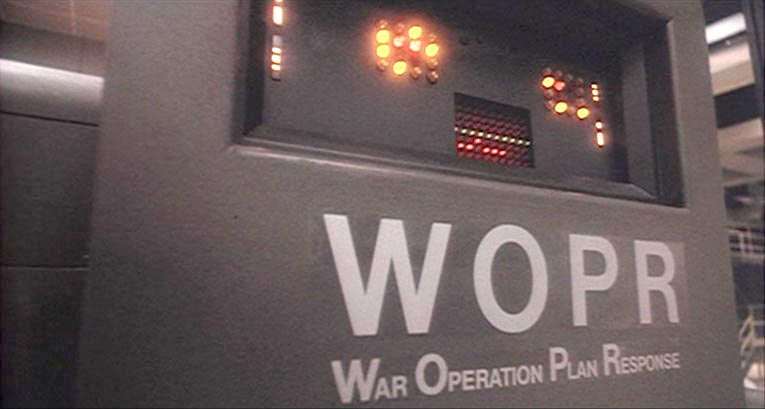
      I suspect there’s little need to recap the film’s plot at length:  Underachiever (and spiritual godfather of Lulzsec and Anonymous) David Lightman (Matthew Broderick) unwittingly hacks into the United States’ computerized defense system (the WOPR) and engages it in a simulated game of Global Thermonuclear War.  The computer decides to play the game for real, never having learned, as its creator Professor Stephen Falken (John Wood) opines, the concept of futility.  The WOPR is another entry in the long list of troublesome movie computers, like 2001‘s HAL 9000, Tron‘s Master Control Program or Terminator‘s Skynet.  Yet especially unlike the latter, WOPR is not acting out of any sense of malevolence – it is a child, innocently smearing house paint all over a priceless work of art, not recognizing that it is damaging something valuable.  In terms of story structure this is an interesting dilemma – there is basically no antagonist in the movie, no bad guy to be defeated.  Rather, the goal is one of establishing an understanding – an awareness of how suicidally stupid the “game” of nuclear brinksmanship is.  Issues of intent, ideology, the worth of communism versus capitalism or ordinary prejudice are removed from the equation completely; in a world of nuance, this is the simplest, most black-and-white question there can be.  Consequently, the many characters populating the movie remain, for the most part, archetypes and relatively undeveloped ciphers.  We don’t get a real sense of why David is a computer-obsessed loner, why Jennifer (Ally Sheedy) wants to hang around with him, why McKittrick (Dabney Coleman) is so driven to prove that the WOPR can usurp the human’s place in the war response decision-making chain.  The question at the heart of the movie is more important, and the characters are servants to finding the answer.  And the writing, direction and editing are handled so well that even watching the movie for the tenth time you are still clenching up as WOPR hacks the nuclear launch codes, wondering if it will figure out what it needs to know in time to save the world.

      It’s unfortunate that a movie like this still holds so much meaning; one would like to imagine that humanity has outgrown the hormonal foolishness that from Hiroshima onwards kept the infamous doomsday clock so close to midnight.  Fear of utter annihilation should not be what keeps us safe in our beds, and yet in many ways we are still like lemurs huddled together in a cave, afraid that the wolves are going to come and take us in the night.  The Soviet Union may be long gone, but the primitive paranoid braintrust that fueled the Cold War is still alive and well; somehow brandishing guns and bombs and strutting about like armed peacocks, boasting about superiority and threatening to metaphorically bitch slap anyone who disagrees is what passes for diplomatic skill in this age.  We read stories about North Korea’s long-range rockets, Iran’s nuclear program and the looming spectre of a potential bombing campaign and think Jesus – why have human beings, who are ostensibly more capable of learning than any machine, not grasped the lesson learned by the WOPR, and WarGames’ timeless message:  “The only winning move is not to play”?

      Spread the word:

      • Email a link to a friend (Opens in new window) Email
      • Print (Opens in new window) Print
      • Share on X (Opens in new window) X
      • Share on Facebook (Opens in new window) Facebook
      • Share on LinkedIn (Opens in new window) LinkedIn
      • Share on Pocket (Opens in new window) Pocket
      • Share on Reddit (Opens in new window) Reddit
      • Share on Tumblr (Opens in new window) Tumblr
      • Share on Pinterest (Opens in new window) Pinterest
      Like Loading…
    • Whither Christmas?

      March 16th, 2012

      Gretchen Wilson’s country hit “Redneck Woman” has a line boasting about how she proudly keeps her Christmas lights on her front porch all year round.  You’d think that folks were taking her advice literally.  One cannot argue that it hasn’t been warm enough to find an opportunity to remove them; temperatures haven’t dropped below zero in weeks and just hit record highs a few days ago.  St. Patrick’s Day is tomorrow and yet a stroll through my neighbourhood reveals plenty of garlands, ribbons, wreaths and even electric deer standing proudly as if waiting for a winter that never really came.  I know it can be tough, un-decorating always is.  But at some point you have to let go.  At this rate the poor Easter Bunny is going to have to muscle out Frosty and Rudolph for veranda space – his nimble cousins have already made an appearance in my backyard.  Given the heat I think old Cottontail can take Frosty, but Rudolph has those strong back legs that could give him a real challenge coming down the stretch.

      Admittedly, this Christmas was kind of anticlimactic, especially since, misleading Weather Network reports to the contrary, December 25th came and went with nary a hint of snow.  And there was a palpable lack of Christmas spirit among my family, friends and colleagues; everybody sort of went through the seasonal motions, but nobody sounded like they were really looking forward to any festivities.  The non-stop carols that kick in on the radio on December 1st sounded tedious by December 4th, and Justin Bieber’s tribute to mistletoe played unendingly didn’t help either.  (I did not hear “Fairytale of New York” or “Christmas Wrapping” once on any FM station, which is criminal.)  Our own decorations were a Griswoldian source of frustration, with two exterior pre-lit trees blowing over and smashing their bulbs at the slightest gust of wind despite my efforts to anchor them in place, a malfunctioning timer, strings of the infernal mini-lights on the big tree inside going dark in random patterns and a mysterious short blowing out the entire outside array.  And we won’t get in to the malfunction of our brand new oven in the middle of cooking Christmas dinner.

      Despite the setbacks we put on the best show of holiday cheer we were able.  But there was something not quite right about the whole thing.  About December 28th it felt like we were still waiting for the real holidays to get going, although in truth, I was so fed up that I would have been happy at that point just to go back to work.  I suspect I’m not alone in that, and I wonder if perhaps that’s the reason there are so many decorations still adorning the nearby houses.  It’s like Linus waiting in the pumpkin patch for the Great Pumpkin to appear, not realizing he missed Halloween in the process.

      My better half has observed that people seem generally unhappy lately.  There is a dourness about the world that is lingering like the worst hangover you’ve ever had.  Poverty is deepening, inequality is worsening and governments aren’t listening to their people, preferring to re-fight old and long-settled battles in lieu of facing the true challenges.  One half of the country hates the other half with a deep-seeded bile it is unwilling to tame.  It is not enough for us to win anymore, we have to see our foe sprawling in the dirt with his limbs broken and face smashed in, and the ground around him scorched and salted.  When did we become so vindictive?  Why this epidemic of hate-thy-neighbour?  Is it those solar flares?  Or is there an insidious cancer eating away at the human soul?

      I don’t mean to sound pessimistic.  But as any alcoholic will tell you, admitting you have a problem is the first step to addressing it.  So many Christmas decorations still out baking away under 20-degree Celsius March heat suggests that there might be a longing out there that everyone doesn’t even realize they share – a hope for the spirit of positivity and unity that lights the world in its coldest months, and was suspiciously absent this past twenty-fifth of December.  There’s no reason why we can’t spend the remainder of 2012 working to bring it back.

      Spread the word:

      • Email a link to a friend (Opens in new window) Email
      • Print (Opens in new window) Print
      • Share on X (Opens in new window) X
      • Share on Facebook (Opens in new window) Facebook
      • Share on LinkedIn (Opens in new window) LinkedIn
      • Share on Pocket (Opens in new window) Pocket
      • Share on Reddit (Opens in new window) Reddit
      • Share on Tumblr (Opens in new window) Tumblr
      • Share on Pinterest (Opens in new window) Pinterest
      Like Loading…
    • Fun with words: If Aaron Sorkin wrote Star Trek: The Next Generation

      March 15th, 2012
      Plenty of room for a pedeconference.

      For those weary of the blatant Sorkin-worship on this blog, I promise this will be the last of him for a little while.  But as he often does, he has inspired me to try my hand at something a little offbeat today.  I would never claim to be half the wordsmith he is, but Sorkin does have a particular style that can be mimicked by us lesser mortals who have studied his works a little too obsessively.  Behold then, for your amusement, Star Trek:  The Next Generation as written by Aaron Sorkin.  Hope you dig.  (Sorry about the pdf, but script format doesn’t seem to want to play well here.  And oh yeah, characters copyright Paramount Pictures, no infringement intended, purposes of parody, so on and so forth.)

      Aaron Sorkin’s Star Trek: The Next Generation

      Yes, as William Shatner would say, I need to get a life.

      Spread the word:

      • Email a link to a friend (Opens in new window) Email
      • Print (Opens in new window) Print
      • Share on X (Opens in new window) X
      • Share on Facebook (Opens in new window) Facebook
      • Share on LinkedIn (Opens in new window) LinkedIn
      • Share on Pocket (Opens in new window) Pocket
      • Share on Reddit (Opens in new window) Reddit
      • Share on Tumblr (Opens in new window) Tumblr
      • Share on Pinterest (Opens in new window) Pinterest
      Like Loading…
    • Baby, what’s your line?

      March 14th, 2012

      I’m obsessed with opening lines.  I can spend hours in a bookstore scanning first pages and evaluating the effectiveness of their greetings.  What is true in the dating world applies equally to literature – the first line sets the tone for the entire story to come.  It can either grab you by the metaphorical balls or wheeze pathetically as if to say, “well, I’m not much to look at, but please if you could be spared a minute or two, if it’s not too much trouble, if you don’t have anything better to do.”  Crafting your own is a daunting challenge mainly because of what you are trying to avoid; you never want your hello to your reader to be the narrative equivalent of “Baby, what’s your sign.”  The Bulwer-Lytton Awards, which commemorate the worst published writing, are named after the man who began his 1830 novel Paul Clifford with the immortal phrase, “It was a dark and stormy night,” and the ranks of mediocrity are plentiful enough without daring to offer one’s own work up for consideration.  The trouble is there are already so many amazing examples out there, that began intimidating all writers to follow decades before you were even born.  Behold just a smattering of the most familiar and most celebrated:

      • “Call me Ishmael.”  (Moby Dick)
      • “Stately, plump Buck Mulligan came from the stairhead, bearing a bowl of lather on which a mirror and a razor lay crossed.”  (Ulysses)
      • “It was a bright cold day in April, and the clocks were striking thirteen.”  (1984)
      • “Many years later, as he faced the firing squad, Colonel Aureliano Buendia was to remember that distant afternoon when his father took him to discover ice.”  (One Hundred Years of Solitude)
      • “It is a truth universally acknowledged, that a single man in possession of good fortune, must be in want of a wife.”  (Pride and Prejudice)

      There is my personal favorite, “It was the best of times, it was the worst of times,” (do I really have to cite it?) and a new addition to my ranks of greats:  “Imagine you have to break somebody’s arm” (Hugh Laurie, The Gun Seller).  So what makes a truly great opening line?  I’ve read thousands and I’m still trying to figure it out.

      There appears to be no singular rationale, other than that the perfect example is able to convey copious amounts of thought-provoking story information while making you hunger for more.  Who is Ishmael?  What is Buck Mulligan up to?  Why are the clocks striking thirteen?  Why is Colonel Buendia being executed, and what would compel him to recall seeing ice for the first time in the moment of his death?  What has always struck me about openers is how off-handed they seem to be, as if they were composed quickly, in a matter of course of getting on with the meat of the story, even though for all I know hundreds of hours of thought and revision have accompanied each individual letter and punctuation mark, their shapes calculated precisely for maximum impact.  There are limitations:  the line cannot be so “out there” that it stops a reader’s momentum dead so they sit and ponder its meaning endlessly.  It has to be a kick in the pants to force you onward.

      The Great Gatsby‘s intro does just this:  “In my younger and more vulnerable years my father gave me some advice that I’ve been turning over in my mind ever since.”  What does this tell us?  That we are about to be led through this tale by a man who is looking back on reckless youth and continuing to this very moment to wrestle with the meaning of those years.  What is the advice his father gave him and why has it haunted him since?  We need to know more, hence, we need to read more.  Contrast this, say, with the first line of Elmer Gantry:  “Elmer Gantry was drunk.”  Without factoring in the character’s name, this is really only two words.  Yet they still crack open the door to a mystery that demands exploring.  The book is called Elmer Gantry; why are we being introduced to the protagonist in such a disagreeable fashion?  Why is he drunk – is this a regular occurrence?  What could be so wrong with his life to compel him to become inebriated?  Is he a tragic or comic character?  Only one way to know.  Turn the page.

      You can drive yourself a bit batty with that first line.  In writing my novel I have gone through dozens of iterations of my opener, scaling up, scaling down, going broad and universal and then small and personal, and struggling to find that ideal balance of brevity versus length, captivation versus compulsion.  It’s an invitation that has to ask without sounding desperate, and has to reassure the reader that a trip inside this little world of words is going to be worth however much time we have asked for their attention.  No wonder it’s as difficult as working up the courage to approach that sexy woman in the bar.  I remember hearing some pick-up advice once and I wonder if it can be applied here as well.  The gist was that if you are at that bar and you see a woman you are attracted to, you are obligated to approach her within 30 seconds of seeing her, otherwise not at all; the idea being that the longer you wait, the more you invest in the outcome, making a possible rejection more damaging to your ego.  The lesson to be drawn, then, is to just start writing in medias res, as if you are already on to the next woman, and that first will either come along or she won’t.  Being casual about it might ultimately lead to failure, but overthinking it makes failure certain.  The thing to remember is that it is only a start, and where you go afterwards is what really matters.

      Spread the word:

      • Email a link to a friend (Opens in new window) Email
      • Print (Opens in new window) Print
      • Share on X (Opens in new window) X
      • Share on Facebook (Opens in new window) Facebook
      • Share on LinkedIn (Opens in new window) LinkedIn
      • Share on Pocket (Opens in new window) Pocket
      • Share on Reddit (Opens in new window) Reddit
      • Share on Tumblr (Opens in new window) Tumblr
      • Share on Pinterest (Opens in new window) Pinterest
      Like Loading…
    • It ain’t easy

      March 13th, 2012
      Aaron Sorkin, making it look easy.

      In Adventures in the Screen Trade, his seminal book on screenwriting, William Goldman talks excitedly about meeting one of his literary heroes, Irwin Shaw (The Young Lions and Rich Man, Poor Man among many others).  They spend an afternoon together, the young Goldman soaking up as much of Shaw’s wisdom as he can.  As they are about to part, Goldman flippantly comments to Shaw that writing must have been easy for him.  Shaw is struck dumb and becomes incredibly morose, remarking quietly, “It wasn’t easy.”  Goldman spends the rest of the chapter berating himself for having said that, for trivializing in one ill-informed quip a lifetime of Shaw’s tribulation and heartbreak poured out on paper.  Perhaps the most intimidating part of attempting to write anything is the mere existence of the reams and reams of brilliant work that have gone before, and the resulting feeling that you will never measure up because it’s so difficult for you and those other guys could just knock out genius effortlessly.  Staring at the blank screen and the blinking cursor with the spectre of Jack Kerouac feeding rolls of paper through his typewriter because he just couldn’t stop can diminish your verve quite abruptly.

      Indeed, writing is one of those paradoxical vocations that people can claim to love in one breath when they are bashing their heads against the wall trying to figure out the right order of words in the next.  While I am presently finalizing my first novel, it is intended to be the beginning of a trilogy – an accidental trilogy, given that when I began writing it, it was only going to be a single work until I found out about word count limits – and while I know how it is supposed to end, I am not entirely certain how to get there.  The other day I had a flash of inspiration and found myself laying out the plot of book two in my head.  Resolving to get at least a workable outline down as soon as possible, I found myself sitting at my computer, utterly stymied.  The words were just not there.  I got up, walked around, got a drink, looked out the window, pet the cat, changed the music and still nothing came.  In that moment I felt about as in love with writing as I am with right-wing conservatism.  An inability to find the words is the wedge that lets all the demons through the door.  Who are you kidding?  You suck at this.  You’ll never amount to anything.  No one will ever want to read this, let alone spend money for it.  When a writer sinks into that well of self-criticism, no amount of positive feedback will help a whit.  One can imagine Irwin Shaw at his typewriter caught in the same spiral, and thus have no difficulty picturing his deep offense at William Goldman’s casual remark.

      One of my writing heroes, Aaron Sorkin, wrote 88 episodes of The West Wing over four years – working on his other series Sports Night concurrently during the first two of those years and still maintaining an unsurpassed level of quality that entrenched a collective ideal of a liberal and intellectual Presidency of the United States during the frustrating Bush years.  A recent Vanity Fair article discusses how The West Wing continues to inspire young staffers who work in the White House to this very day.  Yet while he was writing, Sorkin’s marriage broke apart and he suffered well-documented problems with substance abuse, even an embarrassing airport arrest.  I would love to meet Aaron Sorkin one day, shake his hand and thank him for inspiring my own writing.  But not in a million years would I ever dare to suggest it was easy for him.  That would diminish not only his work, but my own – I think I’d be embarrassed to say I was inspired by something that the guy knocked off in five minutes on a cocktail napkin.

      Writing is the articulation of the soul, the translation of wordless thoughts and feelings into a permanent form that can be shared with and experienced by others.  It is announcing with a megaphone the baring of your vulnerable heart to the world, and hoping for connection, and though it can be as difficult as physically tearing open your ribcage with only your fingertips, we are compelled to do it anyway.  The drive of a writer to craft his message can leave ruin in its wake – the ruin of relationships, of health, of entire lives – the fate of men like Ernest Hemingway.  At the same time, one has to concede nobility in the idea of this sacrifice of personal well-being to a higher purpose – the creation of a lasting story.  This is not by any means to suggest that all great work should require ear-slicing insanity, only that no one should ever expect to reach this mythical idea of effortless writing, and it’s something to remember the next time the flashing cursor unveils the horrifying sight of the blank page.  It’s hard for everyone, no matter how easy they make it look.

      Spread the word:

      • Email a link to a friend (Opens in new window) Email
      • Print (Opens in new window) Print
      • Share on X (Opens in new window) X
      • Share on Facebook (Opens in new window) Facebook
      • Share on LinkedIn (Opens in new window) LinkedIn
      • Share on Pocket (Opens in new window) Pocket
      • Share on Reddit (Opens in new window) Reddit
      • Share on Tumblr (Opens in new window) Tumblr
      • Share on Pinterest (Opens in new window) Pinterest
      Like Loading…
    • The human factor: Game Change

      March 12th, 2012
      Ed Harris as John McCain and Julianne Moore as Sarah Palin in Game Change.

      When Aaron Sorkin was first developing The West Wing, he was advised repeatedly that shows about politics don’t work.  It’s one of the more interesting ironies that even though pundits are fond of dismissing political machinations as “inside the beltway” minutiae that make no difference to the lives of ordinary people, political stories, whether they are Mr. Smith Goes to Washington, All the President’s Men or JFK, are among the most compelling dramas out there.  Why, might one ask?  There is something Shakespearean in narratives set amidst the pursuit of, or the exercise of high office – they are our latter-day tales of the courts of kings and queens.  In fact, Game of Thrones, HBO’s award-winning fantasy series, wins praise not for its dragons and magic and special effects but for the plights of its very human characters caught up in the drive for political power.  Indeed, “HBO” and “Game” would seem to be a winning combination, as exemplified by the premiere this past weekend of Game Change, the Jay Roach-directed story of the McCain-Palin presidential campaign of 2008.  In today’s climate it’s difficult to put politics aside when looking at a movie like this, but the script (by former Buffy the Vampire Slayer actor-turned-writer Danny Strong, who also wrote Recount) jettisons ideology to a large extent.  You don’t really get the sense from the movie of what McCain and Palin were running on or how they differed from the successful Democratic ticket.  The story focuses instead on what made The West Wing and the best political movies work – the human element.

      You don’t have to agree, even slightly, with the positions of John McCain or Sarah Palin to enjoy this movie – you can be the staunchest, conservative-loathing left-winger and still relate to the weary McCain’s fading hopes to be President, the suddenly infamous Palin’s desire to prove herself on a national stage and seasoned advisor Steve Schmidt’s drive to win.  There is an honour to these people when viewed in their private moments (fictionalized as they may be here) and a humanity that we come to realize is stripped away under the lens of 24-hour news coverage, rendering them less people than caricatures defined at the whims of others.  The sublimely talented Julianne Moore is an eerie dead ringer for the infamous Alaskan governor, nailing her look, her movement and her oft-imitated voice, and showing us what made average people gravitate to her in the first place.  It was easy to snicker at Tina Fey’s “I can see Russia from my house” line back in the day; much less so to see the film’s Palin experiencing being pilloried night after night to raucous laughter.  The always watchable Woody Harrelson is excellent as Schmidt, who is instrumental in getting Palin on the ticket over McCain’s initial preference of Joe Lieberman, and who watches like Doctor Frankenstein as his “creation” spirals out of control, only to try and salvage what he can of the party as the campaign begins to go off the rails.  In one of the final scenes, as he angrily tells Palin she will not be allowed to give her own concession speech on election night, he has come full circle, a believer in and defender of the traditions of American democracy, after living the consequences of trying to win through cynical political calculations alone.

      Asked by Anderson Cooper at the end whether he would have put Palin on the ticket had he the chance to make a different choice, Schmidt only comments with resignation that in life, you do not get do-overs.  As the real-life Sarah Palin maintains her public presence and muses to the press about jumping into the 2012 Republican race should Mitt Romney not achieve a solid lock on their nomination, the ultimate lesson of Game Change rings loudly – the reason why, contrary to popular (or at least entertainment executive) belief, political stories work.  John McCain, Steve Schmidt and the Republicans looked at Barack Obama’s effect on his supporters and concluded that rock star charisma was enough to win.  What they and the world came to realize in 2008 was that it is not – gravitas matters more.  At its heart Game Change isn’t about wonkery and punditry and polls; what it does is put the lie to the old saw that anyone can be President – or, perhaps more accurately, that anyone should be President.  Some people just aren’t up to the job, and that’s nothing against them.  Sarah Palin certainly wasn’t, and there is a hint of classical Greek tragedy in the tale of a woman given such an enormous opportunity only to see it drift away because of her own failings.  I’m a proud liberal – I cannot condone Palin’s politics, how she conducts her life or how she would choose to impose her worldview on others, but I can empathize with the loss of a dream I didn’t realize I even wanted.  We all can.  That’s why Game Change works, and why it can take its place among the best political stories – because of the human factor.

      Spread the word:

      • Email a link to a friend (Opens in new window) Email
      • Print (Opens in new window) Print
      • Share on X (Opens in new window) X
      • Share on Facebook (Opens in new window) Facebook
      • Share on LinkedIn (Opens in new window) LinkedIn
      • Share on Pocket (Opens in new window) Pocket
      • Share on Reddit (Opens in new window) Reddit
      • Share on Tumblr (Opens in new window) Tumblr
      • Share on Pinterest (Opens in new window) Pinterest
      Like Loading…
    • A kind of hush all over the world

      March 11th, 2012

      WordPress just added this incredible feature whereby you can track hits on your blog by country of origin.  Admittedly a lot if not the majority of these hits aren’t people looking specifically for my writings, they’re stumbling upon it because search engine tags of a post I’ve written happen to coincide with something they’re looking for.  But any writer would like to hope that a few are sticking around because they like what they’ve discovered.  One thing is for sure, it sort of puts to bed the idea that you need a massive marketing machine to find yourself a global audience – it also reinforces the theory that the Internet is one of the greatest tools of democracy ever invented, and why its freedom needs to be protected wherever the Ministry of Information dares to try to rein it in.  So without further ado, here is where you’ve all come from.  And as always, thanks for visiting.

      I am humbled.  Truly.  Saudi Arabia even???  Yowza.  The only thing I have to add is, come on Japan and New Zealand, get with the program here.  And Greenland is not that big.

      Spread the word:

      • Email a link to a friend (Opens in new window) Email
      • Print (Opens in new window) Print
      • Share on X (Opens in new window) X
      • Share on Facebook (Opens in new window) Facebook
      • Share on LinkedIn (Opens in new window) LinkedIn
      • Share on Pocket (Opens in new window) Pocket
      • Share on Reddit (Opens in new window) Reddit
      • Share on Tumblr (Opens in new window) Tumblr
      • Share on Pinterest (Opens in new window) Pinterest
      Like Loading…
    • Breaking the fourth wall: Michael Kaeshammer live

      March 10th, 2012
      Michael Kaeshammer.

      There is an unwritten rule when attending any performance, be it a concert, a play, even a political debate, that nary the twain shall meet.  It is that separation between performer and audience – he is up there, you are down in the seats, and though the performer may banter with you and encourage you to laugh, sing or applaud, that wall remains intact.  An implicit contract exists to ensure that you both remain in your respective spaces.  The trouble for a performer with the sheer energy of jazz pianist Michael Kaeshammer is that his energy defies captivity.  He bursts from the inside with the spirit of music; you can almost sense the electricity crackling from his skin.  He cannot remain confined; not to his piano, certainly not to the stage, and had the venue been open-air you could imagine him trying to jump onto the wing of a passing plane.  That is not to say his performance is anarchic, far from it – one does not get as good as he is without incredible discipline.  Thousands of notes come dancing and flying at you in the space of milliseconds without a single errant strike.  But watching his fingers fly across his instrument makes you wish that a piano had more than 88 keys, just so you could see what he could do with it.

      Kaeshammer, German by birth (it’s pronounced CASE-hammer) but a resident of Canada is a disciple of the New Orleans sound with a dash of Victor Borge thrown in for good measure.  Last night’s performance at the Burlington Performing Arts Centre was a master class in the application of limitless verve to a style perfected forty years before he was born.  For him, a live show is not so much a chance to entertain fans as it is an opportunity to push the limits of expectation.  For Kaeshammer, the capacity of a piano isn’t restricted to its ivories:  he draws jazz from its shell, its strings, its lid and even creates an unusual harpsichord-like sound by placing a tambourine inside it.  Kaeshammer’s diverse repertoire pays tribute to the heyday of boogie-woogie (with a few gentle jabs at his father’s traditional rendition of Scott Joplin’s “The Entertainer”), but tips its hat to a broader era by working in gospel staples like “People Get Ready” and a virtually unrecognizable – in a good way – cover of The Beatles’ “One After 909”.  And he’s just as at home in quieter numbers like the closing encore, Sam Cooke’s timeless classic “A Change is Gonna Come.”  Regular bassist Marc Rogers and drummer Mark McLean are on the train with as much love for the form and love of trickery as the guy at the keyboard:  Rogers wails on both the electric and the acoustic bass like a latter-day Hendrix, while McLean’s hands are little more than a blur as he uses sticks, brushes and fingertips to make a basic five piece drum kit sound like an entire percussion section.  The skill these guys exude is at a level beyond reach of most average musicians; it must frustrate wannabes that they look like they’re having so much darned fun doing it.  Kaeshammer is all smiles as he plays, tapping his feet as if possessed by a musical Pazuzu (or Stompin’ Tom Connors), and yet at any given point prone to get up and stroll around the stage, pop down into the audience and find an empty seat to appreciate the craftsmanship of his bandmates.  It goes without saying, perhaps, that this enthusiasm naturally bleeds through into the audience, who clap, stomp, sing and cheer for more.  This accessibility in watching him perform makes it less like going to a formal show and more like your buddy Mike invited you over for a beer in his den, which happened to have a grand piano and a backing band in it, and they decided on a spontaneous jam.

      Like Emilie-Claire Barlow, Michael Kaeshammer proves that the spirit of jazz is alive and well in these chilly climes far beyond the sticky, swampy bayous of Louisiana’s Lake Pontchartrain, and that it hasn’t been diminished by the deafening wail of pop and hip-hop in the mainstream music scene.  That there is still room for this amazing virtuoso display of ability and exuberance, that music can still surprise you by defying the straitjacket rules of form and function (and what sells well) is cause for thanks, celebration, and a well-deserved standing ovation.  Kaeshammer has no boundaries in either his playing and in his performance, and least of all in the fourth wall.  Indeed, the ability to reach past the proscenium and touch something inside each soul, is the stuff of music itself – something Michael Kaeshammer has certainly figured out.

      Spread the word:

      • Email a link to a friend (Opens in new window) Email
      • Print (Opens in new window) Print
      • Share on X (Opens in new window) X
      • Share on Facebook (Opens in new window) Facebook
      • Share on LinkedIn (Opens in new window) LinkedIn
      • Share on Pocket (Opens in new window) Pocket
      • Share on Reddit (Opens in new window) Reddit
      • Share on Tumblr (Opens in new window) Tumblr
      • Share on Pinterest (Opens in new window) Pinterest
      Like Loading…
    ←Previous Page
    1 … 28 29 30 31 32 … 39
    Next Page→

    Create a free website or blog at WordPress.com.

    Privacy & Cookies: This site uses cookies. By continuing to use this website, you agree to their use.
    To find out more, including how to control cookies, see here: Cookie Policy
     

    Loading Comments...
     

      • Subscribe Subscribed
        • Graham's Crackers
        • Join 6,281 other subscribers
        • Already have a WordPress.com account? Log in now.
        • Graham's Crackers
        • Subscribe Subscribed
        • Sign up
        • Log in
        • Report this content
        • View site in Reader
        • Manage subscriptions
        • Collapse this bar
      %d