Somewhere, someone is looking at this right now. Wave to them.
I got a little note from WordPress yesterday that I’ve been blogging with them for two years. Two whole years! It doesn’t seem that long since I was idly musing to the better half that I was thinking of starting a blog, and yet here we are, two entire trips round the sun later. Strictly speaking this is not my first blog – there were two antecedents that have long since vanished from the face of the net, and good riddance to them. (The second one actually didn’t have any posts on it, if I recall correctly.) So, two years then; seven hundred and thirty days of wondering what to write about, failing to write anything, figuring it out and writing it, being afraid to hit the publish button once written, worrying that nobody will click on it, getting mad that no one clicks on it, squirming a bit when a copious amount of people are clicking on it and sharing it far and wide.
Have I any insights to share about the experience? Well, a few, take ‘em or leave ‘em. First and foremost it’s made me a better writer (though your opinion may vary). As others have pointed out, writing is a muscle like any other and the more exercise it gets the stronger it becomes. I’ve been able to sharpen my voice and deliver my arguments in a more cogent, more impactful manner. I’ve learned also that an audience is a ravenous beast, and that you cannot drop off the radar after one well-received post and expect people to keep coming back in search of your brilliance. To that end, regular updates on a predictable schedule are a must. This past week has been quite productive and I’m not certain I’ll be able to keep up that pace, but I’m damned well going to try. The only reason not to post is laziness. There are always things to write about, and inspiration can come from the most unlikely corners. I’m finding a lot of it lately in my interactions on Twitter – conversations there can swing into unexpected and wildly amusing detours, providing more than enough fodder for posting more formally later on. Because this is ultimately a form of conversation, I’ve realized that it isn’t enough to post and forget and wait for acclaim to roll in. You need to get out there and talk to other people proactively, follow their blogs, comment when you feel you can contribute (as opposed to just saying “Great post. Check out my blog!”) and be a member of a community.
Above all else, the most important thing I’ve learned is to BE POSITIVE. Even when you’re writing about something that enrages you to the deepest core of your being, you must find it within you to locate the silver lining (and it is there, believe me). There may be a market out there for endless cynicism, for paragraphs of disgust flung at worthy targets like so many buckets of monkey feces, but Jesus, do you really want to be that guy? The nihilist who sees nothing good in or about life and spreads his gloom one kilobyte at a time, determined to twist smiles into frowns wherever he finds them? Yes, a lot of our world is unfair, unjust, even horrifying, and it does us no good to stand in ignorance of that. But the people who have managed to effect positive change have done so from a place of hope and faith in the potential good. An unshakeable trust in the nobility that can arise from the human soul. They have reached out their hands and helped lift others into greatness.
I’m not so naïve to think that I’m changing hearts and minds on a vast scale here. But sometimes I look at that stats map above and it gives me tremendous pause. Each part that is colored represents a different country where someone (and in the cases of the darker colors, quite a few someones) has lent me a few moments of their time to look over what I’ve written. Yeah, maybe some of them are accidental hits while looking for something else. But perhaps one or two of them stayed for a while and poked around a little and came away thinking they’d found something of value. The most wonderful thing about blogging is the ability we now have to touch a truly global audience – to reach out with our hands and lift someone else up, someone we may never meet or even be aware of. How is that not motivation to keep going, to keep pounding out the words, to fight through the self-doubt, the creeping ennui and cynicism and fear?
The right words can change the world. So let’s write a few more of them. Here’s to the next two years.
The United States heads into today’s Fourth of July celebrations consumed by anger at its women, as one state legislature after another attempts to enact laws that remove a woman’s right to manage her own body. Democratic State Senator Wendy Davis of Texas recently became a national figure when she staged a twelve-hour filibuster to kill SB5, a bill that would have shuttered the state’s Planned Parenthood clinics, an event that exposed some truly ugly anti-female leanings from her right-wing colleagues (and a swift decision by chromosome-challenged Governor Rick Perry to schedule a special session to pass the bill anyway in a manner that won’t be able to be filibustered). Ohio’s budget bill recently signed into law by Governor John Kasich contains language that redefines the concept of when pregnancy begins. And it appears that North Carolina has also followed suit by slipping anti-abortion wording into an unrelated bill. Medical decisions that should belong only to women and their doctors are being shoved down throats (or, to put it more bluntly and accurately, up vaginas) by old Bible-waving men whose medical expertise is limited to having seen every episode of Trapper John, M.D. It’s abhorrent and nauseating to imagine the damage that will be done by these draconian measures, and the mind simply reels at the idea of a country where a vagina must be strictly regulated but doing the same to a lethal firearm represents an infringement on freedom.
The U.S. is not alone, but merely the latest world player to climb aboard the bad ship Misogyny. We look aghast across the ocean at nations where women are forced to veil themselves head to toe and walk ten paces behind their husbands, and cannot even ride bicycles, let alone drive cars. It is the most bizarre of pendulum swings that as women become more independent, successful and (gasp!) powerful, the old guard reacts by trying to legislate them back into submission. By suggesting that women aren’t intelligent enough to manage their own bodies, and that it falls to Big Strong He-Man to pat her on the head and tell her boys know better while ushering her back to the kitchen to make him a sandwich and fetch him a beer. Oh, and to have unlimited sex with him whenever and only exactly how he wants it.
That kind of backward attitude can only come, it seems to me, from a place of pure fear, fear of the mystical and irresistibly compelling unknown that is the lady parts. What continues to elude me though is why all these men are so afraid. What do they think is going to happen? Truly? Perhaps it’s the terror of the eternally insecure, the paranoiac who forever walks in worry of being exposed as a complete fraud, a construct of paper with no purpose to his existence. An excellent depiction of this fear can be found in Ksenia Anske’s upcoming novel Siren Suicides, where the heroine must deal with an abusive father who insists that women are made only to “haul water.” Papa frequently belts his daughter across the face to “remind her” and keep her controlled. As the story unfolds, we discover that the seed of this hatred of women lies in his betrayal by one woman in particular. It is not a stretch to imagine that much of the world’s misogyny originates in a man’s frustration with one specific woman from his past – projecting her perceived “sins” onto her entire gender. “You’re all a bunch of feminists,” Marc Lepine railed infamously as he perpetrated the Montreal Massacre. You’re all. Woman is all women. The so-called failings of one are the failings of the collective. They must be controlled, regulated, kept down, lest… well, that’s the question, isn’t it, and that’s where you’ll find the fear.
I’m sorry, but I don’t get it, and as the politicians say, let me be abundantly clear. I’m goddamned tired of it. Because as men, we can do so much better, and yet we’re letting the standard be lowered daily by mouth-breathing troglodytes who can’t handle the funny feels that spring up (pun intended) in their groins when a woman walks by. Who resent the notion that anyone could have power over their manly manliness and who try to prove it by essentially wrapping vaginas in red tape (or shoving ultrasound wands inside them, as the case may be with some of these recent laws). Is this really what men want to be known for when the history of the 21st Century is written?
The aforementioned Neanderthal types need to take a hard long look in the mirror and ask themselves if this is what they signed up for. If they want to perpetuate the cycle of hatred for another generation. I have little optimism at this point that they will do so, however – the proverbial road-to-Damascus conversion is just that, the stuff of proverbs. So it is incumbent on the rest of us – and I’m speaking to my fellow men here, the ones who shift silently and uncomfortably in their seats when their best friend’s douchebag cousin makes a crude remark about the waitress instead of telling him to shut his filthy mouth and get the hell out. We need to be louder, and announce that not only do the Rick Perrys and John Kasichs of the world not speak for us, but that we’re kicking them out of the club, effective immediately – do not pass Go, do not collect $200. That’s it. Their “man card” is revoked. They will no longer be welcome in gatherings of real men, nor will they earn a single one of our votes come election time. We won’t drink with them, we won’t talk sports with them. We’ll cross the street to avoid them. We’ll shun them without pity. They will be condemned to peer longingly in the window from the cold street at those of us who know that a woman’s place is wherever she wants to be.
A man who demeans a woman or women in any way does not deserve the honor of being called a man. He’s an amateur, a lightweight, an utter joke of a waste of otherwise usable DNA overcompensating for what nature saw fit – justifiably so – to deny him. It’s time the rest of us men started treating him accordingly. Like how he treats women. Hopefully he’ll learn something and change his ways. Until then, forget it pal, you’re outta here.
Who is this man? What is he doing? I am intrigued. I must know more.
A disclaimer before we start today: I know nothing, Jon Snow. I am offering the following merely as the opinion of a layperson who has not, for the record, published a single book – not as a treatise of indisputable fact. So it’s entirely possible that the words lying in wait below may be a complete and utter waste of the precious time I’ve requested of you. But please try to give them some consideration before you sit down to your next draft. Trust me, I have been there and done that and I want to try to steer you away from the rocky shores I know lie in wait. Put simply, you need to stop opening your stories with massive information dumps.
Across the Interwebs lies a plethora of sites where authors both experienced and perenially aspiring have posted excerpts of their books – usually the first chapter – for ongoing perusal and feedback. As a veteran lurker I’ve thumbed through a copious number of them, and as my own interest is in writing fantasy (at least for the time being; I’m not limiting the scope of future projects) those tend to be the ones I zero in on. And it pains me to point out that a great many fall victim to the curse of the information dump. The following is my own pastiche, but let me know if any of it rings familiar:
CHAPTER ONE
Prince Xakhar Tazeros, half-dragon Ninth Regent of the Grobulan Confederacy of United Independent Feudal Kingdoms, was seventeenth in line to the throne of Erador. Erador was one of three countries fighting for dominance of the island of Makteros, the only source of the prized mineral hermulite, which was needed to forge the precious Lion Scimitars that were wielded by the ancient warrior race of Qobari. The Qobari Order, descended from the first colonists of Zathan, were the finest combatants that had ever walked beneath the twin suns and possessed the secret martial art of sha’Kaj, which allowed them to possess the forms of trees and plants and turn them against their enemies. One of their most formidable foes was Duchess Zalana, Prince Xakhar’s blood-sister and a sorceress of considerable power, who had long held a grudge against the Qobari and sought to wipe them out. Zalana drew her magic from the Goddess Ia, matron of darkness and one of the Six Gods of Grobular, along with Gatharsa, Yelene, Mq’mal, Rappan and X’gi. The Six Gods were worshipped on every continent except the sub-lands of Serkana, whose belief system operated on a belief in the divinity of blades of grass. Xakhar and Zalana were descendants of the last King of Shocen, who had died in a battle against the Qobari twenty-nine semicycles ago…
Are you still awake? Hope so, but if you’re not, I’m not surprised. Granted, this was a bit over the top, but this is the feeling I sometimes get in reading some of these manuscripts-in-progress. I am in awe – SHEER JAW-DROPPED AWE, I tell you, of the imaginations that can craft these complex worlds that are at once both familiar and alien. I can’t do it. I just come up with silly names like Grobular. But what usually happens is that the writers get so caught up in spilling out these intricate details that they forget to tell a story. Go back and read that paragraph again and note that nothing happens. It’s just fact after fact laid out for you with excruciating precision and at no point does the story start moving. Theoretically, everything I wrote there was important to the telling of the story that is to follow, but rather than introduce this stuff organically, I threw it at you like a bucketload of baseballs. And there’s nothing there to keep you reading unless you really want to know how the last King of Shocen died (fell off his six-legged zorse into a pit of hungry hoopdehars).
Let’s try this again.
CHAPTER ONE (revised)
Xakhar removed his blood-soaked Lion Scimitar from the face of the dead Makterosian soldier, thinking that while his headache of this morning had not eased, it was certainly preferable to that which his opponent had just suffered. Xakhar slid the blade back into his scabbard and cast his gaze upward to the angry, swirling clouds which blotted most of the light from the twin suns, the storm the result of the spell cast by his blood-sister. When they were small they fought over toys or the last slice of dessert; it bemused Xakhar to note that while the scale of their battles had escalated considerably to include thousands of innocent casualties, the stakes had more or less remain unchanged. Zalana still wanted his toys – the kingdom-shaped ones, naturally – and she was not above using her magic to wipe out anyone who stood between her and the prize she sought. As he looked skyward, he could see her evil smile in the curve of the clouds, hear her mocking laughter in the thunder, and feel the might of her anger in each crash of lightning. “Going to be one of those days,” Xakhar said to himself. He glanced down at the soldier’s bisected face. “You got off easy.”
Okay, while this is still not the most magnificent prose ever crafted, at least we have some sense of Xakhar as a character, the world he occupies, and the conflict that is likely to form the spine of the story. We’ve hacked out most of the unnecessary exposition and placed a character in the middle of a tense situation. And while the setting is still alien, the situation is more understandable on a human level. Troubled dude with a jealous, possibly insane sister who won’t leave him alone. This has potential. It still needs to go through the rewrite oven a few times, but we can work with this.
If you’re writing a detective novel, you can usually get away with the most minimal of introductions to your world. “It was raining in San Francisco that Thursday afternoon.” Everyone grasps the setting almost immediately. Unfortunately, a fantasy or SF author has no such privilege. The world and the rules must be established early to provide a point of reference that the reader can latch onto. How do you do that? Well, less is more. And this is where 007 can be of assistance.
You’d be hard-pressed to find anyone on the planet who hasn’t seen at least one James Bond movie. So I’m guessing that most of you reading this are familiar with the basic Bond structure and the pre-titles teaser sequence, which is usually a huge action setpiece that may or may not relate to the main story. You can even argue that it takes its inspiration from William Shakespeare, who almost always begins his plays with a scene involving minor characters before getting on with business. This stylistic invention was, like many things, a creation born of practical necessity – audiences in Elizabethan England would take forever to settle down and pay attention to the stage, so Shakespeare put a bit of fluff at the start to give the rowdy masses a chance to cool it without really missing anything important. The Bond teaser is meant to grab the audience by the metaphorical balls and reintroduce them to their favorite hero in smashing, not drawn-out, polysyllabic style, and much in the same way as the Bard, doesn’t start laying out the important plot until after the main titles. So it’s okay if you’re still distracted a bit when things first start up. After the explosions and the power ballad is when the real story will begin.
My modest suggestion, then, is to “steal from the best” and open with a scene that will introduce a strong character – preferably your protagonist – in a situation where they are forced to do something active instead of idling and recounting the tales of twenty-eight generations of their ancestry. (Think about it – how realistic is this? Do we go to work each morning thinking in exacting detail about the sheer scope of our family bloodline?) The other thing too is that the more of this stuff you hold back in the beginning, the more mystery there will be around your character, the more tantalizing secrets to reveal. When I was first drafting my novel, I fell into this trap. I had the heroine tell you in the first chapter exactly who she was, where she came from and why she could do the things that she could. When I realized as noted above that no one goes around thinking these things about themselves on an average day, I started hacking those parts out, and finding that my leading lady was consequently a lot more interesting – because now you wanted to read on to find the answers.
When you’re world-building, don’t throw it all at us at once, in a blizzard of arcane references and unpronounceable names. Focus on movement, wants, and action, and sprinkle in details where they are relevant. Or, to use a cooking metaphor, use them like spices and not the main ingredient. Come into the story in medias res (in the middle of things, for the non-Latin speakers/non-English majors among us). And if you can open with a Bond-esque, rip-roaring cracker of a scene, with peril and tension and stuff blowing up, more power to you. The aim is to hook us, not give us a history lecture.
Verdict, ladies and gentlemen? Am I on to something here or merely blowing smoke?
This is your life. Credit Vassilis Michalopoulos / Flickr Creative Commons
On Twitter today, Joyce Carol Oates shares a quote from yesterday’s New Yorker about privacy, in which artist Heather Dewey-Hagborg opines, “we are probably the last generation that will realize what we’re losing.” You can’t help thinking that she’s right. An entire generation is growing up with their lives chronicled meticulously for the world’s perusal through Facebook, Instagram, blogs, what have you, either by proud parents or by themselves, seeking connection in the digital space. For the vast majority of the population, these connections will be benign, the consequences minor or nonexistent. Traditional media is certainly keen to hype up the instances of social media gone wrong, and certainly the latest revelations about the National Security Agency are cause for justifiable alarm at what is being collected and by whom for what purposes. To me, it seems that privacy has become a malleable concept. People are okay with sharing to a certain degree, but there is usually a line they won’t cross, and that line differs from person to person. Yet everyone is happy to abdicate at least some of what is uniquely theirs to the great unknown masses; the absolute recluse is soooo last century. (Even Thomas Pynchon lent his voice to The Simpsons a couple of times.) Is Joni Mitchell right, though? Will we not know what we had until it is gone? Or is the march to a completely open community inevitable and privacy a willing sacrifice?
The flexible line intrigues me. A while back, I read a post (I don’t remember where, sorry, or I would provide the link) in which the writer suggested that the level of detail provided in certain “mommy blog” posts about children encroached on the territory of potential libel litigation once the child reached maturity – tired moms calling their kids “little shits” online, and so forth. As a blogger and a new adoptive parent, I too had a choice to make about how much or how little detail I would include about my son in this space. Mindful of my own rule that you should never put anything online that you wouldn’t carve in concrete on your front porch, and not wanting to burden my son with a digital legacy not of his own making, I chose to be quite spare in the amount of information I reveal about him. Where I do post about parenting it’s about my thoughts and feelings – which I can control – and my son is more of a relatively anonymous factor influencing me. You may have noticed I haven’t mentioned his name, and if someone who knows me personally accidentally drops it in the comments, I delete it post-haste. (I have not mentioned my wife’s name here either, for the same reasons, though if you really want to find it, it’s not that difficult.) The siren song of the Internet is calling to him with increasing volume, and he’ll have plenty of time to forge his own footprint his own way, when he’s ready (you know, in about 30 years or so). He doesn’t need me blazing an embarrassing trail with catty remarks about cranky moods or off-color remarks spoken in innocence that will come back to haunt him in his first job interview.
Even if you are cautious about sensible things – not posting your address or phone number, or photos of your house or of you blistering drunk in a pair of your mother’s underpants and so on – you are still giving up an aspect of your privacy when you share your thoughts, whether they be in short bursts of anger at the latest dumb thing done by right wing politicians or long, carefully-reasoned pieces like this one. If someone was a diligent reader of the preceding 200-odd posts here they’d have me at a considerable disadvantage were I to meet them in real life. (Honestly, at any given time I don’t remember half of what I’ve written here.) You don’t know where I live or where I am this very second, but one could argue you know a much more intimate detail about me. You know how I think. That is, assuming you trust that I’ve been truthful and I haven’t been pulling your leg for almost two years with the old unreliable narrator gimmick. And that raises another interesting question. Given the absolute tabula rasa of the digital space for the creation of an online identity, why the presumption that the majority of folks who use it are being absolutely honest about who they are and what they think? I could have created a completely opposite alter ego just for fun and gone to town. But I wanted to be me. And I wanted the digital me to be consistent with the real me, otherwise Lucy would have a lot of ‘splaining to do at dinner parties. So I have in fact given up an integral component of my privacy. I’ve opened my mind to you. There’s an implicit contract then that you are not evil incarnate and you’re not going to find some way to use it against me in a future I have not yet conceived. And even if you do there’s not hellish much I can do about it. I’ve handed over the mallet willingly and it’s your choice whether or not you want to bludgeon me with it.
When you think about it in that context, sharing online is an enormous gesture of trust, and an encouraging one, for it speaks to a deep-rooted optimism that our fellow human beings are good people who can be relied upon to be responsible caretakers of the information we’re providing them. Is it possible that the desire for community, connection and having our voices heard outweighs the wish to protect privacy? For it seems that today, you cannot have both. Certainly, those who shun the digital space wind up missing out on a heck of a lot. There are terrific people I’ve met through blogging and through Twitter that I never would have known about had I chosen to retract my head into my little turtle shell and keep my own counsel. My life, then, has been enhanced by forfeiting aspects of my privacy. In her TED talk, Brene Brown talks about how the people who are the most willing to be vulnerable are those who experience the richest love in return. Yet there’s that catch – being vulnerable. Putting it out there. Extending your hand knowing there is a possibility (however remote) that it might be bitten off. What is worrisome to many, as Heather Dewey-Hagborg suggests with her quote, is that in the future, there simply may be no choice anymore. We need to know if we’re okay with that. The reward of a closer-knit human race is a tempting carrot indeed, but the trouble is, no one knows what it will feel like to be hit with the stick.
Patriotism is a word that seems to be more ill-defined than defined of late. What is ostensibly a concept of some nobility is usually hurled in a threatening manner, to suggest that one is lacking in it if one does not support without reservation whatever controversial policy is being advanced by the government of the day – often the call to arms. The redoubtable Oscar Wilde called it the virtue of the vicious. I’ve always thought of patriotism as loving your country more than you love the dolts who are running it – a sentiment most pertinent when the party you support is out of power. Yet what does it mean to love a country? We can love a song, a great work of literature, a beautiful painting, our life partner, our children. What are we saying when we say we love our country? Since we’re going at this from the point of etymology, apparently, what is it that constitutes a country insomuch as something capable and worthy of being loved? Is it a mere delineation of territory, is it a system of self-governance, is it the character of the people who inhabit its boundaries and the society they have crafted for themselves? What is it I’m saying I love when I say I love my homeland of Canada?
As is true with almost any place on the planet, most of the stereotypes about Canadians aren’t true, as endearing as they may be or as useful to the creation of soundbites. And I’m not talking about the lazy “y’all live in igloos, don’t you?” redneck view of Soviet Canuckistan. Are we unfailingly polite? No more so than anywhere else I’ve chanced to visit, and I have in fact encountered some stunningly rude Canadians in my time, folks who’d just as soon deck you as look at you, and not apologize for it afterwards. Are we peacemakers, honest brokers to the world and friend to any and all to the point of effusiveness? Again, not really – Canadians fight just as hard in wartime as anyone else, and lately our record of living up to our international obligations has been sullied by ideological maneuvering. What about our pristine environment and our unflinching need to protect our natural resources? Hmm… have you chanced to look at the moonscape around northern Alberta recently? Or the rate at which we’re paving over our arable land to build strip malls, big box stores and cookie cutter suburban neighborhoods?
No, we’re not the hosers you think we are. In fact, we’re not entirely sure what we are. For a long time we’ve started our national identity conversation from the point of “not-Americans” and latched on to the quick and simple traits – hockey, Tim Hortons, bilingualism, universal health care – to try to distinguish ourselves on the world stage. Remember those “My name is Joe, and I am Canadian” commercials that were so popular back in the 90’s? While it was amusing to poke fun at the silly questions we’ve all coped with at one time or another while abroad (my personal favorite, my wife being asked about Prince William and Kate Middleton’s wedding plans while at Disney World three years ago, as if she and Kate were BFF’s), the ads still ended with the same laundry list of “Canadian” traits, packaged into five seconds for easy digestion. They made me restless. Surely being Canadian is much more than that. Does my not caring about hockey and preferring Starbucks mean I have to turn in my membership card?
I wanted to write something for Canada Day and I’ve been struggling with it, turning over the question of what it means to be Canadian in my mind all day. It occurred to me, in one of those lightning bolt moments, that I was missing the mark – because the answer lay within the question. Our current federal government has been earnest, if not obnoxious, about pushing symbols of national identity onto the populace – playing up the importance of hockey and Tim Hortons and the monarchy to “honest, average, hard-working Canadians,” positioning the idea of their party and their party alone as the arbiter of Canadianness. Encouragingly, the reaction to these moves, at least from what I’ve seen, has been one of collective indifference. Canadians refuse to be defined; not by their government, not by foreigners, not by anyone. We define ourselves. Because figuring out what it means to be Canadian is, in fact, what it means to be Canadian.
There is no “Canadian Dream,” at least not like its American alternative. Put rather basically (if not overly simplified), the American Dream is about financial success in the capitalist model: starting from nothing, working hard, becoming rich and famous. Does your average Canadian dream about being rich? Sure, a great many do, but the acquisition of massive wealth is not a universal motivator. What does a Canadian want? That is left up to each of us to decide for ourselves. I think about my list of Facebook friends, most of whom are people I went to high school with. From that level playing field they have each followed in some cases wildly divergent paths in life. Some run their own businesses. Some are devoted to charity causes. Some are academics, some are artists and musicians, some work in the trades. Some work for the government, or in health care. Some are attorneys, police officers, computer engineers, teachers, some are stay-at-home parents raising wonderful kids. Some love hockey and follow with religious devotion the trials and tribulations of the Leafs, the Canadiens, the Canucks, the Senators. Some could not care less. They are as diverse a group of people as any random focus group you could gather together, and I would defy anyone to say that a single one of them is any less Canadian than the others. They are the epitome of Canadianness, because each of them is discovering it on his or her own, without feeling any compulsion to conform to a standard. And there’s no group of folks I’d rather stand up and be counted with.
Canada is not without its challenges. We are 37 million people of probably just as many different cultural backgrounds clinging to the border we share with a sometimes very noisy neighbour, one whose influence permeates our daily life (and even our spelling, as my father-in-law would doubtlessly remind me). Often the folks on one side of the country are peeved at the folks on the other (and almost everyone is either peeved at or in love with Quebec at some point). The reason why this grand experiment continues to work, in my humble opinion, is that there is no single destination that can be pointed to as the ultimate objective. Each Canadian is free to follow his or her own path. The objective, as it were, is to discover who you are and make that your Canada. And that is an idea I can get behind and fall in love with. I love this country for allowing me to find myself within it.
Graham (G2): Meh, pretty tired. The cat decided to wake us up at three in the morning again.
G1: That sucks. Frickin’ felines.
G2: Yeah.
G1: So I saw on Twitter last night you said you thought you might write a post about dialogue today.
G2: You must have been up late.
G1: I was.
G2: Couldn’t sleep either?
G1: What “either”? You and I are the same person.
G2: True enough.
G1: I’m just choosing not to be snippy and cranky about it this morning.
G2: “Snippy” and “cranky”? What are you, channeling our grandmother now?
G1: Do you think we could get on with this, Mr. Snarkypants?
G2: Fine. Where do you want to start?
G1: Well, it occurred to me that there is a lot of contradictory advice about dialogue floating around out there.
G2: I’ve noticed that too. Some people think too much dialogue is a bad thing.
G1: I don’t get that. I mean, obviously a novel is not a play and you need to create a balance of description and dialogue, but come on. I think that’s an excuse invented by people who can’t write dialogue well.
G2: And you accused me of being snarky.
G1: Well, if I didn’t think I was a good writer of dialogue, I would pare it back as much as I could. But do you remember when we were watching There Will Be Blood, how pretentious it seemed that there was no dialogue at all in the first half hour? Characters were going out of their way to not talk. It was forced and artificial. Real people are insatiable chatterboxes.
G2: Our son would certainly agree with you there.
G1: He’s kind of the singular example.
G2: Yeah. But you wouldn’t write a character like him, would you?
G1: No. Because a lot of what he says is just random stuff that pops into his head – half-remembered lines from TV shows, updates on the video game he’s playing, stuff he did at school that day. It doesn’t have a lot of coherence to it, or readability if you were to type it out word for word.
G2: Naturally. He’s twelve, and he’s a real person, not a character in a novel. We’re not expecting erudition and fully formed sentences with multiple clauses.
G1: No, no one would believe that, even in a novel. Unless you were portraying him as the most preternatural, linguistically-gifted twelve-year-old in the history of the human race.
G2: We love him very much, but no, that’s not who he is.
G1: Nope. So there’s a balance between the accurate portrayal of a twelve-year-old’s mentality and the need to establish a readable character, one who serves the narrative. People just don’t talk how writers need to write them. We yammer on about everything but what’s actually on our mind – we tell silly jokes, we blather about the weather. In a story you have to get to the point.
G2: That’s what you mean about serving the narrative.
G1: Yeah. Every conversation needs to push some aspect of the story, if only the slightest of nudges. The relationships between the characters need to develop, or the characters have to get closer to their goal. If your guys are going to stop for a five minute exegesis on hamburgers, there had better be some payoff to it.
G1: You know me so well. That’s a really good example. That whole conversation between Jules and Vincent has nothing to do with the plot, but it helps establish their relationship, and shows us that these guys are interesting, endearing people we’re going to dig spending time with. Even though they are on their way to commit a series of murders. Would we have liked them if they’d devoted the conversation to the methodology of how they were going to kill the guys once they got to the apartment, or worse, said nothing at all?
G2: That would have been the insufferable arthouse version.
G1: So, I come back to this idea of balance. You can go too far the other way, where characters become plot explainers. I’ve seen this in fantasy a lot, where two people who have no real reason to talk to each other do an information dump about where they are in their quest, what happened over the last couple of days, and what has to happen next. There’s no nuance to the conversation – the characters just agree with each other for pages on end as they lay out the story so far. It’s the “As you know, Bob” problem. Or Basil Exposition, depending on your preferences. If the sole purpose of your dialogue is to tell your audience things they could learn another way, You’re Doing It Wrong.
G2: My eyelids sag at the mere thought. Of course, you and I are basically just agreeing with each other here. What did you mean by nuance?
G1: Characters should never talk about what they’re actually talking about. Concepts and pellets of information should be implied, not blatant.
G2: Oh, so we would talk about mochacinos in the guise of discussing dialogue?
G1: I like to approach conversations from oblique angles. Like yeah, maybe I would compose a scene of two writers (or two halves of the same mind, as it were) discussing dialogue and set it in line at a Starbucks while they wait for their lattés.
G2: Yeah, because you’d never find a writer at a Starbucks. Real original.
G1: You get my point, though?
G2: Not really. Please explain it to me with statistics and visual aids.
G1: You cribbed that line. You really need to get more sleep.
G2: I really need a lot of things and sleep gets in the way of them.
G1: Suit yourself. Picture it this way. When you’re building dialogue, you have a couple of elements to consider. You have the setting. You have the goal – the piece of information that you need to convey. Maybe it’s a simple fact, maybe it’s a clue to the mystery, maybe it’s the next step in a relationship. That’s where you’re heading, but you don’t start with it. You start in the wilderness and build towards it. Imagine a scene of a couple eating in a restaurant. The husband has to tell the wife that he’s lost his job, but he doesn’t know how to break the news. His first line, then, is not going to be “I don’t know how to tell you this, but I lost my job.” Is it?
G2: I guess it could be, but that seems a waste of a lot of potential dramatic tension.
G1: Exactly. Instead, you might start with them talking about the food they’re eating, other restaurants they’ve been in, you know, casual, everyday, innocent stuff. They might recall fond memories of when they were first dating. The husband will realize that losing his job means they won’t be able to have nights like this anymore. That will start to creep into what he’s saying to his wife. She’ll notice something’s wrong and she’ll ask him about it. He’ll deny it. She’ll ask again. He’ll deny it again, until he breaks down and confesses – or maybe doesn’t at all. You see how 95% of the conversation won’t be about the main piece of information that comes at the very end, right? Instead, you find your way in from the edges. Organically. The characters will lead you there on their own.
G2: Like the scene in our novel where the two leads talk about their respective parents. It begins with the heroine humming a stupid old folk song, and the guy noting that he recognizes it.
G1: Or the scene later on where a conversation about the role of women in the world begins with a chat about sandwiches.
G2: Pick the oddest thing and work your way back from it.
G1: You are learning, young padawan. The other thing to keep in mind too is that unless you’re writing a 1920’s silent movie, characters don’t wear their hearts on their sleeves. Nor do most people. Subtlety and understatement are the way to go. A solemn declaration of undying love shouldn’t sound like it was scripted for daytime TV. In fact, avoid solemn declarations of undying love altogether.
G2: Something just occurred to me. We’re unpublished – where do we get off flinging rules around like so much confetti?
G1: There are no rules, only our interpretation of our own truth. There is every possibility that this exercise has been one in utter nonsense. We can only pass along what works for us in the hope that someone else might find it useful. And this is a rich topic that could go on for thousands upon thousands of words, but eventually, folks will want to tell us to shut up.
G2: Are there some resources we could point people towards?
G1: I think you just have to read a lot of books, watch a lot of movies written by great writers, listen to a lot of different kinds of people talking and process it all in the mind’s blender. And then try and fail a few times on your own before you figure it out.
G2: You were going to mention Aaron Sorkin, weren’t you.
G1: We both know he’s a big influence on us, it goes without saying. Look at him, look at people like David Mamet, Richard Curtis, and David Seidler, who wrote The King’s Speech, to name but a very few. Listen to their rhythms, listen to how someone like Mamet deconstructs patterns of speech to convey character. Glengarry Glen Ross is a terrific example of this. The scene between Moss and Aaronow “talking about” versus “speaking about” is fantastic.
G2: You haven’t mentioned any actual novelists.
G1: Well, funny you should bring that up, because we’re reading a book right now, Patrick DeWitt’s The Sisters Brothers, which has an interesting approach to dialogue. It’s a western, set in 1851 California, but everyone speaks in very elegant, grammatically precise phrases that are probably not an accurate reflection of how people in 1851 California really spoke. Not the artistic choice I was expecting, but refreshing after plodding through Ian Fleming’s clumsy attempts at American slang which felt as artificial as nobody talking in the first act of There Will Be Blood did.
G2: Way to bring it full circle, dude.
G1: I know what you like. Anyway, how to portray dialect, how to vary word choices to denote different speakers, the value of repetition, talking it out to make sure it sounds right – like I said, a rich palette and worth discussing further at a later time.
G2: If you can persuade me to do this again. I feel like I didn’t get to say very much. You were doing all the talking.
G1: You’re tired. The cat, remember? Just looking out for you.
There’s a person in the U.S. who thinks abortion should be banned because fetuses masturbate. There was another one a few weeks ago who claimed that yoga was a gateway to Satanism. Are these the random ravings of a guy on a street corner with a cardboard sign proclaiming the imminent arrival of the apocalypse? No, they are statements made in seriousness by elected officials. People who have managed to convince a sizable number of other people to entrust them with a position of real power and influence. On last Friday’s Real Time with Bill Maher, one of the panelists, herself a Republican (oh yeah, the aforementioned remarks were both made by Republicans, as if you needed to guess) thought the “masturbating fetuses” comment represented a tipping point, and that sanity would begin to reassert itself on the right wing. What has become abundantly clear over the last decade where politics is concerned is that there is no such thing as a tipping point anymore. Every time we think we’ve reached the limit of the pendulum swing towards “the crazy,” someone else doubles down. And someone else doubles down again on that someone else. Forget tipping points – we’ve fallen off the cliff, and we’re competing to see who can scream loudest on the way down.
Last year’s comedy The Campaign was supposed to be an absurdist take on an escalating battle of nutbars for a congressional seat, and as star Zach Galifianakis observed, they found themselves out-absurded by real life. Birtherism, “You lie,” the 47%, “legitimate rape,” Sarah Palin, anchor baby terrorism, unborn self-pleasure and Downward Dog apparently now being a reference to Cerberus, absolutely none of this meme-ready dumbassery, enough to cost any one of us regular folks our jobs and our friends were we to utter them in public, has been able to persuade the general public that something is rotten in the state of our discourse. Rather, ideology has been entrenched in cement. In the past I compared it to how fans support sports teams with unfailing devotion, but that may have been inaccurate. Even the most dedicated fans will criticize their team from time to time, and the most zealous will go at their chosen squad with profane hatchets if they are dissatisfied with how the season is going. Not so in politics. Usually, an elected official who gets rightly excoriated for saying something inane and insulting will do the “I misspoke” non-apology apology routine and turn the incident into a fundraising plea by complaining that the big bad mainstream media is picking on them. The lemmings will duly empty their wallets in response, and the rest of the world will shake its head at the same old story playing out again and again.
Living in a democracy means that theoretically, any citizen should be able to step up into a position of leadership so long as they have been properly elected by a majority of voters. (The role of money puts the lie to this basic assumption, but let’s just go with it as a key principle for the sake of my argument here.) That does not mean, however, that everyone living in said democracy is capable of governing, just as the guy who sits on his bar stool bitching about the Leafs does not actually possess the skill set to coach them to a Stanley Cup victory. The canard that “the system is broken” is repeated ad nauseum to justify a cynical attitude toward public institutions. Even those in power rely on the “everybody does it” excuse – see the Canadian Conservatives trying to deflect justified public outrage at their Senators’ grotesque abuse of taxpayer-funded expense accounts by flinging blame back at the Liberals (who have been out of power for seven years). Justin Trudeau had it right when he said that the solution is not abolishing the institution, it’s choosing better people to populate it. I feel like I say this a lot, and yet, it bears repeating – why is the bar set so catastrophically low for what we expect from the people we choose to govern us? If our only qualification for electing someone is a suit, a flag pin and a series of poll-tested sound bites, why do we then act surprised when things go wrong? It’s government by the lowest common denominator, and it keeps rolling along with the inevitability of the seasons and the tides.
Here’s a thought experiment. Imagine going on a job interview – it doesn’t matter what the job is – and whatever question is asked, just pivot to how important family values, faith, low taxes and supporting the troops is to you. Which outcome is more likely – landing the corner office or never hearing from the interviewers again? Let’s delve deeper into this situation. What are you usually asked when you’re being interviewed? Questions about your experience as it pertains to this new role, ability to function as part of a team, aspirations for your potential future with the organization, your general character. When one considers the lofty esteem with which the private sector is regarded (as compared to the piss poor reputation of the public sector), why should its standards for hiring not apply equally to choosing from a slate of candidates for office? If you want the best government, should not those selected to take part in it boast the deepest, most relevant resumes, and a corresponding depth of character and empathy for one’s fellow human being? If governing is supposed to be serving the public, you would think that a general like of the public would be a critical qualifier for taking part in it, which seems rarely to be the case. We are inundated with angry elected faces spewing hateful rhetoric against everyone and everything that is wrong with this country, but of course, it’s the greatest country in the world and it’s perfect and infallible and hooray for freedom and support the troops.
Sorry to get off on a rant there for a moment, but I’ll bring it back to earth again. There has been a confluence between the world of reality TV, which bases its revenue model on attracting viewers with displays of stupidity, and the world of politics. The ensuing treatment of the stupid in our civilization, where it is better to make noise than speak substance, leads to tolerance, expectation, and finally glorification and celebration of stupidity. Will the “masturbating fetuses” congressman apologize, resign in disgrace and spend the rest of his life asking his customers if they want fries with that? Nope, he’ll be re-elected, handily, and continue to give the world the benefit of his inexperience and ineptitude. And people will suffer, directly or indirectly, because of it.
Unless, as the Lorax said.
Never before in our history have we been so equipped to take stupidity head-on and kick its drooling, mouth-breathing hindquarters to the metaphorical curb. We walk around with repositories of infinite knowledge clipped to our belts, packed with tools to root out willful ignorance. We don’t have to be spoon-fed with what the self-propagating media machine is serving us in the name of getting us to buy things – we can become active pursuers of truth, and exposers of the foolishness that left unchecked will lead our civilization the way of Rome. When we complain about congressional gridlock, or free-spending senators, we must accept the blame for gifting such unworthy persons with the responsibility to make decisions for us, and the resulting course of our country. We need to vet these people better before we decide to trust them, and to hold even the most noble of souls rigidly accountable once in office. And we have absolutely no excuse not to do it anymore. The resources are at our fingertips. It has never been easier. It takes only the will to use them. One click to start to make the world a better place. Is the status quo really preferable? Are we just morbidly fascinated to see what comes next, what new Caligula or Nero will dare present himself for our appraisal?
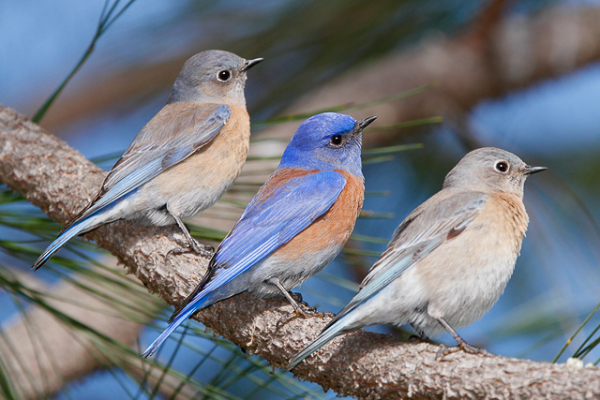
Western Bluebirds by Julio Mulero. Creative Commons license.
“How to get more followers fast!” is the 21st Century equivalent of “How to make money in real estate with no money down.” In social media, we measure success not by dollars earned, but by reach – by the size of our audience. Given that the vast majority of those who use social media are looking for bigger numbers, it’s unsurprising that the vultures would swoop in and begin releasing endless volumes of “how-to” schemes. Though widespread, the advice is more or less the same – use some variety of app to follow large numbers, unfollow people who don’t follow you back, rinse and repeat. Presto, tens of thousands of strangers hanging on your every word, a massive untapped market ready to lap up whatever variation of widget you want to push on them.
Or is it?
What these “get followers fast” folks won’t tell you is how many of these new people are truly engaged with you – if they care about what you have to say, or if they just followed you because they have a similar app building a following for them. I’ve posted before about what I look for in people I choose to follow, and when I see someone new following me who has almost identical following/follower numbers, my red flag is raised (especially if their feed is nothing but requests/pleas/desperate cries to buy their book). Often I won’t follow back, and a few days later I will react with not a shred of surprise when that person disappears from my followers list. Sayonara, nice to know ya, sorta. The question I would ask is, what is ultimately more worthwhile: 100 engaged Twitter friends or 100,000 “followers” who never retweet you, never click on your links and never reply to anything you put out there? 100 people who like and care about you or 100,000 who consider you nothing more than a digit?
By any measure advanced by every social media “guru” or “ninja” (aside, isn’t being a ninja antithetical to the concept of social media? I mean, you want people to know you’re there, right?), my Twitter presence is a failure. I have been on Twitter for over two years and I have just over 400 followers. Not exactly Lady Gaga numbers (she probably garners that many every twenty minutes). Yeah, we love the electric charge we feel when we open it up one morning and see an uptick, and we loathe the disappointment of watching the counter tick down. I can point to three incidences when I’ve seen a surge in new people coming on board – two of them involve being retweeted by famous people (Justin Trudeau and Russell Crowe respectively), while the third was tied to a Huffington Post article of mine about airline travel that was featured as a headline. Other than that, it stays pretty steady. One wonders from time to time if there’s something one is doing or not doing that is keeping the digits immobile. Am I not funny/irreverent/profound/snarky enough? What do I have to do to mimic the example of Megan Amram who started from nothing and parlayed a massive Twitter following into a professional TV writing career?
The truth is, nothing. You can’t be anyone but who you are, as people will be able to smell phoniness ten miles away. And pretending to be something you’re not is exhausting. It will suck you dry, because you’ll be forcing yourself to live up to an unnatural standard, and you’ll begin resenting having to fake it day in and day out. Twitter shouldn’t be a duty, it should be entertaining, thought-provoking, and fun. Because Twitter has no societal strata barring entry, you can jump right in and chat with whomever you please (of course, customary manners still apply, or you’ll find yourself on a lot of “blocked” lists really darn fast). Thus you get a chance to befriend and talk with people you might otherwise never meet. I look back on my Twitter experience and I think of some of the amazing, generous people I’ve encountered, some of the stimulating conversations I’ve had, some of the fantastic writing I’ve discovered, and above all, the quality, not the quantity, of these interactions. The enrichment of one’s life through being able to communicate with kindred spirits far and wide. That is Twitter to me, not a race to ratchet up a follower count.
I cringe every time I see one of these automatic updates about someone’s day on Twitter that consist of nothing other than an accounting of their new followers and unfollowers (in the past, I have unfollowed otherwise interesting people who’ve overdone it with these waste-of-Tweets). It’s plain old boasting, and the height of narcissism to assume that anyone else cares about your self-applied sense of awesomeness. What I would consider to be a successful day on Twitter consists of more intangible statistics. If I’ve made someone laugh, if I’ve moved someone to tears, if I’ve helped someone to think differently about a difficult situation, if I’ve provided a little bit of inspiration, or I’ve motivated someone to make a positive change in their life, that means more than numbers ever will. So the gurus will cluck their tongues, the ninjas will fling throwing stars at me and tell me I’m Doing It Wrong, but truly, just as everyone is meant to find and follow their own path in life, so too is everyone’s social media experience whatever they choose to make of it. Mine works for me. How’s yours going?
This fascinating article from last week illuminated an otherwise unnoticed fact – that over the last few decades, the faces printed on Lego minifigures have been getting steadily more angry and intense. Those cute little plastic guys, population 4 billion and rising, who for a long time faced the world with a uniform array of sweet smiles have succumbed to the creeping angst of a 21st Century obsessed with dystopia and inner turmoil. Is nothing sacred? Is there no refuge from the seeming relentless push towards “dark and edgy” as the only virtues in our entertainment, no matter its form?
My first Lego set came my way when Jimmy Carter was still President; it was a Space set featuring a tiny wedge-shaped ship, controlled by a steering wheel, mounted on a launch vehicle, and it included a single red-suited spaceman, happy at the prospect of the adventures he was certain to have with me. Shortly thereafter Lego became my toy of choice – forget Transformers, G.I. Joes or whatever else, if that wrapped Christmas present didn’t manifest the trademark rattle when shaken it was bound to be disappointment on the morning of December 25th. With birthdays and other special occasions my armada grew to include astronauts in white and yellow, and eventually (once the line expanded) blue and black. And darn it if those little guys weren’t always cheerful. Even when Lego went a step further and introduced the first “bad guys” of Lego Space – Blacktron – beneath those ominous dark-shielded helmets could be found the same delightful grin. The same went for the Town and Castle lines.
Kids grow up, of course, and Lego falls by the wayside… until 1998 and Lego Freakin’ Star Wars drops. By then I’m handling my own discretionary spending and so set after set gets snapped up to the detriment of my income but to the benefit of recapturing childhood glee. But the minifigures have changed. Their faces have been customized to better suit the Star Wars characters. Leia has eyelashes and lipstick, Han has a little wry smirk. Luke Skywalker looks rather dour with a very even, mature expression more suited to the way Mark Hamill looks now than his A New Hope variant. As the line prospers, pieces are refined and more and more sets are released, with the minifigures continuing to evolve alongside them, finally trading in their trademark yellow hue for tones borrowed from the actors who played the characters. And many of them are downright grumpy. A few of the nameless officers still sport the crescent-moon grin, as though working for the Galactic Empire or the Rebellion respectively is the most awesomest job ever, but the more famous characters are all pretty darned serious. And this is only Star Wars – this isn’t considering Batman, Indiana Jones, Harry Potter or the Lego City lines or innumerable others where often, minifigures look pissed off, as if someone has completely ruined their wonderful little plastic day. (We won’t get into the replacement of megaphones with blaster pistols for the Stormtroopers’ weapons, that’s another conversation).
So, is Lego driving this trend or is it merely responding to the downward (emotionally speaking, that is) trend in popular taste? Whenever you hear about a new movie or television series being pitched, the makers’ first comment is usually that it’s “dark and edgy,” almost as a reflex response. It’s what’s in – presumably, a “bright and sunny” film would be laughed out of the room. We have seen countless remakes and reimaginings where otherwise optimistic tales are “darkened” for public consumption. And yet, there is obviously an appetite for optimism that is desperate to be satisfied, growing ever hungrier every time “dark and edgy” sighs its way onto our screens again. We saw evidence of this appetite in recent years with the brony phenomenon coming out of My Little Pony: Friendship is Magic, where otherwise-angst-consumed teens and adults embraced a colorful children’s cartoon that emphasized the importance of kindness in all things. We want to feel happy, yet our entertainment producers keep shoving melancholy down our throats, and we swallow it willingly, trying to ignore the sting of the razor blade as it rattles its way down into our stomachs.
Lego is hedging their bets somewhat, as it often prints Janus-like heads with two different expressions, one serene and one more intense, that can be rotated depending on the mood of play. Part of what made the original smiling minifigure so endearing, however, was that no matter what horrific fate might befall him – usually bisection in a spaceship crash, if we’re going by my experience – he came through it with unflappable joy and spunk, ready to be reassembled for more. No matter what kind of day you’d had, if you’d flunked a test or been shoved into the locker again by that mean kid twice your size, when you shuffled back into your room your Lego men were always smiling at you and standing ever ready to help you explore the very limits of your imagination. Maybe there are limits to what a bunch of little plastic guys can teach a kid, but the attitude of the classic minifigure – embracing challenge with positivity no matter what the circumstance – is worth preserving and passing along. Let’s save the angst until high school at least.
Tired of your own voice? Try writing as someone else! When one is blocked, feeling intimidated by the overwhelming talent of others or otherwise discouraged about the state of one’s literary pursuits, one potential solution is to come at things from a different angle. If your ego is tripping you up, just set it aside. Become a different person. Shapeshift (or as my malaprop-prone son sometimes says, ship-shafe’t). It’s incredibly liberating. You feel so much less pressure to live up to the standards that you’ve placed upon yourself, because what you’re producing isn’t really you. It’s pastiche, it’s fun, and I’ve done it before, here and here. So you can probably guess where I’m heading with this. I’ve decided to take one of the simplest, most enduring stories, Dr. Seuss’ Green Eggs and Ham, and speculate what it might have sounded like had Aaron Sorkin banged it out. Enjoy it. Or don’t, it’s entirely up to you.
FADE IN:
INT. LEO’S OFFICE – DAY
LEO MCGARRY is at his desk. On the phone.
LEO: Yeah. Okay. Thanks.
He hangs up.
LEO: Margaret!!!
MARGARET pokes her head in, notepad and pen at the ready.
MARGARET: You really don’t need to yell.
LEO: Yeah, this time I do. Send in Josh and Toby. Tell the Secretary of Agriculture he needs to be up on the Hill smooth-talking the committee chair on 404. And I need the next five minutes the President’s got.
MARGARET steps out. JOSH LYMAN and TOBY ZIEGLER enter.
JOSH: Leo, settle something for us. You’re on a desert island and you have a choice between Iolanthe and the Mikado.
LEO: Yeah, I don’t really care. Listen…
JOSH: This is about the Ag Bill, isn’t it.
TOBY: It’s not the Ag Bill.
JOSH: I bet it’s the Ag Bill.
TOBY: It’s not gonna be the Ag Bill, the one that we just spent seven weeks negotiating, to the detriment of our physical and psychological health, not to mention every social relationship we ever pretended to care about.
LEO: It’s the Ag Bill.
TOBY (resigned): This is why I continue to hate the world.
JOSH: What happened?
LEO: I just got off a call with the Minority Whip. Republican leadership is attaching an amendment.
TOBY: To the Ag Bill.
LEO: Yeah.
TOBY: To the bill that cost us the support of the entire progressive wing of the Democratic caucus.
JOSH: I’m telling you, we coulda used those three votes.
TOBY: To the bill that is basically a laundry list of every Republican priority on agriculture in this country. A bill that could not be more Republican-friendly if we called it the “Ronald Reagan Second Amendment Let’s Blow Up an Abortion Clinic and Drill in Yellowstone Bill.”
LEO: Yeah.
TOBY (smirks, looks down): Why?
LEO: They’re not happy with the subsidies for organic hen farming and pork production. They want them taken out or they won’t move the bill out of Committee.
JOSH: The Republicans are threatening to block the bill because they don’t like green eggs and ham?
LEO: They do not like green eggs and ham.
TOBY: I do not like them.
LEO: Sam!
SAM SEABORN is walking by the open door. He stops and pokes his head in.
SAM: I am!
LEO: Siddown. Republicans are attaching an amendment to 404. We need to see if we can unlock some Democratic votes for it.
SAM: If they didn’t like the bill before, they’re not going to go for it with another Republican amendment. What is it this time?
TOBY: Green eggs and ham.
SAM: The organic farming section?
LEO: Who do we have on our side that’s movable if that part’s gone?
SAM: You might get Jankowitz, Stephens… Geller’ll vote for it just to stick it to Martindale and his three.
JOSH: I can probably wrangle three more from the Blue Dogs.
TOBY: Nothing like fighting for a watered-down joke of a bill we never wanted in the first place.
LEO: Okay. Time to make some calls. We need this win, I don’t gotta tell you twice. The latest Gallup says our poll numbers are softening and the country is crying out for a solid agricultural policy.
TOBY: Which we’ll get by getting rid of green eggs and ham.
JOSH: It’s okay, nobody likes green eggs and ham.
PRESIDENT BARTLET enters from the side door.
BARTLET: What’s this about green eggs and ham?
LEO: Republican amendment to 404. Deleting the organic farming section.
BARTLET: Well, if there’s one thing we can count on Republicans for, it’s screwing Mother Earth with her pants on.
LEO: Sir…
BARTLET: Did you know that organic farm subsidies account for a tenth of one percent of all federal spending on agriculture? We’re happy to fork out the cash, so long as you’re spraying your fields with toxic sludge you wouldn’t dare use to wax your own car. You know what the problem is? No one’s ever been forced to try green eggs and ham. We’ve become a country so accustomed to the comfort of familiarity that the thought of change has become a terrifying prospect. Even if that change is for the better. The problem with that is, it’s not what the Framers had in mind. America was meant to be an experiment in constant change. Forming a more perfect union is about forever trying new things with the understanding that some of them will be scary, and some of them won’t work. Some will be spectacular failures. But we have to try them anyway, because we’ll never know if we don’t. It’s like Voltaire said: we cannot let the perfect be the enemy of the necessary. Who knows – in the midst of all the noise, all the partisan bickering, maybe we’ll find out in the end that we do like green eggs and ham.
Determination settles upon the faces of his staff.
LEO: About 404, sir?
BARTLET: Let’s have a debate. A real debate. We the People can decide if they like green eggs and ham.
SAM: Not for nothing, but I’ve always liked them.
LEO: Sam…
SAM: I am.
FADE OUT.
What’d ya think? Anyone else want to give it a go? Pick a different writer – novelist, screenwriter, whoever, and retell your version of Green Eggs and Ham in their voice. Put the link to your story in the comments. Anxious to see what you come up with!







 Graham's Crackers