The original blog of writer Graham Milne – content published from 2011-2017

Graham's Crackers

    • It’s the Other 54 Games that Matter: The Blue Jays’ Season So Far

      May 6th, 2016

      jays

      There’s a saying in baseball, I first heard it paraphrased on The West Wing but I’m sure it originates somewhere else:  Every team is going to win 54 games, every team is going to lose 54 games; it’s what you do with the other 54 games that matters.  162 games is a brutally long season, and completely botching 70 of those outings could still net a team a record decent enough to win a division.

      As the Toronto Blue Jays sit in third place just having clawed their way back to a .500 won-lost percentage (15-15), while elsewhere about MLB the Cubs, White Sox, Red Sox, Mariners and Nationals are off to explosive starts, both longtime fans and bandwagoners who marveled at the can-do-no-wrong 2015 Toronto squad have been left scratching their heads.  Last night’s 12-2 blowout against the Texas Rangers was a welcome dose of ointment for that itch, a hint of the promise this team still holds in its reserve tank.  And there are 132 games left to play.  39 more wins, 39 more losses, and a whole lot of possibilities in those remaining 54.

      When I was eight years old and going to games at the Ex with my dad, I didn’t pay attention to off-season maneuvering – trades, free agent signings and so forth.  So long as those guys on the field were in blue and white, I and the rest of Toronto would be cheering for them.  The same cannot be said for the electron microscope that was placed on every rumor, both legitimate and cockamamie, surrounding the Blue Jays as a Kansas City glove closed on the last out of the 2015 World Series.  What kind of team would newly appointed team president Mark Shapiro and general manager Ross Atkins assemble?  Would the notoriously tight-pursed Rogers Communications pony up enough loonies and toonies to get the band back together?  Did some of those guys even want to come back?

      We found out the answer pretty quickly as the ramifications of outgoing GM Alex Anthopoulos’ decision to go all in on 2015 by purging the farm system crashed down like a bad hangover.

      It was something of a poison chalice handed to Shapiro and Atkins, and while one can still legitimately question some of the choices they made, as fans, we were fortunate that as many of those same heroes of 2015 came back as they did.  Maybe for one last hurrah as it turns out, as the impending free agencies of Jose Bautista and Edwin Encarnacion loom in November, and plenty of teams with big bucks and hungry for big bats are salivating at the prospect of snapping one or both of them up.  (The thought of either in a Red Sox uniform in 2017 filling David Ortiz’s soon-to-be-hung-up cleats is enough to inspire cold sweats.)

      We said goodbye to David Price, Mark Buehrle, Ben Revere, Mark Lowe, Liam Hendriks, Dioner Navarro, Cliff Pennington and the lovable Munenori Kawasaki.  We welcomed back J.A. Happ and Jesse Chavez.  We said hello to Drew Storen, Gavin Floyd, Joe Biagini, Franklin Morales, Pat Venditte and a whole slew of new and eager arms.  We finally saw a return on investment in Michael Saunders after he narrowly escaped a last-minute pre-season trade.  For the past couple of months this mix of veterans and newcomers has been struggling to jell as a team under the lights of the television cameras, the stares of thousands of fans and the weight of an entire country’s collected expectations.

      So far, in 2016, we’ve seen our share of heartbreak.  The season’s first loss to Tampa Bay, when the Jays got smacked with a questionable application of the new “Chase Utley Rule,” reminded us again how vulnerable we are in close games and that Major League umpires in the clutch tend not to be on Toronto’s side.  (Recall that questionable umpiring handed Game 6 and the ALCS to Kansas City by awarding the Royals a home run on obvious fan interference, being too generous with the strike zone on poor Ben Revere and failing to call a blatant balk on Royals’ closer Wade Davis when the go-ahead runs were on base.)  We watched reliever Brett Cecil’s incredible scoreless pitching streak come to a spectacular dumpster fire of an ending as he, along with our carefully crafted bullpen, let lead after lead slip away.  And we shook our heads in stunned disbelief as we watched one of last season’s most beloved players, Chris Colabello, take an 80 game suspension when a banned substance was found in his urine.

      April 2016 hasn’t just been a hangover from last year’s high; it’s been the full-on nauseous throes of heroin withdrawal.  Perhaps one consolation is that however the Blue Jays seem to be struggling, the hated New York Yankees are doing far worse:  9-17 out of the gate and poised for possibly their worst year in decades.

      But let’s be honest with ourselves.  As much as Toronto sportswriters like to fantasize, the Blue Jays were never going to go 162-0 and sweep all three playoff series.  Baseball remains a game of obsessive statistics, and as hot as those other teams are right now, slumps (or regressions) are inevitable.  It could be that the Blue Jays have just spent April purging their bad karma, and that May 5’s trouncing of the Rangers – karmically embarrassing Texas starter Derek Holland, who wiped himself with a Blue Jays rally towel during the ALDS last year – is the Jays settling back into where they’re supposed to be.  They’ve won three in a row now, and while this weekend’s inter-league matchup against the Dodgers won’t be a cakewalk (particularly with the strikeout-prone Jays facing MLB strikeout leader Clayton Kershaw on Saturday), it’s a chance to solidify the team’s direction and remind themselves, the fans and the world that they are no fluke, that they remain a force to be reckoned with and a serious contender to take it all in the fall, no matter how many people say the Chicago Cubs are due.

      The alternative, what Blue Jays fans dread most, is more slips and stumbles, a fall out of playoff contention, and greedy front office suits champing at the bit to launch a Marlins-esque fire sale at the trade deadline in favor of cheaper, lesser players who will proceed to suck for the next ten years – what baseball executives charitably like to call “rebuilding.”

      We endured 22 years of that, we don’t have the patience to go through it again.  The franchise itself might not survive it.

      The Blue Jays have all the ingredients of a championship team.  The defense is borderline flawless.  If Troy Tulowitzki isn’t producing at the plate, he’s making up for it in the hits he’s denying opposing batters.  The starting pitching has been the highlight of the season so far, on balance arguably the strongest five-man rotation in baseball.  Happ in particular, who was exceptionally average in his first stint as a Blue Jay and whose off-season signing was greeted with resigned sighs given that it slammed the door on any lingering hopes of reacquiring David Price, has been simply exceptional, going 4-0 with one no-decision and proving to be that guy about whom you can relax and let out a long breath when you know he’s going to be on the mound that day.  Yes, with the exception of Roberto Osuna, the bullpen has been a source of many jangled nerves, shouldering the blame for nearly every single loss so far this year, but they seem to be settling down finally, with Chavez starting to rack up the K’s and Biagini throwing clean innings (and curveballs in his post-game interviews) and once Cecil and Drew Storen figure things out the whole crew should prove to be as lights-out as any bullpen in the majors.

      The big difference between this year and last is the hitting, or lack thereof.  It’s almost as though the Blue Jays read too many of their own clippings and league-leading 2015 stats, and have been so focused on belting the ball out of the park that they’ve lost their timing and failed to recall that small ball can win games as well as home runs can.  Interestingly enough, of last night’s twelve runs scored, only three of them came from homers, and those three were the result of one three-run blast by Encarnacion in the bottom of the third.  Whatever magical combination of circumstances was working for the Blue Jays on May 5th, 2016, they need to etch it into their brains and hearts and continue to summon it as they face Kenta Maeda and the Dodgers this evening.  If the bullpen can’t save you, and the umpires are against you, just keep the line moving, keep padding the lead and make the games into no-doubters.

      It’s still too early to say that the corner has been turned.  There are at least 39 losses yet to come, and some of those are going to be nail-biters, and teeth-gnashers, and set-your-jersey-on-fire heart-shredders.  That’s baseball for you.  Like any team sport, it demands faith.  Toronto fans have been tested by far worse before, and last night was a crumb of that fabled manna falling from the heavens into a well-worn leather glove.  Let’s hope that it portends bigger and greater things, and if it doesn’t right away, there’s lots of baseball left.  It’s the other 54 games that will make the difference.

      Spread the word:

      • Click to email a link to a friend (Opens in new window) Email
      • Click to print (Opens in new window) Print
      • Click to share on X (Opens in new window) X
      • Click to share on Facebook (Opens in new window) Facebook
      • Click to share on LinkedIn (Opens in new window) LinkedIn
      • Click to share on Pocket (Opens in new window) Pocket
      • Click to share on Reddit (Opens in new window) Reddit
      • Click to share on Tumblr (Opens in new window) Tumblr
      • Click to share on Pinterest (Opens in new window) Pinterest
      Like Loading…
    • The Fourth is With Us Again

      May 4th, 2016

      saga

      When I reflect on the state of Star Wars on May the 4th of two years ago, the word that springs foremost to mind is nervous.  We knew that Episode VII was in production, we’d read the rumors and seen that first black and white picture of the cast at the table read, we knew the original heroes were coming back – but we still couldn’t shake the jitters.  Too many unknowns in play.  Despite the scorn dumped on George Lucas for the wobbly prequel trilogy, the idea of a new Star Wars movie without any involvement from him whatsoever still set many stomachs ill at ease.  Would it turn out to be an empty exercise in fanservice (from a filmmaker with something of a reputation for leaping headfirst into that well-cratered minefield) or would it catching Force lightning in the proverbial bottle and gift us with the wonder we first felt at the theatres in 1977 (or with our videocassette copies in the early 80’s, depending on our respective ages)?  Would we be leaping up and cheering and racing back to the kiosk to buy another ticket or would we be shuffling for the exits with the sour faces we wore as the Revenge of the Sith credits rolled?

      Fast forward to May the 4th, 2016, and we know the answer to that.  Against expectations, we have entered the Star Wars Renaissance.  Star Wars is everywhere in a way it hasn’t been, since, well, longer than I can remember.  The Force Awakens was one of the highest-grossing movies of all time, and its highly anticipated sequel is filming presently and due to hit our collective consciousness in a little over a year and a half.  Daisy Ridley has become an instant movie superstar.  This December’s Rogue One: A Star Wars Story promises to unspool the never-told-but-oft-alluded-to tale of how the Rebel Alliance acquired the infamous Death Star schematics (with another compelling lead female role, essayed by Felicity Jones.)  Plans for Han Solo and Boba Fett spinoffs are also in the works, to say nothing of the eventual saga-concluding epic Episode IX in 2019.  Literary tie-ins bulge off shelves with novels like Aftermath and Bloodline.  Oh, and yes, the Walt Disney Company is building two massive Star Wars lands at its American theme parks.  Toys and pop culture references abound and kids are throwing on Jedi robes and running around swinging plastic lightsabers again, pretending to be Rey and Finn and Kylo Ren just like we used to pretend to be Luke, Han, Leia and Darth Vader.

      It’s a great time to be a Star Wars fan.

      A week or so ago I was trolled on Twitter by an – let’s say interesting individual who, according to his timeline, goes around latching on to people who’ve said unkind things about the prequel trilogy and then spams them with memes and rants about the wonderfulness of Episodes I, II and III before blocking them in what is presumably a masturbatory fit of self-satisfied pique.  You can’t please everyone, I suppose.  Contrary to what this fellow presumes, I never said I hated the prequels.  There are plenty of things about them to like:  John Williams’ score, some of the lightsaber fights, the depth of the worldbuilding among many others.  What they get wrong, however, is that they lack the key ingredient that makes Star Wars resonate with its fans, and that is the sense of hope.

      The prequels were always going to be a tragedy, and despite the whiz-bang-whee moments of adventure supplied generously throughout, the ominous, inevitable sense that this is all going to go wrong in the end casts a dark pallor over the seven-hours worth of narrative.  It doesn’t matter that you know IV, V and VI are going to set it right.  Taken on their own, the prequels are just simply not a very happy experience.  Art always mirrors its creators’ mindsets, and the young, eager, starry-eyed neophyte George Lucas who made the first trilogy is not the cynical, fearful, age-embittered auteur who cobbled together the second after spending decades as a billionaire CEO shuffled daily from meeting to meeting – a man increasingly worried about the world awaiting his three children.  Lucas thought America had learned the lessons of Richard Nixon and then watched helplessly as it turned around and anointed George W. Bush.  He couldn’t have made a film with the optimism and hope of The Force Awakens because it’s simply not who he is anymore.  But that didn’t have to mean that the hope dwelling at the heart of his slumbering creation could not have awakened as it did.  We should thank Lucas for the wisdom to bequeath his legacy to the custody of Kathleen Kennedy who recognized more than anyone what Star Wars had been and what it could be again.

      Yes, bad stuff happens in Star Wars.  Entire worlds are obliterated at the whims of very bad people craving absolute power.  And unlike in its other more sci-fi oriented cousin Star Trek, you can’t save the galaxy far, far away by reconfiguring the deflector dish to emit a phased tetryon stream and realizing the true meaning of “Darmok and Jalad at Tenagra.”  In Star Wars you have to pick up a blaster, or a lightsaber, or climb into an X-Wing.  Set aside your fears and stand up against the bad guys trying to set everything you hold dear aflame.  Each one of us dreams that in our inevitable moment of crisis, we will summon the courage to awaken our inner force, and that through the brave, extraordinary efforts of ordinary people, and despite the power of the dark side, we too will be able to change the world for the better.  There were some tremendously sad moments in The Force Awakens, but was there anybody who didn’t watch that final scene of Rey offering the lightsaber to Luke and feel that kind of optimism, that things were going to be all right in the end, both for the characters and for us?  The metaphor of the generational handover in the movie was not subtle, but it was indeed apt, and proven by how the new generation of fans has responded.  Kids who weren’t even around when Revenge of the Sith came out are asking to have their hair styled like Rey for Star Wars Day.  We old sods are back too, and we’ve let Rey, Finn, Poe and BB-8 into our crusty, guarded hearts with the same welcome we extended their predecessors.

      They are, at long last, the New Hope.

      I’ve written extensively about the implications of and reactions to The Force Awakens since before and after its release, but it occurred to me that through these many thousands of words I haven’t actually said what I thought of the movie.  And I can think of no more suitable judgment than this:  I didn’t want it to end.  I knew, as I watched Rey ascend those stony steps, that the credits were imminent, but a very young, long since quiet part of me hoped that somehow the story would go on.  And I’m contented knowing that it will – in more than just a collection of movies.

      Because the Force is with us.  Always.

      Spread the word:

      • Click to email a link to a friend (Opens in new window) Email
      • Click to print (Opens in new window) Print
      • Click to share on X (Opens in new window) X
      • Click to share on Facebook (Opens in new window) Facebook
      • Click to share on LinkedIn (Opens in new window) LinkedIn
      • Click to share on Pocket (Opens in new window) Pocket
      • Click to share on Reddit (Opens in new window) Reddit
      • Click to share on Tumblr (Opens in new window) Tumblr
      • Click to share on Pinterest (Opens in new window) Pinterest
      Like Loading…
    • Mosaics on International Women’s Day

      March 8th, 2016

      mosaics

      I am a feminist.

      Hardly a stop press moment if you’ve followed my writing for a while.  Still, one that is important to announce from time to time without ambiguity or any possibility of misinterpretation.  International Women’s Day is as appropriate a moment as any.  Yet I don’t put it out there for applause, or to suggest that it is somehow worthy of excessive note.  In fact I would hope, rather, that we continue to evolve collectively as a species toward a place and time where being a feminist is simply a natural component of being a man.  I say “natural component” because at present there are still far too many men in the world – and far too many of them in positions of significant power and global influence – whose factory default setting includes the compulsion to press their boots down hard on women’s throats.

      I don’t get it.  I never have.

      If I try to boil my feminism down to a single, easily digestible concept, it’s the basic notion that men shouldn’t be dicks to women.  I don’t see why that is so hard.  In the wilds of the Internet you’ll sometimes stumble upon these bizarre misogynist rants and just shake your head and think to yourself, “wow, if he and everyone like him had taken all the energy it must require to remain so hateful on a daily basis and turned it in a positive direction instead, we’d have world peace and eighteen cures for cancer by now.”  Since before recorded history women the world over have paid an unfathomable price for the insecurity and self-loathing of males, for this comical notion that a man’s worth is somehow defined only by how much of his world he is able to dominate absolutely; by how much he can control of the things he fears and does not understand.

      We recognize this, we shake our heads at it, and yet it continues, whenever a male-dominated legislature starts introducing bills prescribing what a woman can and can’t do with her uterus.  When males harass women off the Internet with threats of rape just for saying something they don’t agree with.  When women have their personal information made public because they dared challenge males to make the playing field fair.  When a female opinion expressed aloud is met with a torrent of pictures of penises.

      When a woman’s pain is greeted with male laughter.

      When a lawyer can suggest with a straight face in court that ESPN reporter Erin Andrews wasn’t harmed by having a stalker post online nude pictures of her because her television career has continued to ascend, something is seriously askew.

      Why does it have to be this way?

      Misogyny is a bloated, slouching, Hutt-like beast relentless in its pursuit to crush out every light and smother every voice with its oozing, pustulent folds.  Its faces are disappointingly legion, and united in the horrific tenet that apparently, women should exist solely for the purpose of making more men.

      We don’t have colonies on the moon yet because too many men are too busy working at grinding women into the dirt, whether their names are splashed across international headlines as they pursue the Republican presidential nomination or cried out only by the woman who begs them not to hit her again.

      We should all be ashamed.

      How different might things be if men made a conscious decision to learn from women rather than treating them as chattel?

      I was asked by a friend to review the first volume of a short story compilation out today called Mosaics: A Collection of Independent Women.  The book brings together twenty female authors of diverse origins offering short stories, poetry and essays on the subject of femininity.  Profits from this book are to be donated to the Pixel Project to End Violence Against Women.  The pieces are by turns challenging, enlightening, magical, gritty, heartbreaking and always provocative.  One that stood out for me was P.K. Tyler’s The Book of Lilith, which recounts the legend of Adam’s first wife in the Garden of Eden, and presents the story of the first woman to have her uncontrollable spirit condemned by the (literally) prototypical man.  I was struck also by Tonya Liburd’s Adventures in Gaming, which shines an important spotlight on the positively ghastly misogyny infecting the world of online games.  While these two stories are stylistically quite removed from one another, the theme is the same:  a woman who would like to experience the world on her own terms and is slapped back hard by the rigid male-dominated status quo.  And despite what men’s rights types would immediately suggest when presented with such a collection, these and the other stories contained therein are not voices that are haranguing, propagandizing or spewing misandry – they are merely voices asking to be heard and inviting you to listen, because they are as worthy to be heard as any other.

      I read on, and I nod at the lessons learned and admonish myself for not seeking out more female perspectives in the works I choose to read.  Truly, the gender of the author has never factored that much into the stories I seek out, but maybe it should.

      Maybe I need to listen and learn even more.

      Prime Minister Justin Trudeau has a piece in The Globe and Mail today.  The entire piece is worth a read but here’s the passage that really strikes home:

      Every day, I meet incredible women who inspire me to be a better feminist and a better person. Women can do (and be) anything they want. But powerful cultural change cannot happen when only half of the population works toward that change. Men need to act, set examples and be role models.

      I was raised by an incredible woman, I am married to an incredible woman.  I work with incredible women and I am friends with incredible women.  I have learned something from every single one of them, and I continue to look to their wisdom and their experience to guide me.  I do what I can to encourage and promote them as well, because when women do better, we all do better.  And to the prime minister’s last point, I try to impart the importance of doing so to my teenage son, in the great hope that one day we may simply breed the hulking beast that is misogyny out of existence.  That future generations may regard the concept with as much uncomprehending disdain as we reserve for people who insist the earth is flat.

      The old way ain’t working, folks.  Dedicating themselves to abusing and demeaning women with each breath isn’t making that portion of the male population any happier.  What if instead, one of these men chose to lift a woman up instead of pushing her down?  Isn’t a smile more of a balm for that terribly fragile ego than a shiver of terror?  Isn’t it better to court a woman’s respect than to stoke her fears?  Isn’t it fundamentally just better to be kind – to say “way to go” instead of “get back in the kitchen”?

      Isn’t treating women with their due respect what makes us better men?  Isn’t celebrating their achievements our duty – not just as men, but as human beings?

      Isn’t that what we mean when we say, I am a feminist?

      Mosaics is available through Amazon.


      Spread the word:

      • Click to email a link to a friend (Opens in new window) Email
      • Click to print (Opens in new window) Print
      • Click to share on X (Opens in new window) X
      • Click to share on Facebook (Opens in new window) Facebook
      • Click to share on LinkedIn (Opens in new window) LinkedIn
      • Click to share on Pocket (Opens in new window) Pocket
      • Click to share on Reddit (Opens in new window) Reddit
      • Click to share on Tumblr (Opens in new window) Tumblr
      • Click to share on Pinterest (Opens in new window) Pinterest
      Like Loading…
    • Fun and Fancy Speculation about Star Wars: Episode VIII

      February 26th, 2016

      viii

      Spoilers, of course.

      The last reels have unspooled.  The final reviews are in.  Billions of dollars have exchanged hands.  Billions of bytes of data have been exchanged in the evaluation and measurement of the story’s worth.  Opinions have been cemented and there is little else to say about Star Wars: The Force Awakens.  There remains but one lingering question:  what’s next?

      Episode VIII has begun filming; we know this, thanks to the official announcement featuring a recreation of the final moments of the previous movie, and writer-director Rian Johnson’s sporadic tweets on the subject.  We’ve heard that Benicio del Toro and Laura Dern have joined the cast, most of which is returning.  We were disappointed but ultimately understanding about the shift of the release date from May to December of 2017, particularly if the additional time means a better movie is the result.  Other than that, the lid is closed, and as fans the only thing we can do between now and then is speculate.  What lies among the stars for Rey, Finn, Poe, Kylo and BB-8?  How will Luke and Leia fit in?  Will the Resistance defeat the First Order once and for all?

      Figuring out what happens next isn’t actually that difficult.  The way forward is much clearer than the dangling threads of The Force Awakens would make it seem.  Let’s look at them one at a time.

      The state of the galaxy

      The First Order was successful in wiping out the capital of the Republic and most of the Republic fleet, leaving the Resistance without its primary means of support.  However, their superweapon Starkiller Base was also destroyed, reducing the First Order to much the same state.  So as Episode VIII begins, the galaxy is without a central government – essentially in a state of anarchy, with two substantially weakened powers grappling to establish themselves as the sole viable unifying force, with thousands of star systems up for grabs.  The Resistance was depicted as something of a ragtag band using old ships and weapons, while the First Order appears to be much better funded with plenty of state of the art materiel and personnel.  Even with Starkiller Base eliminated, the First Order may be better equipped to continue the battle for the galaxy even if it has to be one measly star system at a time.  One could very well envisage the opening crawl setting up the story thus:  while the First Order has been dealt a blow, with the Republic gone they have begun a war of attrition, pushing outward and laying claim to system after system, and the Resistance finds itself unable to keep up and looking desperately for a way to stem the tide.

      We know nothing about Benicio del Toro’s character yet, other than vague comments about him being a villain.  That doesn’t mean necessarily that he’s another member of the First Order – their entire leadership is intact after The Force Awakens.  What if, instead, he’s the leader of a third party – some kind of wealthy (if shady) syndicate that the Resistance needs to court in order to keep up the fight?  We know the galaxy is full of criminals, like the infamous Hutts, or the rival gangs that sought to extract their swindled funds from Han Solo before they were eaten by rathtars.  What if Del Toro is the head of the mysterious Kanjiklub – or more likely, the leader of a Spectre-like organization that controls all illicit activity throughout the galaxy and has no great love for the First Order?  You could have an interesting story there with both the Resistance and the First Order attempting to sway his group into the fight, a sort of “enemy of my enemy is my friend” type of dilemma.  For General Leia, it would mean a significant challenge to her principles.  Is it worth doing business with devils to defeat the greatest devil of all?  If it has to resort to similar methods to achieve its ends, is the Resistance no better than the very foe it professes to despise?

      The state of the Force

      Even though the previous movie ended on a shot of Luke Skywalker and Rey looking silently at one another as the music swelled, Episode VIII likely won’t pick up with them for at least the first ten minutes (remember, all Star Wars movies begin with a spaceship going somewhere).  It would be foolish to believe that merely a glimpse of his old lightsaber will be enough to convince Luke to impart his knowledge to this completely unknown girl.  And I do believe she is unknown, despite the wishes by many fans that she will turn out to be Luke’s daughter.  There would simply be no story for Luke if that were the case.  Why would he refuse to train his own child?  You can suggest that it might be because the previous attempt to train one of his bloodline went bad, but there’s a considerable difference between a nephew and a daughter.  Rather, I would imagine that Luke will want nothing to do with Rey, having decided (at least at first) that the galaxy is better off without people who can touch the Force.  At least, until Rey proves herself somehow.  This is where a concept that was deleted from The Force Awakens might come into play.  (Hollywood never lets a good idea go un-recycled.)

      Before screenwriters Arndt, Kasdan and Abrams decided that Luke himself was to be the object of the quest, there was discussion that there might be some valuable information left over in remnants of the Death Star that had crashed in an ocean on Rey’s world, and that that would be the story’s McGuffin.  In the movie, Han said that it was rumored Luke had gone looking for the first Jedi temple.  Yet when we find him he’s on an empty island in the middle of a vast ocean.  What if the Jedi temple is somewhere under all that water, and in order for Rey to be granted the benefit of Luke’s teachings, she is forced to help him find it, in a quest through ancient ruins that invokes Indiana Jones?  (Laura Dern as an oracle/ghost of one of the first Jedi, perhaps?)  The journey would of course be a spiritual one as well as a physical one, with Rey finding out even more about herself along the way and discovering, rather like The Karate Kid, that what appears as a futile series of labors has in fact been her Jedi training all along.  One aspect I find interesting in the discussion of who Rey might be is that every single theory suggests she was left on Jakku for her protection.  What if that’s not the case – what if she was abandoned there because her parents were afraid of her, because they thought she was dangerous?  What if there is more dark side in her than we’ve been led to believe thus far?  It sets up a fascinating contrast with Kylo Ren, whose training we know thanks to Snoke’s last line of dialogue is also incomplete.  In Episode VIII we might see parallel stories of Rey being trained to resist her innate darkness while Kylo struggles to purge the last of his inner light as he endures unexpected guilt over his act of patricide – and because there is an Episode IX to come, we may not see the resolution of that conflict yet.

      The state of the galaxy’s favorite bromance

      When we last saw Finn, he was lying unconscious in a Resistance medical bay after taking a lightsaber to the spine.  He will of course make a miraculous recovery and be consumed now with taking the fight to his former colleagues after spending most of the first movie running away from them.  John Boyega, tweeting on the first day’s shooting, included a hint of what might be either his character’s arc or an actual line of dialogue:

      boyegatweet

      This would fit what I talked about above, with the Resistance in regrouping mode as the First Order takes system after system, and Finn growing impatient with the progress of the war.  He’s going to want to punish the people who stole his life from him.  Trying to keep him from going too far down the dark path – even though in this example it’s not a question of being seduced to the dark side of the Force – will be his BFF Poe Dameron.  One could even see the two of them being dispatched on a mission that has something to do with the scenario I hypothesized above regarding Benicio del Toro’s character.  Rian Johnson is said to have arranged screenings for the cast of the Gregory Peck war movie Twelve O’Clock High and the Russian film Letter Never Sent; the former is about a hard-nosed general whipping a bunch of misfit bomber pilots into fighting shape, while the latter is about a group of geologists who get trapped in the Siberian woods while searching for diamonds.  Finn and Poe (and little BB-8 for good measure) might be cast into an homage to either, or a combination of both of these narratives.

      As to “the lip bite that launched a thousand ships”?  I think it would a tremendous and welcome step forward to have gay characters in a Star Wars movie.  I don’t think it’s going to happen.  I don’t think the powers that be would slam the door on the possibility by dropping Poe’s yet-unseen girlfriend into the plot, but they will more than likely skirt what they could see as a potential audience-alienating controversy by leaving the matter to wishful conjecture instead.  The main thrust of the story is always going to be the war in the galaxy far far away, and every subplot will be in service to that narrative, not progressive social commentary, as much as we might welcome it.  Finn and Poe will remain pals and comrades-in-arms, but nothing more.

      Putting it all together

      The second act of a play is traditionally the darkest, or, as Lawrence Kasdan has put it, “when everything goes to hell.”  Characters are brought to their lowest point.  Everything we’ve taken for granted collapses.  The remaining pieces are assembled in an unexpected order for the final dramatic showdown.  I think we will see the First Order resurgent, the Resistance on the edge of a final defeat, friends set against one another and Rey and Kylo Ren both forced to wage mortal battles with their own respective souls, perhaps even in the form of a lightsaber rematch.  I doubt we will see anything as gut-wrenching as Han Solo’s death – it would be gilding the lily a bit to take another one of the classic trio out of the picture – but as the credits roll we’ll be left with significant doubt as to whether our heroes will survive.  We may even be doubtful as to whether our heroes are actually heroes.  Just as Darth Vader ultimately turned out to be the true hero of the original trilogy by killing his evil master in Return of the Jedi, what if his grandson, whom we could never possibly consider forgiving after what he did to our childhood idol in The Force Awakens, is fated to follow a similar path?

      About the only thing we can be certain of about Episode VIII is that once it’s done we’ll be having the exact same conversation about Episode IX.  In the meantime, let me know your own thoughts in the comments – do you see these as logical developments, or do you have another idea about what will follow the crawl on December 15, 2017?

      Spread the word:

      • Click to email a link to a friend (Opens in new window) Email
      • Click to print (Opens in new window) Print
      • Click to share on X (Opens in new window) X
      • Click to share on Facebook (Opens in new window) Facebook
      • Click to share on LinkedIn (Opens in new window) LinkedIn
      • Click to share on Pocket (Opens in new window) Pocket
      • Click to share on Reddit (Opens in new window) Reddit
      • Click to share on Tumblr (Opens in new window) Tumblr
      • Click to share on Pinterest (Opens in new window) Pinterest
      Like Loading…
    • Vintage, Part Twenty-Six

      February 3rd, 2016

      vintagetitle

      Been a long journey – 17 months to be precise, but the conclusion draws ever nearer.  Here we go.

      Update:  Content removed.

      One last chapter awaits.  Should be very soon.  Watch this space…

      Spread the word:

      • Click to email a link to a friend (Opens in new window) Email
      • Click to print (Opens in new window) Print
      • Click to share on X (Opens in new window) X
      • Click to share on Facebook (Opens in new window) Facebook
      • Click to share on LinkedIn (Opens in new window) LinkedIn
      • Click to share on Pocket (Opens in new window) Pocket
      • Click to share on Reddit (Opens in new window) Reddit
      • Click to share on Tumblr (Opens in new window) Tumblr
      • Click to share on Pinterest (Opens in new window) Pinterest
      Like Loading…
    • In Search of Rey’s Parents… Or Not

      January 22nd, 2016

      rey

      Prefacing this entry with the usual SPOILER ALERT for Star Wars: The Force Awakens, although seriously, if you’re one of the eight people left in the world who hasn’t seen it yet, what’s stopping you already?  I’m gonna get into major storyline discussion here, so please stop now if you don’t want to have the movie ruined for you.  Should you proceed past this paragraph, you are tacitly agreeing to hold me blameless.  Putting on the hold music while you consider wading further…

      …doo dee doo dee doodeedoo, da da da da, dara dada daa.  (That’s the Cantina Band song, FYI.)

      Now that we’ve had a little over a month to watch, re-watch, digest, mull, contemplate and postulate regarding the implications of the newest Star Wars movie, not to mention its – in the modest opinion of this scribe – gobsmackingly awesome lead character, we turn our lonely eyes to imagining what lies beyond the horizon of December 2017 and revelations promised to us by the ambiguous finale there on that isolated mountaintop in the middle of an endless sea where nascent Jedi Rey presented the fabled blue lightsaber of Anakin Skywalker to its last master Luke, just before the iris wipe to credits.  One of the biggest mysteries left unanswered as those blue names began fading in and out surrounded Rey herself, how she was able to achieve a decent mastery of the Force so quickly, and if perhaps the solution lies in her parentage.  There are three main theories circulating the Internet to that regard:  that she is Luke’s daughter, that she is Obi-Wan Kenobi’s granddaughter, or she is another child of Han Solo and Leia Organa whom they chose not to acknowledge during their many interactions with her in The Force Awakens.  While it’s very possible that one of those theories is the correct answer, I would argue that from a story perspective, it’s better if Rey is none of the above.  Why?  Let’s get into that.

      1.  The Star Wars universe is incestuous enough already.

      One of the loveliest aspects of the narrative of the very first Star Wars movie is how each character guides you to the next through a series of what seem like chance encounters.  Princess Leia hides the Death Star plans inside R2-D2, who meets up with C-3P0 and crashes with him on Tatooine.  They are abducted by Jawas who then sell them to the family of Luke Skywalker, who takes them to Obi-Wan Kenobi, who takes him to Han Solo and Chewbacca, who takes the whole gang back to Princess Leia, completing the circle.  With the sequels we learned of familial connections that made that journey in the first film seem like an amazing series of coincidences.  Indeed, it’s well known that making the villain the father of the hero did not occur to George Lucas until well into the second draft of The Empire Strikes Back, and likewise had he known that Luke and Leia would turn out to be siblings in the next movie we would have escaped the notorious makeout scene in the Hoth medical bay.

      You can’t argue the dramatic impact of those revelations – the original trilogy probably would not have had as much resonance without them – but as modern writers and directors, you can’t go back to that parched well yet again without risking the audience’s suspension of disbelief.  The prequels made things worse by establishing that C-3P0 had been built by Anakin Skywalker himself and that R2-D2 had been present for every significant event that transformed the Republic into the Empire, the cumulative effect of which was to retroactively make old Obi-Wan Kenobi into the biggest exaggerator/outright liar this side of Coruscant.  (Theory #2, that Rey is a descendant of Kenobi, would make him an even bigger liar, and render all his sanctimonious teachings to Anakin about forsaking attachment for the greater good pretty well moot.)

      It almost escalated into the realm of the ridiculous:  we were spared, thankfully, an “Anakin, I am your father” moment from Episode III when a planned monologue from Palpatine about how he used the Force to will the midichlorians (ugh) to create the young Skywalker was dropped from the final script.  To paraphrase Douglas Adams, space is really, really, really, really big.  Are we to accept that every major happening in the really, really, really big Star Wars galaxy centers on three generations of a single family who keep running into each other in amazingly convenient fashion, and hold back just enough truth from their encounters to keep the plot moving right along?  The Force Awakens was fairly criticized for having its story rely too much on coincidence, and Episode VIII should endeavor to move away from that – not turn the whole enterprise into a “who’s your father” exercise that would embarrass Maury Povich.

      2.  It weakens Kylo Ren’s character arc.

      Kylo Ren, a.k.a. Ben Solo, sees himself as the natural heir to Darth Vader (the evil part of Vader, not the redeem-yourself-in-the-end-by-killing-the-bad-guy-aspect).  As a member of the hallowed Skywalker line, Kylo believes he has been chosen by the Force itself to fulfill a grand purpose left unfinished.  When he is using the Force to extract information from Rey’s mind and finds his own mind under siege by her awakening Force powers, his deepest fear, that he will never achieve that goal, is revealed.  After Rey rejects his offer of teaching her and defeats him in their climactic lightsaber duel, the implication for Kylo going forward is an escalating path of bitterness that he is not, in fact, the Chosen One he believes himself to be.  That his destiny is one of mediocrity, being vilified for his murderous actions, and ultimately being forgotten.  How much more brutal for his ego does it become, how many more lightsaber-slashing tantrums ensue, if the person who is fated for greatness in the Force turns out to be a mere nobody from a backwater world plucked from obscurity, instead of being yet another scion of an already famous family?

      Kylo feels entitled to greatness by virtue of being descended from greatness.  If he is pitted against someone descended from that exact same greatness, what results is petulant cries of “mom and dad always liked you best” as glowing blades clash (and Kylo is teetering a little too far on the emo scale for the liking of many to begin with).  It becomes the equivalent of Kim and Kourtney and Khloe duking it out for Force supremacy, and honestly, nobody really roots for anyone in that contest, do they?  Instead, Kylo’s rage at failing to measure up to someone who has not a drop of Skywalker blood in her would truly push him over the edge – and if he is to follow Anakin Skywalker’s ultimate path of redemption, the choice to save someone who was not family (especially after he had no problem murdering his own father) would be all the more meaningful.

      3.  It makes Rey less special, and it reinforces the dubious lesson that greatness depends solely on where you came from.

      Daisy Ridley’s performance as Rey elevated her above contemporary genre female heroes simply by how much whiz-bang joy she invested in it.  Rey wasn’t one of these downtrodden “sigh, I guess I have to go reluctantly save the world now because I’m the only one who can” tropes yanked from dystopian teen fiction.  While her choice to join the fight was not a willing one, once she committed she went all in, and brought a sense of wonder to the new world she was discovering both without and within.  Despite her initial and understandable fears, she embraced her abilities with the Force and became stronger than the young “no one” had ever dreamed.  Obviously Rey’s connection to her family is a pivotal component of her character; when we first meet her she is marking off the days since she was abandoned by them on the desert planet Jakku, and she longs to go back and continue waiting for them to return.  In the vision that accompanies her first touch of the lightsaber, we see a young Rey begging them not to go, and a spaceship rising into the sky in the distance, the faces of her family conveniently kept off camera for a possible future revelation.  If we see a future reprise of this scene and the camera whips around to reveal Luke Skywalker, or anyone else we already know, Rey’s choice to grow becomes less about personal courage and more about inevitability and predestination.  In that iteration, the choice was never hers – her DNA made it for her.  Put it in more contemporary terms:  a young man is born to a legendary major league home run hitter and eventually grows up to hit even more home runs than his father.  How interesting is that story, versus that of a young man born to an non-athletic minimum-wage day laborer who against much longer odds achieves the same goal?

      The Chosen One is a trope that stretches back to the beginning of human storytelling, and resonates because there is a part of every single one of us that sometimes wishes we were “chosen ones” ourselves.  But in a way, this fantasy is abdicating a very precious responsibility – free will, our ability to write our own destiny – by wishing that someone else had set everything in motion for us long before we were born.  That we were born into royalty, or a long line of millionaires/magicians/mutants, or whatever, and all that is needed to rise from the puddle of mediocrity in which we think we swim is that fabled call to adventure.  There is something to be said for the concept of a true nobody who comes from nothing rising to seize the lightsaber by virtue of her own determination and hard work (a concept sure to appeal to the libertarians out there) and righting the course of history.  It would certainly be a positive message to send to the young women who identify with Rey that they don’t need to be of noble blood (or marry someone who is) in order to make something remarkable of themselves.

      We know, based on the existence of Yoda, Obi-Wan Kenobi and the countless other Jedi who populated the prequels, that the Force is not confined to the members of the Skywalker family.  Kenobi says in the first movie that the Force exists in all living things, and as much as you might hate the whole midichlorian concept, it reinforces this idea that everything has the ability to touch the Force on some level.  We also know that the Force is sentient, and is constantly attempting to balance itself by investing individual people with an enhanced ability to use it.  For all we know, there could be thousands of young men and women like Rey spread throughout the galaxy, gifted in different areas with an unusual level of aptitude that they don’t fully understand.  Poe Dameron’s ace piloting skills, for example, might even be another manifestation of the Force, if to a more limited degree.  But only Rey has the courage to “let it in,” which, if it speaks to her fortitude and not her parentage, makes her all the more compelling a character.  It tells the audience that every last one of you has the potential for greatness, and nothing about that requires that your last name is or has ever been Skywalker.

      4.  And it’s exactly what we’re expecting them to do.

      And that is my biggest gripe with the potential big reveal about Rey’s parents in Episode VIII.  J.J. Abrams et al did such a phenomenal job in keeping Rey’s story secret for The Force Awakens that watching her discover her true self was the most wonderful surprise about a movie that relied so much on echoing the story beats of the first, classic trilogy.  I can’t help but thinking that if Rian Johnson and Colin Trevorrow (respective directors of Episode VIII and IX) go down the well-trodden road of hanging the emotional stakes of the next two movies on a tired, obvious theory about Rey that everyone has already guessed, then the audience response will be a fairly giant collective shrug – and it’s not as though those movies don’t already have enormous expectations to live up to the standard set by TFA.  Certainly it’s fun to speculate about who Rey could really be, but we want the answer to be something that nobody ever saw coming.  We want to be surprised again, and frankly, given the amount of money and talent going into producing these things, we should see nothing less than their best efforts to do just that.  The greatest stories are those where your expectations are turned on their head, not just met (barely).

      It was announced this week that Episode VIII‘s release date has been bumped from May to December 2017, ostensibly due to that being a window that steers it clear of the comic-book adaptations and other summer movie fare that might eat into its potential box office take.  But it was also revealed that writer-director Rian Johnson is doing another revision on the script (even though filming has already begun) to pare back the roles of some new characters and ensure that the spotlight remains on Rey, Poe and Finn (umm… obviously?).  If they are going to take that extra time to make sure we get the best movie possible, then use it to give us a story that will keep us guessing or make us admit in hindsight that “I never would have thought of that.”  Don’t count on holding the audience’s loyalty if what you are serving is a lame, obvious “Rey, I am your father” reveal.  (The latest theory about Rey is that she is descended from Emperor Palpatine, based on, I don’t know, the fact that they both have British accents?  Not quite sure how old Palps was getting some on the side while he was so single-mindedly plotting to take over the galaxy.)

      Rey is such a wonderful addition to the Star Wars universe, and to the motion picture science fiction/fantasy genre in general, that it would be a shame to see her lessened by a cheap, easily anticipated plot twist about her parentage.  She, and her fans cheering her on from the theater seats, deserve far more.  It may be fun to speculate about such things, but I have a feeling that if any of these theories turns out to be right, the result will be only disappointment – and everyone knows we have endured far too much disappointment from this franchise already.

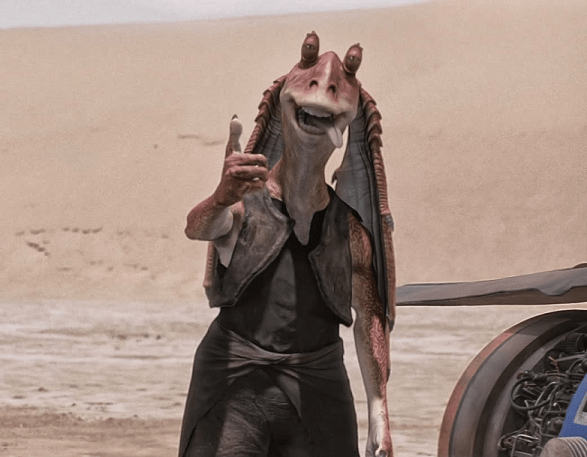
      jarjar

      Spread the word:

      • Click to email a link to a friend (Opens in new window) Email
      • Click to print (Opens in new window) Print
      • Click to share on X (Opens in new window) X
      • Click to share on Facebook (Opens in new window) Facebook
      • Click to share on LinkedIn (Opens in new window) LinkedIn
      • Click to share on Pocket (Opens in new window) Pocket
      • Click to share on Reddit (Opens in new window) Reddit
      • Click to share on Tumblr (Opens in new window) Tumblr
      • Click to share on Pinterest (Opens in new window) Pinterest
      Like Loading…
    • Vintage, Part Twenty-Five

      January 21st, 2016

      vintagetitle

      We might just get this monster finished after all.  Here is Part 25.

      Update:  Content removed.

      Spread the word:

      • Click to email a link to a friend (Opens in new window) Email
      • Click to print (Opens in new window) Print
      • Click to share on X (Opens in new window) X
      • Click to share on Facebook (Opens in new window) Facebook
      • Click to share on LinkedIn (Opens in new window) LinkedIn
      • Click to share on Pocket (Opens in new window) Pocket
      • Click to share on Reddit (Opens in new window) Reddit
      • Click to share on Tumblr (Opens in new window) Tumblr
      • Click to share on Pinterest (Opens in new window) Pinterest
      Like Loading…
    • Vintage, Part Twenty-Four

      January 15th, 2016

      vintagetitle

      So in what appears to be a recurring theme, this part got too long so I had to split it in two.  Herein the more digestible part twenty-four.

      Update:  Content removed.

      It’s not over yet!  Stay tuned for Part 25 coming next week!

      Spread the word:

      • Click to email a link to a friend (Opens in new window) Email
      • Click to print (Opens in new window) Print
      • Click to share on X (Opens in new window) X
      • Click to share on Facebook (Opens in new window) Facebook
      • Click to share on LinkedIn (Opens in new window) LinkedIn
      • Click to share on Pocket (Opens in new window) Pocket
      • Click to share on Reddit (Opens in new window) Reddit
      • Click to share on Tumblr (Opens in new window) Tumblr
      • Click to share on Pinterest (Opens in new window) Pinterest
      Like Loading…
    • That Voice

      January 14th, 2016

      rickman

      Not been a great week, folks.  I saw a tweet this morning that suggested we should call an early end to it and head over to the pub to drown our sorrows.  The news of actor Alan Rickman’s passing from cancer at the age of 69 has left me inclined to agree.  Between him and David Bowie earlier this week, we’re losing too many of our heroes.  People we were never going to meet and who never knew of our own existence but still occupy that special place in our hearts reserved for family.  Alan Rickman was a compelling actor for whom no one ever seemed to have a bad word, either in regard to his work or the man himself.  And yet it’s surprising to know that for someone who provided so many indelible, endlessly quotable screen moments, he was never nominated for an Academy Award, never broke out of the character actor mold for a really meaty lead part, never achieved the level of stardom someone of his talents really deserved – although by the reaction seen on social media this morning, it’s clear that he was considered something by millions that many more “famous” actors can only dream of being:  a treasure.

      I did not know the man, I have no personal anecdotes about chance encounters with him to share.  I have only what most people have:  his legacy.  Few on this side of the pond had heard of Alan Rickman when he signed on to star opposite Bruce Willis in 1988’s Die Hard.  In retrospect it seems hard to imagine how risky a gamble that movie was considered at the time:  an expensive action picture with an untested TV actor in the lead and an even lesser known British stage veteran as the villain.  Yet it’s almost a perfect piece of cinematic entertainment, and so much of its success hinges on the strength of the two men pitted against one another.  Rickman, with his singular, resonant, sepulchral tones coiling themselves lovingly around clever, sophisticated, literate dialogue with the slickness of an eel drenched in light sweet crude, crafted the perfect foil for the wisecracking, blue-collar Willis, and established a standard for memorable villains that led every single movie casting agent to burn through their Rolodex hunting for the next Shakespearean Brit they could pluck from obscurity to face off against the mumbling American action star du jour.  You could argue that without Alan Rickman in Die Hard, there would have been no Anthony Hopkins in The Silence of the Lambs, no Jeremy Irons in The Lion King, no Gary Oldman in… pretty much everything.  And there certainly would have been no Alan Rickman in Robin Hood: Prince of Thieves, emoting to the rafters about calling off Christmas and carving out innards with a spoon because “it’s dull, it’ll hurt more.”  Rickman became so identified as the prototypical villain that it’s interesting to note he never played another straight baddie after that.  (Your daily trivia:  the villain in Arnold Schwarzenegger’s fourth-wall busting Last Action Hero was written for Rickman, literally – the script features the movie’s young hero calling him by name – but after Rickman begged off, Charles Dance took the part and wore a T-shirt to the set reading “I’m cheaper than Alan Rickman!”)

      Wary, perhaps, of being relegated to what might have in fact been a profitable career of snarling and firing guns every few years, Rickman stepped back into smaller features, deploying his talents instead in period pieces and romantic films, and when it suited him, riffing on his own pop culture image.  He was brilliant in Galaxy Quest as a character inspired by Leonard Nimoy, a classically trained stage actor typecast as an alien in a cheesy sci-fi show and reduced to spouting his tired catchphrase at department store ribbon cuttings.  (His best moment in the movie:  challenging co-star Tim Allen to find the motivation of a marauding rock monster and accusing him of never being serious about “the craft.”)  And perhaps no one else could have so beautifully captured the hilarious over-the-top melancholy of Marvin the Paranoid Android in the underappreciated Hitchhiker’s Guide to the Galaxy either – one cannot help but smile when Marvin first descends from the ceiling warning everyone in Rickman’s voice that he’s feeling very depressed.  Our instinct to immediately love an Alan Rickman character worked against us in Love Actually when we couldn’t believe what a heartless prat he was being to his adoring wife Emma Thompson, but our faith that there was more to him than the obvious notes was rewarded when we saw at the end that he was clearly trying to atone for his terrible mistake for the sake of their family – just as we hoped we would under the same circumstances.

      And then, of course, there is the cherished Severus Snape in Harry Potter.  However well-intentioned or made, the movies simply can’t capture the intricate details and backstories provided in the books, and so we rely on the performances to fill in the blanks.  In the early films Snape always seems to be a character very much on the periphery, vacillating between heroics and villainy, and, atypically for Rickman, rather understated.  In a few of the early movies you almost forget Snape is there, so minimal are his contributions to the plot.  In the first film Rickman’s presence serves as an efficient red herring, so focused are you on the notion of this blatant bad guy that he distracts you completely from the true puppet master.  From then onward, he lurks about in the background, and yet, because it’s Alan Rickman, you know there will end up being a deeper story to this man than the one you’re seeing on the surface.  You can’t ignore what’s going on behind those dark eyes, and in that basso as it intones “Mis… tah Pottah.”  The stage is carefully set over the course of eight films for the revelation of Snape’s complicated yet ultimately noble soul, and one doubts whether or not an actor other than Alan Rickman could have pulled it off, with the patience and the skill to weave together a character one tiny, almost unnoticeable thread at a time.  Millions of children (and children at heart) will forevermore read those books and picture Rickman speaking the lines, a special kind of immortality after which many can long and few will ever achieve.

      Like David Bowie, it is strange to contemplate the notion that there will never be another Alan Rickman movie.  That no lucky screenwriter will ever again have the privilege of hearing that utterly unique voice giving life to their lines.  But he leaves behind a rich body of work of which he could be proud and of which many of his generation of actors and those after him will be envious.  Though he often played intense characters, he was not off-puttingly intense himself.  He did not mouth off to the press or pretend that his chosen calling was somehow divine.  He was never one to embrace the culture of celebrity or push himself into the tabloids with scandalous affairs or nasty comments about his peers.  He was a good man, who did good work, always brought his best game, and possessed that endearing, ever-so-British trait of being able to take the piss out of himself every once in a while (watch his final appearance on the Tonight Show as he and Jimmy Fallon inhale helium balloons.)  And millions of people loved him for it.  Little gold statuettes are no substitute for the echo of applause that lingers long after the final curtain has come down and the stage lights have gone out.

      Our ovation for Alan Rickman will go on for quite a while yet.

      Spread the word:

      • Click to email a link to a friend (Opens in new window) Email
      • Click to print (Opens in new window) Print
      • Click to share on X (Opens in new window) X
      • Click to share on Facebook (Opens in new window) Facebook
      • Click to share on LinkedIn (Opens in new window) LinkedIn
      • Click to share on Pocket (Opens in new window) Pocket
      • Click to share on Reddit (Opens in new window) Reddit
      • Click to share on Tumblr (Opens in new window) Tumblr
      • Click to share on Pinterest (Opens in new window) Pinterest
      Like Loading…
    • Ch-ch-ch-changes

      January 11th, 2016

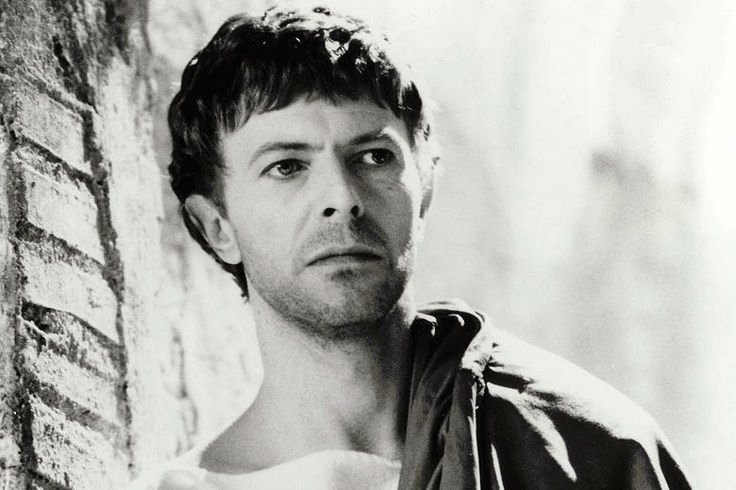
      bowie

      You think some people will be around forever.  Children of western civilization grow up with the perpetual presence of our idols in the background of our daily tribulations, and we come to rely on them as permanent fixtures.  Even if you weren’t the world’s biggest David Bowie fan (full disclosure:  I wasn’t) he was an undeniable pillar of the strange and constantly changing edifice we call popular culture, one that he carved himself to his own unique specifications – as though before him there had been a David Bowie-shaped hole that only he could fill.  There was a reassurance to be found in knowing that he was always there, continuing to make challenging music and appear in quirky movie roles and push the boundaries of expectations in art, and while maybe nine-tenths of those projects would pass by unnoticed, one standout here and there would pique your interest, and it would be a singular David Bowie creation.  It seems odd to think that Bowie’s life’s work is complete and there won’t be anything else from him.  (Listening to “Lazarus” from his final album Blackstar this morning is a bit of an eerie experience.)

      More musically literate scribes than myself will pen paeans to his aural masterworks.  I come not to reel off deep album cuts but to offer only feebly-worded praise to the same great Bowie tunes that everyone else likes:  “Space Oddity,” “Life on Mars,” “Fame,” “Under Pressure,” “Let’s Dance” to name a mere, mere few – not to mention that wonderful annual Christmas oddity of his duet with Bing Crosby on “Little Drummer Boy.”  But I always liked David Bowie best as an actor.  The profession suited him in a way it did few other musicians-turned-thespians, likely because his talent for reinventing himself was a perfect match to the art of screen performance.  He wasn’t the glamour boy ported in for a high-wattage cameo struggling to deliver his lines; in every role you could see the thoughts going on behind the mismatched eyes, the true character emerging from beneath the natural “Hey!  It’s David Bowie!” reaction the audience would be expected to have.  He elevated anything he was in simply by choosing to take on the part, on occasion braving the essaying of historical figures such as Andy Warhol (in Basquiat) and Nikola Tesla (The Prestige), turning them into memorable, magical fusions of his own persona.  He didn’t just show up and expect adulation – he acted.  He earned it.

      His appearance as Pontius Pilate in Scorsese’s The Last Temptation of Christ is my favorite Bowie role, brief as it is, and coming towards the latter half of what isn’t easy Saturday afternoon viewing.  Befitting a musician’s approach, Bowie’s Pilate is a melody of complex notes:  rational, reasonable, world-weary and oddly sympathetic, and one cannot watch the prototypical pop culture chameleon and author of “Changes” tell Willem Dafoe’s Jesus that “it doesn’t matter how much you want to change things; we don’t want them changed” without a wry grin.  I’m certain Bowie himself was fully aware of the many levels of irony at work in that scene.

      I don’t think I’m necessarily qualified to say anything more about him; I leave that to those who were more invested in his career, who knew all the Bowie trivia, who looked up to him as a role model, who scored their lives with his music and waited breathlessly on each new iteration of David Bowie.  It’s perhaps enough to leave on the note that Bowie’s passing is a reminder that life is truly a matter of turning and facing the strange, that evolution is the modus operandi of our tragic and beautiful limited existence.  That there will always be changes, and how we adapt ourselves to the inevitability of such changes is a measure of how well we live our life.  The man born David Robert Jones seems to have managed it exceptionally well, and one can speak best of a man by being able to say at the last that he left the world a little better than he found it.

      If he has to be gone now, then let us accept and embrace the change just as he would have.  To paraphrase David Bowie, we don’t know where we’re going from here.

      But we can promise it won’t be boring.

      Spread the word:

      • Click to email a link to a friend (Opens in new window) Email
      • Click to print (Opens in new window) Print
      • Click to share on X (Opens in new window) X
      • Click to share on Facebook (Opens in new window) Facebook
      • Click to share on LinkedIn (Opens in new window) LinkedIn
      • Click to share on Pocket (Opens in new window) Pocket
      • Click to share on Reddit (Opens in new window) Reddit
      • Click to share on Tumblr (Opens in new window) Tumblr
      • Click to share on Pinterest (Opens in new window) Pinterest
      Like Loading…
    ←Previous Page
    1 2 3 4 5 6 … 39
    Next Page→

    Blog at WordPress.com.

    Privacy & Cookies: This site uses cookies. By continuing to use this website, you agree to their use.
    To find out more, including how to control cookies, see here: Cookie Policy
     

    Loading Comments...
     

      • Subscribe Subscribed
        • Graham's Crackers
        • Join 6,280 other subscribers
        • Already have a WordPress.com account? Log in now.
        • Graham's Crackers
        • Subscribe Subscribed
        • Sign up
        • Log in
        • Report this content
        • View site in Reader
        • Manage subscriptions
        • Collapse this bar
      %d