The original blog of writer Graham Milne – content published from 2011-2017

Graham's Crackers

    • The future ain’t what it used to be

      February 10th, 2012

      It’s 2012 – wondering where the flying cars are?  The way some people drive, maybe it’s not a bad thing Ford hasn’t rolled them off the production line yet.  But as a fan of science fiction from a young age, a passionate supporter of space exploration from around the same time and a gazer at the stars from long before that, I kind of expected the future to be, well, a little more futuristic.  I’d hate to think that all those classic movies like 2001: A Space Odyssey lied to me, and yet, as 2001 came and went we weren’t boldly voyaging to Jupiter and beyond, we were mired in terrestrial disputes, our feet welded to the ground by political infighting, war, terrorism and relentless media-induced fear.  The words of Robert F. Kennedy come to mind:  “Some men look at things the way they are and say why; I dream of things that never were and say why not?”  Somewhere along the line we, collectively, stopped dreaming of things that never were and became coddled by advances in technology that heighten only the convenience of life, not its quality.  Probably the greatest step forward in the last ten years has been anything produced by Apple, and yet, really, a portable Justin Bieber catalogue isn’t exactly the sort of thing Jules Verne would have envisioned as a quantum leap.  We still get from place to place, basically, on 19th Century engines – they are faster and sleeker but the principle is the same one that propelled your great-grandfather’s old jalopy down Main Street when it was a dirt road with horse hitching posts along the sidewalks.  As Leo McGarry opined on The West Wing, “where’s my jetpack?”  Forget that – I want my damn Back to the Future Part II Mattel hoverboard.

      I laud the advances we’ve achieved in communication, this forum being one of them.  What concerns me is that we are moving towards a point in our existence where we may have very little of substance to communicate about.  Human beings are needy creatures – we are forever craving stimulation to make us productive.  From adversity comes advancement.  But what happens when life is so easy, so crammed with distraction, that challenge is all but forgotten?  Look at the difference in a little over half a century – after Pearl Harbor, Americans banded together to enlist, volunteer, ration, buy bonds, collect scrap metal, anything that could be done to assist in the war effort.  Contrast that to the post-9/11 era where the President told his people that the best thing they could do to help their country was to go shopping.  Rosie the Riveter?  Nope, Penny the Power Purchaser.  And why?  Because it’s easier.  It’s yet another distraction, an erosion of altruism for self-interest über alles.  Surrounded by distractions, we do not think.  We forget about the whole and focus on the pleasure of the one.  These mass-produced trinkets are fun, but they fill the one empty space that should be uniquely our own – our imagination.  They saturate it so completely that we don’t think we are lacking for anything anymore, and thus, we are no longer compelled to create.

      I am a victim of this myself.  When I was first living on my own, I had only an old computer with no Internet capability, let alone access.  I wrote constantly, generating screenplay after screenplay, thousands of pages of would-be novels.  Without distraction, I could focus on creation.  Then one day I decided to buy a Nintendo 64.  And who wanted to stare at a blank screen and flashing cursor anymore when there were so many goombas for Mario to jump on and so many princesses to save from castle dungeons?  My imagination took a huge hit and I don’t think it has ever completely recovered.  To this day I prefer surfing through a few favourite sites and catching up on the latest show business news over writing something of my own nine times out of ten.  I’ve been prolific here lately because I’m really forcing myself.  But it’s not easy.  The lethargic soul is a persistent enemy forever at the gates.  And he seems tragically immortal.

      Primitive computers with barely the memory of today’s pocket calculator helped land men on the moon and return them safely to Earth.  That was in 1969.  2001: A Space Odyssey came out a year earlier, and given the pace at which things were happening then, it seemed a reasonable prediction – barring the unforeseen bankruptcy of Pan Am – of what our lives could be like as the 21st Century dawned.  Instead, HAL 9000 is the iPhone 4S, and the moon seems further away than ever.  But goshdarnit all, I’ve got 100,000 songs in a little gizmo a third the size of my wallet.  Is this what RFK had in mind when he was dreaming of things that never were?  Is this what Stanley Kubrick expected?  Is this what Aristotle, Copernicus, Leonardo or Galileo would have wanted?  Full seasons of Fear Factor streaming to my HDTV on Netflix?  Snooki with a million Twitter followers?

      The capacity of what humanity can do with imagination and hard work is limitless.  But we have to force ourselves to look up from the screen and back at the stars again.  Because although they’ll be there forever, we won’t be, and I’d rather not see the ability to download Jackass 3-D at lightspeed as our civilization’s greatest lasting legacy.

      Spread the word:

      • Click to email a link to a friend (Opens in new window) Email
      • Click to print (Opens in new window) Print
      • Click to share on X (Opens in new window) X
      • Click to share on Facebook (Opens in new window) Facebook
      • Click to share on LinkedIn (Opens in new window) LinkedIn
      • Click to share on Pocket (Opens in new window) Pocket
      • Click to share on Reddit (Opens in new window) Reddit
      • Click to share on Tumblr (Opens in new window) Tumblr
      • Click to share on Pinterest (Opens in new window) Pinterest
      Like Loading…
    • Tears in rain

      February 9th, 2012

      Memory is a curious thing.  It is not the same trait as intellect; many of the world’s smartest people can’t remember where they left their car keys.  The most frustrating aspect of memory for those of us who don’t have the gift – apart from the headaches it causes those who live with us – is the failure of our brains to act like reliable nth-terabyte hard drives from which we can instantly access any desired thought as simply as double-clicking a mouse.  This can be particularly intimidating when attempting to participate in a conversation where your friends are sharing detailed recollections of events that happened twenty, thirty years ago, recounting every sound, every smell, every syllable of dialogue.  You feel lesser somehow.  Incomplete.  As we grow older, and friends and family fall away either through distance or the tragedy of passing, the reserves from which we can draw the history of our lives begin to dry up.  Without a reliable memory to keep the flame alight, it can lead you to feel like a part of you is missing – that like in Blade Runner, it has been “lost in time, like tears in rain.”  I’m envious of those who have had the foresight to keep diaries from a young age.  Like saving for retirement, there are innumerable advantages to starting sooner rather than later.  (If only there had been a version of WordPress for my old Commodore VIC-20.)

      It’s been said that an unexamined life is not worth living, and how else can we examine that life without our memories to draw upon?  At the same time, one is forced to ask whether the sum worth of a person’s existence is the breadth of the memory he carries, or the impact he has left on the outside world – in a sense, the memories others have of him.  We must each arrive at a point in our histories where we question whether we have done enough with the life we have been given, if we have experienced, tasted enough of the richness that is our universe.  What is it about our memories that makes us walk taller than the others who share the street with us?  Are memories truly the building blocks – the only building blocks – of the soul?  The end of Blade Runner is one of the most poetic expressions of this question.  Nearing the last minutes of his four-year lifespan, the replicant Roy Batty (Rutger Hauer) engages in a cat-and-mouse chase with Deckard (Harrison Ford), the man assigned to hunt him down and kill him.  As Deckard is about to fall to his death from the side of a building, Batty unexpectedly reaches out and saves his life.  Sitting quietly together with his adversary as his final seconds tick down, Batty recounts some of the wonders he has seen and mourns their passing.  Up to this point the entire film has posed the question of what it is to have a soul, whether or not it matters if the components of that soul are electronic or organic.  The replicants – the androids – show empathy for one another, feel fear, anger and sadness, while the humans are cold, relentless killers:  Deckard at one point shoots an unarmed female replicant in the back twice as she flees half-naked through the streets.  Batty’s final act of pure compassion toward the man who was sent to destroy him seems to suggest – notwithstanding his lament for his lost memories – that the soul is found in the actions, not the recollections.  Not what we bring to the game of life, but how we play it.  Perhaps that explains Batty’s wry smile as he whispers “Time to die” and his head sinks in the silence of the falling rain.

      Whether we remember them or not, our memories have played a part in shaping our evolution as people, directing our choices based on past experience, the recollection of what works and what doesn’t.  But they are not the definition of who we are.  We exist in four dimensions and our future actions are as important to the overall portrait of us as what we have done in every second of existence leading to this point.  The key difference is that the future is still under our control, the way our pasts and our memories never will be.  We can choose to remember things a certain way, but that does not change how they happened.  Each new moment brings with it limitless opportunity to forge a new and bolder path, to create a lasting legacy – a complete soul – whose every minute detail you won’t need to remember, because the evidence of it will be all around you wherever you go.  Never to be lost like tears in rain.

      Spread the word:

      • Click to email a link to a friend (Opens in new window) Email
      • Click to print (Opens in new window) Print
      • Click to share on X (Opens in new window) X
      • Click to share on Facebook (Opens in new window) Facebook
      • Click to share on LinkedIn (Opens in new window) LinkedIn
      • Click to share on Pocket (Opens in new window) Pocket
      • Click to share on Reddit (Opens in new window) Reddit
      • Click to share on Tumblr (Opens in new window) Tumblr
      • Click to share on Pinterest (Opens in new window) Pinterest
      Like Loading…
    • Laudantium Duo Cathedrales

      February 8th, 2012
      "Have I displeased you, you feckless thug?"

      A review I found of The Grey recently (not mine) pointed out that it’s not often we see poetry in the movies.  Nor are we likely to find it on television, particularly when there is after all so much donkey semen to be consumed, and so much ritual humiliation to be suffered, in pursuit of cash and prizes.  In a way though, it’s not really surprising.  The production of episodic television can best be likened to a meat grinder churning through product ever faster.  Compromises are the order of the day to meet the schedule; creativity takes a distant back seat to speed.  Poetry, by contrast, is meditative and contemplative – it takes time and care to compose, and even more time to read and reflect upon.  That is why the rare occasion one does come across televised poetry is such a gift.  James Lipton called The West Wing‘s “Two Cathedrals” the finest hour of television ever produced, and I’m inclined to agree.  Written by series creator Aaron Sorkin with his usual brilliance and flair, it is an allegorical story of Job, a story of a man, the President of the United States – ostensibly the most powerful man in the world – whose faith is tested to its limits.  A man who is forced to confront his innermost demons, who is pushed to the edge, to breaking, and finds solace and strength once more to stand against the coming storm.  A story of the true bravery of which human beings are uniquely capable.

      The setting:  The White House.  As re-election looms, President Josiah Bartlet (Martin Sheen) is about to reveal to the world that he has multiple sclerosis and did not disclose it during his first run for high office.  His beloved long-time secretary and confidante Mrs. Dolores Landingham has just been killed in a car crash.  Tragedies and misfortunes pile on and the President finds himself questioning what he sees as God’s plan, wondering if God is, in fact, merely a feckless thug.  In a series of flashbacks we see young Jed demeaned by an imposing, small-minded father who seems to resent his son’s very existence.  When the President curses God in Latin (“Cruciatus in crucem – eas in crucem”) and crushes out a cigarette on the floor of Washington’s National Cathedral, he is rebelling against God and his father as one.  He has sunk to his lowest and is resigned to defeat, advising his staff he does not intend to seek re-election.  An hour before a press conference at which he plans to announce the same to the world, Bartlet sits quietly in the Oval Office, preparing himself for the grand humiliation to come – when suddenly the door is blown open by the wind and his conscience reasserts itself.  In the form of a conversation with an imagined Mrs. Landingham, Jed reminds himself – through the voice of his departed mentor and friend – that the fight is worth the struggle, that he is in a unique position to help so many faceless people, and he cannot and will not be undone by the failings of the father.  He walks outside, and as the haunting guitar of Dire Straits’ “Brothers in Arms” starts up, Bartlet is baptized by the driving rain.  At the press conference, he throws away the script and invites the question of whether he intends to run again.  It’s established earlier on that when Jed has made up his mind, he smiles and puts his hands in his pockets.  Without speaking, he does so again, and his journey is complete.  He has descended to the depths, walked through the fire, and emerged whole and greater.

      One cannot watch the episode without feeling a similar lift, regardless of whether or not one is a person of faith – and that, to me, is one of the triumphs of “Two Cathedrals.”  The allegory of God/father vs. Jesus/son is plain, but it is handled so delicately that even though the underlying themes of the episode are highly religious, it does not come across as a sermon, but rather a paean to the faith a single human being can have in himself, and the ability to overcome any amount of doubt in order to do what is morally right.  There will likely be a time in every man’s life when he looks to the image of his own father and questions why he is here, or what purpose, if any, his suffering must serve, very much as Jesus on the cross cried toward heaven asking why his father had forsaken him.  It is the paradigm of the relationship between a father and a son.  The clarity and certainty Bartlet finds as he stands in the rain is to be admired, and in many ways, to be envied as well.  We should all be so lucky to understand ourselves and our place here on earth.  Where “Two Cathedrals” helps is in throwing down the challenge, forcing us to ask the question – one of the most terrifying any man can ask, because the answer can truly shape the rest of his life.  It can come to define the limits of who he is and everything he will ever be.  That is more than mere poetry – it is the essence of truth.

      Spread the word:

      • Click to email a link to a friend (Opens in new window) Email
      • Click to print (Opens in new window) Print
      • Click to share on X (Opens in new window) X
      • Click to share on Facebook (Opens in new window) Facebook
      • Click to share on LinkedIn (Opens in new window) LinkedIn
      • Click to share on Pocket (Opens in new window) Pocket
      • Click to share on Reddit (Opens in new window) Reddit
      • Click to share on Tumblr (Opens in new window) Tumblr
      • Click to share on Pinterest (Opens in new window) Pinterest
      Like Loading…
    • Of Dickens and dancing

      February 7th, 2012
      One is known for penetrating insight into the human condition, the other for a sublime figure and captivating dance moves. If you think you know which is which, you obviously never saw Dickens do a tango.

      February 7, 2012, is the 200th birthday of Charles Dickens.  The best of times, or the worst of times?  One wonders if Dickens, who died thirty years before the turn of the 20th Century, would be pleased to know that his stories and characters are remembered well into an era he could not have conceived, yet arguably might have found a home in.  You don’t have to have read his entire catalogue, or even a single volume of his works to know names like Oliver Twist, David Copperfield, Nicholas Nickleby, the Artful Dodger, Miss Havisham, Sydney Carton and Charles Darnay, and perhaps most notably, Jacob Marley, Tiny Tim and Ebenezer Scrooge.  As I’ve observed before, how we celebrate Christmas today is largely the result of how Dickens portrayed it.  Dickensian is a familiar adjective that conjures immediately an idealized image of the grand old city of London, his everlasting muse.  Stylistically, Dickens was a master of character, an expert wielder of the cliffhanger.  Socially, he was a champion of the poor, an advocate of justice and a relentless believer in the capability of good to triumph over evil.  Story was his sword, and with it he carved himself a legacy still seen in the most popular fiction of today – particularly that which celebrates the underdog and his fight against overwhelming odds.

      The romanticism of the Dickensian tale resonates to this day, I believe, because he recognized that we all crave that same heightened sense of adventure in our own lives.  Edyta Śliwińska of Dancing with the Stars fame, in discussing the various failed relationships that had sprung up between celebrities and partners during the course of the show, cannily observed their failure to know the difference between intense attraction and a lasting emotional connection – the mistaking, as it were, of movie love for real love.  Fictional romances, whether on the screen or in printed pages, are a powerful narcotic because of their savvy manipulation of the universality of emotions.  We want to be swept off our feet in slow motion to the swell of orchestral strings and walk into the sunset of the happily ever after.  It is not that our real lives are less interesting – far from it when closely examined – but we are drawn in by the heightened and artificial reality of the story.  The natural ebbs and flows of relationships are compressed into 90 minutes, the sweet moments escalated into diabetic fits of ecstasy.  In the story you don’t see the sitting up at three a.m. worrying while your partner squats noisily on the toilet, and any screaming matches usually only happen in the last third of the second act; once the screen goes to black and the credits roll, all is right in the world forever and evermore.  Real love is messy, and angry, and hurtful, even hateful at times.  But it is real, and unlike the movie, it is lasting.

      Why then, do we still want the storybook version?  It is perhaps a gut reaction to the madness of the world outside, an existential search for meaning in the face of suffering.  I choose to see it as a case for optimism about the nature of humanity.  Like all of nature’s creatures we are designed for survival at all costs, often by the cruellest methods available to us.  Yet paradoxically we are still drawn toward the positive, the sense of anticipation of the prosperous future.  We hunger for the reassurance of the triumph of good against evil no matter what the stakes, or the cost.  Charles Dickens knew it, and could translate that longing into characters and tales into which we could invest ourselves.  That, I think is the key to Dickens’ lasting appeal – the nurturing of that tiny flame which continues to burn in every human heart, no matter how downtrodden, how wracked with despair at seemingly unending misery.  The longing for the light.  The everlasting sense of hope.

      And I’m told he had great legs too.

      Spread the word:

      • Click to email a link to a friend (Opens in new window) Email
      • Click to print (Opens in new window) Print
      • Click to share on X (Opens in new window) X
      • Click to share on Facebook (Opens in new window) Facebook
      • Click to share on LinkedIn (Opens in new window) LinkedIn
      • Click to share on Pocket (Opens in new window) Pocket
      • Click to share on Reddit (Opens in new window) Reddit
      • Click to share on Tumblr (Opens in new window) Tumblr
      • Click to share on Pinterest (Opens in new window) Pinterest
      Like Loading…
    • And now for something completely different – space vampire zombies

      February 6th, 2012

      No one ever sets out to make a terrible movie.  Ed Wood at his creative peak (or nadir) thought he was doing good work.  It’s hard to believe with what gets released nowadays, films so mind-numbingly awful that you can feel parts of your brain oozing out your ear as vapid dialogue, inept performances and ludicrous stories flicker across the screen in front of you.  But even the worst of the worst feature hundreds of hard-working performers and technicians doing their damnedest to create something memorable, even if their efforts are undermined by bad decisions at the top, or doomed from the start by a flawed story that should have long ago been dissolved in the electronic ether of the Windows Recycle Bin.  Remember, if you hated the Twilight movies, it wasn’t because the key grip or best boy didn’t try hard enough.

      Still, there are those in the pantheon of cinema dreck that stand apart because the scale of their absurdity defies comprehension.  You can’t quite dismiss them out of hand.  It almost becomes a question of thinking, “surely they can’t out-weird this” when inevitably, that next moment raises the bar of the bizarre.  Lifeforce (1985), directed by Poltergeist’s Tobe Hooper, is one of those movies.  It is literally a smorgasbord, with not only the kitchen sink, but the refrigerator, the dishwasher and the Easy-Bake oven thrown together and mashed up in the garburator to concoct a diabolical stew that challenges the most experienced reviewers to describe it.  The plot in a bulging nutshell:  A space mission to Halley’s Comet brings back three aliens in suspended animation who wake up and begin sucking the life force out of every person they can find, transforming the population ofLondon into zombies.  The only survivor of the space mission teams up with a jaded SAS colonel to try to find and stop the alien leader, a beautiful woman who spends the majority of the movie wandering around nude.  One could stop there, but as infomercials like to say, “But wait!  There’s more!”

      With one major exception, the acting is actually not that bad.  The cast is mostly Brits, who play the material with their trademark understatement, lending the subject matter a smattering of respectability.  Peter Firth, best known for his role on the BBC series MI-5, or as the stuffed-shirt political officer Sean Connery kills in the first ten minutes of The Hunt for Red October, leads the heroes as SAS Colonel Caine, and his wisecracking unflappability even when confronted with soul-draining vampire extra-terrestrials gives the role an unexpected gravitas.  The same goes for Frank Finlay, who plays a scientist obsessed with the idea of life after death and who is saddled with most of the expository dialogue.  The same cannot be said, however, of American actor Steve Railsback as Colonel Tom Carlsen, the man who discovers the vampires in space and becomes obsessed with their shapely leader.  Railsback’s casting smacks of the “well, we can’t get our first twenty-seven choices, who else is left?” approach.  “Oh yeah, the guy who played Charles Manson – he just personifies the spirit of space explorers.”  Railsback chomps on the scenery from moment one, looking like he’s two seconds from snapping and trying to bring on Helter Skelter.  Although in fairness, Olivier in his prime probably couldn’t do much with lines like “I’m going to have to force her to tell me!  Despite appearances, this woman is a masochist!”  Patrick Stewart – yes, that Patrick Stewart – has his first-ever screen kiss with Railsback while his character is possessed by the space girl.  The space girl herself, the embodiment – literally – of evil in this movie, is played by French actress Mathilda May.  Her performance leaves nothing to the imagination.  It’s all there to experience in glistening glory as she wanders around in her birthday suit, silently consuming souls and blowing up buildings.  She is stunningly, seductively beautiful and yet otherworldly, making her a perfect alien and creating an indelible impression – one that may have assisted a lot of boys as they struggled with puberty, but didn’t necessarily assist her acting career.  John Larroquette of Night Court fame appears in the first minute, uncredited, as the narrator setting the stage for the lunacy.  And Mick Jagger’s brother Chris plays one of the space girl’s partners-in-life-sucking-crime, investing some unintentional double-entendre in the latter-day phrase “Moves like Jagger.”

      For 1985, the special effects are serviceable, if not Star Wars.  The makeup effects for the zombies are pretty cool, but Halley’s Comet looks like banana pudding smeared across the sky.  The musical score, on the other hand, is better than the movie deserves – somehow Henry Mancini, of Charade, The Pink Panther and Breakfast at Tiffany’s “Moon River” renown, was coerced into providing his services to this weirded-out apocalyptic extravaganza and creates a driving, memorable main theme.  I’d mention the screenwriters, but whoever typed the line “The web of destiny carries your blood and soul back to the genesis of my lifeform” probably prefers to remain anonymous.  There is, truly, a lot of real talent at work here, and they were obviously trying hard, but the resulting flame-out is utterly spectacular, like the grandest NASCAR crashes.  That’s the thing – perhaps after this preamble you’ll be tempted to check Lifeforce out.  Be warned – this review shouldn’t be taken as a recommendation, more like a war story from someone who survived it by the skin of his teeth.  Lifeforce, like its villains, tends to infect those who come into contact with it with a strange fascination that is neither love nor loathing, but rather a continuing obsession with trying to process what the hell it is we’ve seen – searching vainly for logic where none is to be found.  So my final word on Lifeforce is this – abandon all hope, ye who enter here.  You won’t be able to take your eyes off it, but that doesn’t mean you shouldn’t.

      Spread the word:

      • Click to email a link to a friend (Opens in new window) Email
      • Click to print (Opens in new window) Print
      • Click to share on X (Opens in new window) X
      • Click to share on Facebook (Opens in new window) Facebook
      • Click to share on LinkedIn (Opens in new window) LinkedIn
      • Click to share on Pocket (Opens in new window) Pocket
      • Click to share on Reddit (Opens in new window) Reddit
      • Click to share on Tumblr (Opens in new window) Tumblr
      • Click to share on Pinterest (Opens in new window) Pinterest
      Like Loading…
    • Fun with words: Fry’s Theorem

      February 4th, 2012

      As regular readers know, I love the peculiarities – the quirks, as it were, of the English language.  Because to me, English is a bottomless trove of enigmas, a linguistic vein to be mined in endless permutations.  Creatively, it remains an invaluable resource, for if you are ever short on inspiration, you need only dive into its well to uncover a fresh helping of treasure.  Do not fear that bane known as writer’s block.  English will always be there when you need her.  Finding the creative impetus again can begin with something as small as the shape of a single word.

      Glance if you will at the following sentence.  “Hold the newsreader’s nose squarely, waiter, or friendly milk will countermand my trousers.”  I borrowed it from a classic episode of A Bit of Fry & Laurie, a sketch involving Stephen and Hugh discussing the infinite capacity and flexibility of English.  Just ponder for a second the absurdity of that phrase and how it could only belong to the Queen’s grand old tongue.  Keeping in mind of course that other languages can be arranged in their own nonsensical combinations, Fry’s main argument – delivered in his unique style – is that because of the dexterity of English, one can speak such absurdities in the certainty that they have never been uttered before by anyone in the history of language itself.  Language is capable of so much more than we realize.  Much like the oft-repeated factoid that humans only use 10% of their brains, in our regular conversations we use only a fraction of language’s potential.  No wonder why dialogue with one another can often feel so stilted, so underwhelming.  Our reluctance to exploit the potential of language to its greatest extent is one of our many failings.  Perhaps it’s worth taking a step back and thinking about how we converse with each other, and whether we are truly saying all we can say.  Quite possibly, those word-a-day calendars are really on to something.

      Realistically, though, one has to wonder if we are an evolutionary downslope when it comes to how we speak to one another.  Slang is a far-too-easy layman’s recourse when our brain’s thesaurus fails to measure up.  Textspeak is another, and to a linguist like Stephen Fry must represent a true collapse of imagination, his well-documented love of technology to the contrary.  Ultimately the best approach on an individual basis is to set a good example, and hope that others may rise to the challenge.  Very likely some may dismiss this as elitism or worse, snobbery.  Whether or not they do is no reason why we shouldn’t still try to raise the game.  Xenophobia, or more precisely the fear of strangers’ reactions, certainly isn’t, in my mind, a compelling argument against it.

      You may have noticed, if you are reading astutely, a particular quirk with this post, and you’re invited to submit your best guess as to what it is in the comments.  Zillions of imaginary happy points to the winner!

      Spread the word:

      • Click to email a link to a friend (Opens in new window) Email
      • Click to print (Opens in new window) Print
      • Click to share on X (Opens in new window) X
      • Click to share on Facebook (Opens in new window) Facebook
      • Click to share on LinkedIn (Opens in new window) LinkedIn
      • Click to share on Pocket (Opens in new window) Pocket
      • Click to share on Reddit (Opens in new window) Reddit
      • Click to share on Tumblr (Opens in new window) Tumblr
      • Click to share on Pinterest (Opens in new window) Pinterest
      Like Loading…
    • Guest post: The Cat’s Meow

      February 3rd, 2012

      My better half is very critical of her writing skills.  I’m not entirely sure why.  She has a natural, friendly style that is earnest and highly readable, and she can get her message across without sounding as long-winded as another unmentioned member of her immediate family (blush).  I try to be as encouraging as I can, but my compliments don’t seem to be sticking.  So today I’m going behind her back a little bit and offering a sample of her prose for your enjoyment.  From the end of this paragraph, all remaining words in this post are hers.  Hope you like it – I know I do.

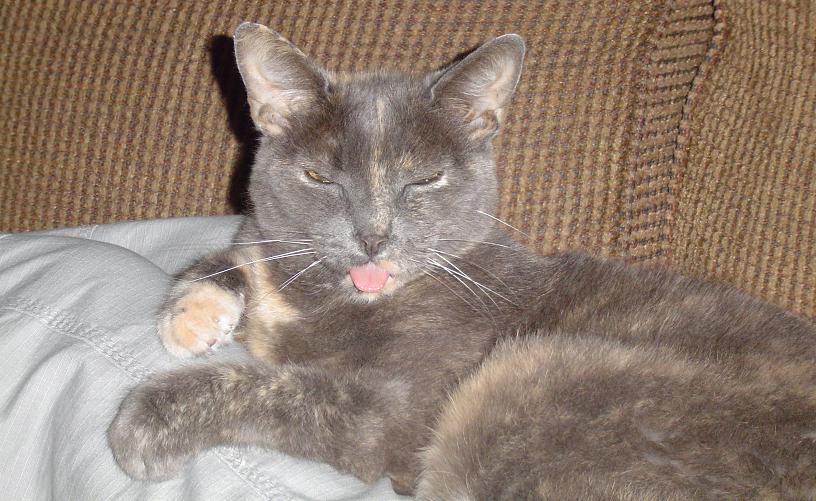
      When a person is speaking of something that they think is really great, they sometimes refer to it as “the cat’s meow.”  So I took it upon myself to do a bit of research to see if I could discover where exactly this phrase comes from.  Most sources seem to indicate that it originated in the 1920′s when flappers and other hipsters used “cat” to refer to ideas that were too cool for words.  In addition to “the cat’s meow” there was the “cool cat” or “hep cat” and “the cat’s pajamas” (although this one I will never understand since I have yet to see a cat lying around in a flannel nightie).  But I must say that lately, I do not consider my cat’s meow to be anything other than highly annoying.

      It was a little over 8 years ago, when I innocently went to the Humane Society one day with my sister so she could pick up an application to volunteer.  I had a few minutes to kill while waiting for her to collect the proper paperwork, so I ventured into the “Cat Room.”  The walls were lined with cages containing cats of many colours, shapes and sizes.  Some of them paced back and forth as I walked by meowing loudly, saying, “Look at me, I am stunning.  You will not find a more beautiful cat than me”  Others slept in curled up balls and simply opened one eye as they heard me pass, deciding I was not worth waking up for.  And then, as I shuffled past one cage in the middle of the room, this pretty little gray creature slowly walked up to the front of the cage and tilted her head, looking at me as if she thought she knew me from somewhere.  She moved a little closer and stretched up on her hind legs, inviting me to bring my face a little closer to hers.  As I did so, she reached her two front paws out through the bars of the cage and gently touched my cheeks.  That was it, I was a goner.  I immediately surrendered to Muffins, a dilute tortoiseshell of about 11 years old at the time, and we headed off to start our new life together.

      Now, by all accounts, Muffins is a great cat.  She’s clean, well-behaved and she loves to make new friends, as long as they are of the two-legged kind (other cats and dogs just will not do).  And she is affectionate – well, that is to say she loves attention.  In fact, she demands it on a regular basis.  And it used to be that she would simply rub up against us or park herself on my lap whenever I sat down, expecting some petting or face and ear scratching or even a brushing.  But lately, she has taken to meowing whenever she wants attention.  And I’m not talking about a cute little meow that says “Yoohoo, do you see me?  I’d like a bit of  love if you can spare a couple of minutes.”  No.  I’m talking about a loud, annoying meow that goes on incessantly and says “Hey you, yeah you, it’s been at least 5 minutes since you paid attention to me.  How many times do I have to remind you that your job is to give me all the love and affection I desire, no matter what you may be doing.”  And did I mention that Muffins is an early riser?  Her usual wake up call is around 5:15 am but sometimes she’s had enough beauty rest by 3:00 am and it doesn’t matter to her one bit that my husband and I are trying to sleep.  Oh yes, and she doesn’t believe in weekends!

      Perhaps, like humans as we enter our senior years, she is having trouble sleeping through the night.  We’ve tried being understanding and waking up briefly to appease her with a few quick pets. But that was not enough for her.  Then we tried ignoring her which only led to her amping up her performance by taking it from just pacing the floor of our bedroom, to jumping up on the bed and pacing across our bodies. So it was time for tough love.  When the meowing started, out of the bedroom she went and the door was closed behind her.  End of discussion.

      But neither one of us wanted to be the bad guy.  After all, she’s part of the family.  How can we banish her from the room when she loves us so much and just wants to be close to us?  What if she’s lonely when she’s put out in the hall?  She is getting older, so who knows how much time we have left with her.

      So, what next?  Well, after a great deal of thought, I realize that the answer is simple.  I mean, who are we kidding?  Do we really think we can put our foot down now after years of giving in to her every whim.  It is us, after all, that created this mess.  We’ve taught her that all she has to do is turn on the cute a little bit and she can have whatever she wants.  We have no one to blame but ourselves.  This will all be resolved if we just accept who is really in charge in our house.

      Meow.

      Spread the word:

      • Click to email a link to a friend (Opens in new window) Email
      • Click to print (Opens in new window) Print
      • Click to share on X (Opens in new window) X
      • Click to share on Facebook (Opens in new window) Facebook
      • Click to share on LinkedIn (Opens in new window) LinkedIn
      • Click to share on Pocket (Opens in new window) Pocket
      • Click to share on Reddit (Opens in new window) Reddit
      • Click to share on Tumblr (Opens in new window) Tumblr
      • Click to share on Pinterest (Opens in new window) Pinterest
      Like Loading…
    • An aggravating post

      February 2nd, 2012

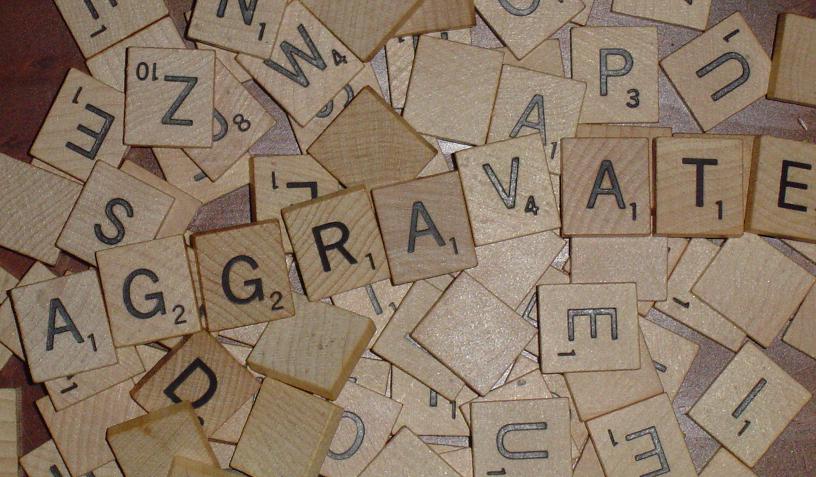
      As I’ve discussed before, language, and particularly the English language, is in continuous motion.  While I’m all in favour of conjuring new words and phrases as our little rock spins silently around its mother sun, I’m not so keen on the ongoing mangling of the lexicon we already have.  What is most frustrating is how much of this misuse becomes societally acceptable and adopted into common parlance.  One grating example, timely with the summer Olympics unfolding in London later this year, is the transformation of the word “medal” into a verb.  As in, “the Canadian team is poised to medal in the fifth race,” when the proper phrasing would be “the Canadian team is poised to win a medal in the fifth race.”  I first encountered this malapropism during the broadcast of the 1996 Olympics in Atlanta, and, though it was pointed out at the time as incorrect, to my chagrin “medal-as-a-verb” managed to infect all subsequent television coverage of Olympic events.  I can’t quite figure out why this usage arose – were the colour commentators simply too lazy to say two syllables, “win a,” or was it a conscious decision to remove the element of competition from this, you know, athletic competition?  Like how they now always say “And the Oscar goes to,” instead of “And the winner is,” because being nominated alone is supposedly enough of a win.  (Tell that to the runner-up in every election in history.)  The endgame of this will be, of course, the use of the individual medal colours as verbs.  “Schmidt silvered in the downhill yesterday, this is a disappointment from when he golded four years ago.”  So the bronzer I buy at the drugstore will, apparently, now help me win Olympic third-place medals.  Perhaps – if I’m competing on Jersey Shore.

      I’m really not that much of a grammatical Puritan.  In fact if you go back and read through these 55 posts so far you’re likely to find plenty of split infinitives, dangling modifiers, lapses of British versus American English and even the occasional occurrence of E. Henry Thripshaw’s disease (Google it).  But if there’s a common thread running through everything I write, it is my desire for us to do better as a species – to always aim for the greatest heights.  If we fall short, it shouldn’t be because we didn’t try hard enough.  Which is why the lazy use of language infuriates me – it’s the sign of an unengaged intellect.  I’m not talking about slang, that’s a different category altogether.  I’m more concerned with writing and dramatic presentations that are full of amateur mistakes, from people who should know better.  Few cinematic experiences are as disappointing as watching accomplished Shakespearean performers reciting dialogue that is just plain wrong.  The 90’s Star Trek shows were horrific offenders in this regard.  One episode of The Next Generation had a scene where Captain Picard was talking about the Borg and he said something along the lines of “their entire existence was centered around acquiring cultures and technology.”  Centered around.  So many shows make this mistake.  You can’t center around something.  You can center on it, but not around it.  But even that doesn’t compare to the most egregiously misused word, one that causes my blood pressure to rise several points every time it emerges, like sandpaper against skin, from an actor’s mouth:  Aggravating.

      You might be thinking, “What’s wrong with that?  That guy who cut me off on the highway this morning was really aggravating.  My co-worker forgetting to refill the photocopier really aggravates me.”  For the love of Oscar Wilde, no!  What you mean to say is irritating.  Aggravating means to exacerbate, to make something worse, like, “Eating hot peppers aggravates my heartburn.”  If bad drivers or your co-worker’s laziness are getting up your back, it’s irritating you.  I suspect what has happened is that people have latched onto the “gra..ting” part of aggravating and confused it with grating, resulting in this strange substitution of one word for the other.  And, like “medal-as-a-verb,” “aggravating-as-irritating” seems to be finding more and more societal acceptance.  I hear it from the mouths of colleagues, superiors, friends, and in almost all of my favourite TV programs.  I daresay it’s almost a lost cause at this point – but I’m doing my part to try and reclaim its proper meaning, without being that guy who’s smugly correcting everyone else’s grammar.  Otherwise, all the irritation I feel at the misuse of aggravation and its variations will be fruitless stress, and there are much bigger things to worry about.

      Like the many other mysteries of English, including why incense can be thought of as calming, while to be incensed is to be utterly outraged.  Then again, that’s what the ad wizards live for.  “Feeling incensed?  Try incense!”

      May your day be free of irritation and “aggravation.”

      Spread the word:

      • Click to email a link to a friend (Opens in new window) Email
      • Click to print (Opens in new window) Print
      • Click to share on X (Opens in new window) X
      • Click to share on Facebook (Opens in new window) Facebook
      • Click to share on LinkedIn (Opens in new window) LinkedIn
      • Click to share on Pocket (Opens in new window) Pocket
      • Click to share on Reddit (Opens in new window) Reddit
      • Click to share on Tumblr (Opens in new window) Tumblr
      • Click to share on Pinterest (Opens in new window) Pinterest
      Like Loading…
    • Live and die on this day

      January 30th, 2012

      “Once more into the fray, into the last good fight I’ll ever know.  Live and die on this day.  Live and die on this day.”

      One of the many drawbacks of our culture of 24-hour celebrity news is that it often becomes difficult to separate our perceptions of actors as people from the roles that they play.  Whether deliberately or not, our ambient awareness of their personal lives always affects our appreciation of their performances.  Brad Pitt’s passion for Cate Blanchett in The Curious Case of Benjamin Button is undermined by our knowing that off-screen he’s shtupping Angelina Jolie.  Mel Gibson remains a talented actor, director and storyteller, and yet, rightly or wrongly, his career has been tainted by the public face of his personal demons.  So too does the tragic real-life death of Liam Neeson’s wife Natasha Richardson following a skiing accident in Quebec a few years ago play subconsciously in our minds as we watch him as a broken, despondent and suicidal man in The Grey.  But on this rare occasion, the tragedy of the real man only deepens the emotional impact of the story.

      Liam Neeson’s career has seen him play a string of men of uncompromising integrity on both sides of the great moral divide.  He has a fatherly screen presence that has led to his frequent casting as a mentor to the movie’s true hero – as Qui-Gon Jinn in The Phantom Menace, Godfrey of Ibelin in Kingdom of Heaven, Henri Ducard in Batman Begins, Priest Vallon in Gangs of New York, Zeus in the remake of Clash of the Titans.  Having once turned down the role of James Bond, the actor who embodied Oskar Schindler has in recent years begun to reinvent himself as a big-screen badass in the mode of early Clint Eastwood, in movies like The A-Team, Taken and Unknown.  The trailers for The Grey lead you to believe that it leans more toward the latter, that the big Irishman will be doing bare-knuckle battle this time not with white slavers or international assassins, but with those most vicious of Nature’s killers, wolves.  Not so.  There are wolf fights in the movie, but they are not its raison d’etre.  Rather the story is more of a solemn meditation on the inevitability of death and our free will in deciding how we will meet it – as exemplified by the poem above.

      In a rare, precious world teeming with life, humanity has, ironically, spent a great deal of its existence in an obsession with life’s end, questioning what comes beyond, and sadly, crafting inventive ways to hasten its arrival.  There will be a moment in everyone’s time when he will speculate about his death, what form it will take, and whether he will go out in the archetypal blaze of glory or in quiet, frightened solitude – as though the meaning of the entirety of one’s life can be encapsulated in and defined by its final moment.  Liam Neeson the man may have pondered this question before, but certainly has had greater cause to dwell upon it since the loss of his wife – much as for me, death was only the thing that happened to the bad guys in the movie, until my father passed away.  I’m reminded of the scene at the end of Saving Private Ryan when the elder Ryan turns to his wife and pleads with her to assure him that he has lived a good life, that he has been worthy of the sacrifices made by others so he could go on.  It’s important that we ask ourselves that question not as the end nears, but every day, even in the moments when death is the furthest from our thoughts.  Are we the most of what we can be?  And when the end does come, will the course of our individual history enable us to stand proudly against it, or will we let silence slip over us without resistance, in quiet shame and lingering regret?

      The final line from the poem in The Grey is the most telling and the most interesting since it is misquoted on the movie’s poster.  Where the poster asks “live or die on this day,” the true line is “live and die on this day,” suggesting that the moment we face our death is the moment, and the singular chance, to appreciate life in all its magnificence.  Liam Neeson plays a man who is willing to let death take him as the movie begins, and by the end, is alone, forsaken by man and God, but, having come face to face with the depths of his soul, is now raging against the dying of the light.  It is a cathartic journey to be admired, as we watch a man strip away the layers of doubt to discover the purest truth of who he really is, crystallizing at the moment the screen cuts to black – a perfect, if controversial ending to this tale – for we, the audience, cannot know another man in the way he knows himself.  That question is up to each of us as individuals.  That’s our choice, our challenge.  To live and die on this day.

      Spread the word:

      • Click to email a link to a friend (Opens in new window) Email
      • Click to print (Opens in new window) Print
      • Click to share on X (Opens in new window) X
      • Click to share on Facebook (Opens in new window) Facebook
      • Click to share on LinkedIn (Opens in new window) LinkedIn
      • Click to share on Pocket (Opens in new window) Pocket
      • Click to share on Reddit (Opens in new window) Reddit
      • Click to share on Tumblr (Opens in new window) Tumblr
      • Click to share on Pinterest (Opens in new window) Pinterest
      Like Loading…
    • Fathers, sons and the great game

      January 27th, 2012

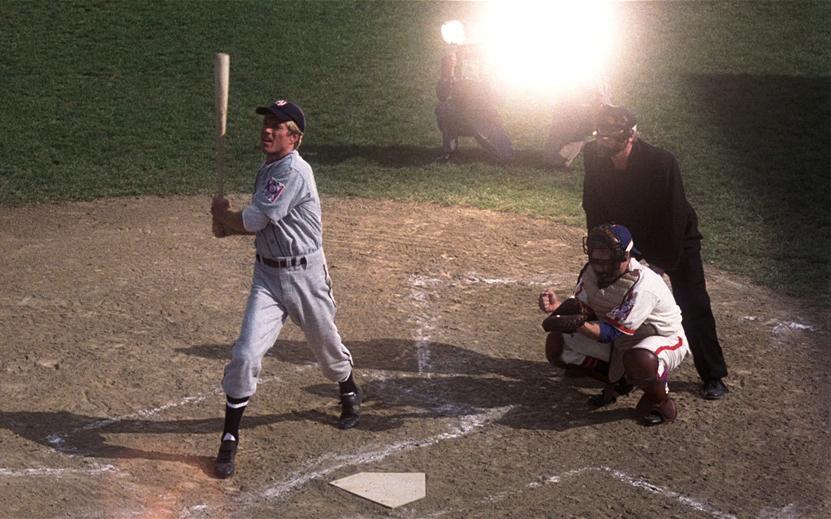
      The Natural was on last night.  Like The King’s Speech in my previous post, it’s a movie that if stumbled upon compels me to watch it in its entirety – no matter how chopped up for commercials the version being aired might be.  Every few years I revise my Top Ten Movies of All Time list – some drop off, some new entries sneak their way inside, but The Natural’s berth is secure.  Online, you can find plenty of great reviews both amateur and professional of this classic Robert Redford movie about the mythic power of baseball; one that I read nailed it when it said that the movie feels like it was made decades before it actually was.  (It was released in 1984.)  The Natural depicts an idyllic 1939, untouched by depression or the fog of looming war, when the only thing that mattered was the game, and the larger-than-life heroes who played it.  Men who were couch potatoes by today’s standards of athletics but still managed to inspire enduring legends.  Babe Ruth.  Ted Williams.  Lou Gehrig.  Jackie Robinson.  Mickey Mantle.  And The Natural’s Roy Hobbs.  “The best there ever was in this game.”

      My father and I bonded over baseball.  He shared seasons’ tickets with a friend, and because he knew more about baseball than said friend, managed to score all the best games.  In the summer you would find us on the cold metal seats of Exhibition Stadium, nine rows up from first base, a couple of times a week, bonding with our fellow fans as we cheered for Dave Stieb, George Bell, Damaso Garcia, Willie Upshaw and Jesse Barfield; as we screamed at umpires for bad calls, kept the score meticulously in the glossy $5 program, sang along to “OK Blue Jays” and did the ritual passing of the hot dogs and beer down the row to the guy ten seats in.  My father was part of an amateur slow-pitch team, the Honda Hawks, and I was with him for every game, keeping score, managing the equipment and making sure the beers were cold.  Discussion of statistics, standings, games back, trades, runs batted in and earned run averages was impenetrable to the other half of our family.  Baseball was our thing, mine and his.  I can recall how frustrated he was the night the two of us went out to see The Natural, and couldn’t find a theatre that carried it – we had to settle for Phar Lap.  The Natural had to wait until its home video release a year later (back in the bad old days when it really was a year between theatre and tape).  And it seems the perfect movie for a father and son to watch together, as we did, on our uppity Betamax VCR that spat the tape out seven times before giving in and playing it.

      For all its reference to classical myth, at its heart The Natural is truly about fathers and sons, and the relationship that they forge with each other through the game of baseball.  Roy Hobbs makes his famous bat Wonderboy from a tree on his farm that is split open by lightning the night his father dies.  Throughout his life we see him in search of father figures – the scout who pits him against The Whammer, coach Red Blow, New York Knights manager Pop Fisher, even, in a dark and twisted way, the sinister figures of gambler Gus Sands and corrupt Knights owner The Judge.  It is only at the end when Roy reconnects with childhood love Iris Gaines and discovers that her son is also his, that he finds the elusive father he has been searching for – in himself, leading to the triumphant, explosive home run at the finale that showers Knights Field with rain of pure light, accompanied by the famous Randy Newman fanfare that cannot fail to bring a tear to the eye of every grown man who ever played catch with his dad.  As Roy rounds the bases after that final blast, I can sense my father’s proud arm around my shoulders, and the warmth of the smile coming from his face.  He’s been gone over twenty years, but I can still feel a little part of his soul whenever I watch The Natural – perhaps even more than I do looking at his photograph.  He loved baseball, he loved the movie, and his sharing it with me was a gift that I continue to treasure – and can live again whenever I happen across the incredible tale of Roy Hobbs.  And like Roy, as I get older, I hope to come closer to finding, within myself, the part of my father that I miss the most.

      Spread the word:

      • Click to email a link to a friend (Opens in new window) Email
      • Click to print (Opens in new window) Print
      • Click to share on X (Opens in new window) X
      • Click to share on Facebook (Opens in new window) Facebook
      • Click to share on LinkedIn (Opens in new window) LinkedIn
      • Click to share on Pocket (Opens in new window) Pocket
      • Click to share on Reddit (Opens in new window) Reddit
      • Click to share on Tumblr (Opens in new window) Tumblr
      • Click to share on Pinterest (Opens in new window) Pinterest
      Like Loading…
    ←Previous Page
    1 … 31 32 33 34 35 … 39
    Next Page→

    Blog at WordPress.com.

    Privacy & Cookies: This site uses cookies. By continuing to use this website, you agree to their use.
    To find out more, including how to control cookies, see here: Cookie Policy
     

    Loading Comments...
     

      • Subscribe Subscribed
        • Graham's Crackers
        • Join 6,281 other subscribers
        • Already have a WordPress.com account? Log in now.
        • Graham's Crackers
        • Subscribe Subscribed
        • Sign up
        • Log in
        • Report this content
        • View site in Reader
        • Manage subscriptions
        • Collapse this bar
      %d