The original blog of writer Graham Milne – content published from 2011-2017

Graham's Crackers

    • Finding the why

      February 27th, 2012

      “The key to a great story is not who, or what, or when, but why.” – Elliot Carver (Jonathan Pryce), Tomorrow Never Dies

      Our stories are an attempt to make sense of the human experience, to assign order and meaning to what can otherwise seem to be a random sequence of events.  The best writers, and indeed the best minds, are those driven by an insatiable curiosity about the great mystery, wanting to figure out the reasons for things being the way they are.  There is a story for every human being who has treaded the earth, and the stories that endure are the ones that touch the common humanity at the centre of each soul.  They recognize our uniquely human longing and they try to captivate us by inviting us along on their journey to sate it.  Indeed, what applies to the story applies as equally to its creator – the writer behind the words.

      I spent this past weekend in a course taught by British writer-director Alan Denman called “Unleash the Screenwriter Within.”  Denman’s approach to the craft is novel and surprising in that he spends very little, if any time on the mechanics of how to format a screenplay – something that bothered a few of the over 160 attendees who seemed to want to learn page length, font size and quick tickets to massive success.  Denman recognizes that the siren call of fame and money has resulted in far too many films with nothing to say, their scripts cobbled by committee using overly familiar, focus group-tested tropes.  He understands, and attempts to impart, that while passion without talent can lead to mediocrity (see:  the collected works of Ed Wood), all the talent in the world will still result in failure if there is no passion driving it.  The author and motivational speaker Simon Sinek, in his studies on how leaders spark inspiration, notes that those who are the most successful are the ones who focus on the why of the question.  Why do we write?  Is it because, like a Warner Brothers cartoon character, our eyes turn to dollar signs at the successes of J.K. Rowling and Stephenie Meyer?  Sinek shares the tale of Samuel Pierpont Langley, the American aviation engineer you’ve never heard of, because his motivation for achieving man-powered flight was based largely on acquiring wealth and fame – the what.  Working with the best minds and the best budgets, covered daily by the major American press, Langley was still eclipsed by the underfunded, unknown Wright brothers, whose unbridled enthusiasm gave both metaphorical and literal wings to their pursuit of taking to the skies.  Their why was an expression of the universal longing, the most human of dreams.

      Denman’s course is a series of exercises whereby he challenges students to get out of the linear restrictions of the left brain and into the flights of fancy of the right.  He advises you to throw away the script (sorry) and work on fleshing out character and theme – who is your protagonist, who is your antagonist, and what are you trying to say – before even thinking about typing your first FADE IN.  Those who felt disappointment after what for me was an exhilarating two days likely did not pay attention to the title of the course.  It wasn’t “How to Write a Screenplay,” after all.  It was instead a challenge to reach down deep and locate that why.  Denman doesn’t simply want to give his students the tools to write a screenplay – ten dollars at your local bookstore gives you any number of options for paint-by-numbers manuals.  He wants them to write great screenplays; works that will challenge, entertain, endure – and give rise to the next why, igniting a chain of inspiration to light the world.  Most of the people sitting in that room won’t ever achieve that; they’ll lose their way in crises of structure, confidence and patience and join the ranks of the Samuel Pierpont Langleys of the world, the never-weres.  But a few may, someday, find their own why, and translate that passion into something brilliant.  The potential lies within all of us – we just need to ask why.

      Spread the word:

      • Click to email a link to a friend (Opens in new window) Email
      • Click to print (Opens in new window) Print
      • Click to share on X (Opens in new window) X
      • Click to share on Facebook (Opens in new window) Facebook
      • Click to share on LinkedIn (Opens in new window) LinkedIn
      • Click to share on Pocket (Opens in new window) Pocket
      • Click to share on Reddit (Opens in new window) Reddit
      • Click to share on Tumblr (Opens in new window) Tumblr
      • Click to share on Pinterest (Opens in new window) Pinterest
      Like Loading…
    • Fun with words: Update your dictionary

      February 25th, 2012
      Photograph by Henry Lim.

      There are too many fascinating words in English that don’t get used very often.  Our vocabulary tends to be limited to the scope of our daily lives, and the mundane exchanges of forgettable pleasantry that pass for typical conversation.  If the Inuit have a hundred different words for snow, English has a billion permutations of how to talk about snow in a workplace elevator.  Still, our language is full of tricks and tropes that allow us to use these same old words in exciting new ways.  You’ve probably used many of these without realizing what you were doing (or writing) at the time.  But much as a famous technology company would assure you that “there’s an app for that,” in English, there’s a word for that as well.  These are some of my favourites, and I hope they shall find greater use in the future:

      • Portmanteau – From French for “carry your coat,” this is a word that originates as the combination of two separate words in order to describe something new, like how combining smoke and fog gives you smog.  Some popular examples include breathalyzer, jazzercise, soundscape, televangelist, bromance, and, regrettably, bootylicious.
      • Mondegreen – Refer to my previous post on misheard lyrics – this is the term for those.  It was coined by writer Sylvia Wright in an essay in Harper’s Magazine in 1954, referring to a 17th Century poem called “The Bonny Earl O’Moray,” in which a stanza reads:  “They hae slain the Earl O’Moray, and laid him on the green.”  Wright heard the latter phrase as “And Lady Mondegreen.”  The key to a true mondegreen, according to Wright, is that the misinterpretation must improve upon the original; hence, my father’s (in)famous misreading of Hall & Oates’ “The woman is wild, ooh” as “Poobulasquaooh” probably doesn’t count.  (See also:  “‘Scuse me while I kiss this guy” from Jimi Hendrix’s “Purple Haze.”)
      • Anacoluthon – Familiar, if not immediately, to any man in trouble with his wife, this is the term for a phrase where the grammar is broken.  “It was just a – I didn’t mean to – I’m so sorry.”
      • Apophasia – Politicians love this one, for it lets them slag their opponents without seeming like they’re doing so on purpose.  This is when you say you’re not going to mention something but end up insinuating it anyway.  Ronald Reagan used it to great effect in his 1984 debate with Walter Mondale when he said after being challenged that he was too old to be President, “I am not going to make age an issue of this campaign.  I am not going to exploit, for political purposes, my opponent’s youth and inexperience.”  Or “You know, it’s not true, all that stuff they say about Phil being a lying, sleazy, unprincipled, back-stabbing, philanderous, greedy old opportunistic horse thief.”
      • Mumpsimus – Anyone who insists on saying “nucular” is guilty of this grammatical offense – the term for a habit adhered to obstinately, no matter how many times evidence shows it to be in error.  It comes from a story about a monk who mispronounced part of the Latin Eucharist and refused to change it to the correct version because he’d been doing it his own way for forty years.
      • Paraprosdokian – I just learned this one yesterday and I’ve saved the best for last.  This is where the second part of a sentence unexpectedly causes you to reinterpret the first part.  You could almost call it the Groucho Marx, as he was a master of it:  “I’ve had a perfectly lovely evening – unfortunately, this wasn’t it.”  Or the other famous quote, usually interpreted to be said by or about Winston Churchill depending on where you read it:  “There, but for the grace of God, goes God.”

      There you have it – six fun terms to expand your vocabulary – not that they’re likely to help when you’re stuck in that elevator on a snowy day.  Perhaps “anacoluthon” might spring to mind the next time you find yourself struggling for words in a difficult situation.  You could even try to relax the tension of the moment by pointing it out to your sparring partner.  I disavow myself of all legal responsibility therefor should you then get summarily punched in the face.

      P.S. Thanks to the Great Encyclopedia of Earthly Knowledge for its customary assistance.

      Spread the word:

      • Click to email a link to a friend (Opens in new window) Email
      • Click to print (Opens in new window) Print
      • Click to share on X (Opens in new window) X
      • Click to share on Facebook (Opens in new window) Facebook
      • Click to share on LinkedIn (Opens in new window) LinkedIn
      • Click to share on Pocket (Opens in new window) Pocket
      • Click to share on Reddit (Opens in new window) Reddit
      • Click to share on Tumblr (Opens in new window) Tumblr
      • Click to share on Pinterest (Opens in new window) Pinterest
      Like Loading…
    • Don’t worry Coldplay, I still love you

      February 24th, 2012
      Fun-loving guys, not that you’d know it from the humorless Anton Corbijn photograph.

      What’s with the Coldplay hate?  Google “Coldplay criticism” and you’ll find oodles of articles and blog posts slagging the successful English pop quartet for any number of ills including but not limited to vapid lyrics, uninspired melodies, unabashed sentimentality, and that most lethal of sins in the music world, being popular.  I suppose the pile-on of sour grapes might be understandable if Coldplay were a bunch of pretentious, unapologetic douches (a la Chris Brown), but that certainly isn’t the sense you get from them in interviews, or more importantly, in performance – no walking off the stage in a huff of profanity mid-set because there were brown M&M’s in the candy bowl.  No one, even their most ardent supporters, will claim that Coldplay are edgy, envelope-pushing avant-garders, but I’m not convinced that’s what they’ve ever wanted to be.  They are not tortured Van Goghs forcing music out through their pores in relentless emo wrist-cutting agony.  Throughout their career, they have never failed to lose sight of the goal that most musicians, ostensibly, set out to achieve – to entertain.  Last summer I wrote about seeing Hugh Jackman’s show and how his sheer love of his job elevates the act of performance into an unforgettable experience; Paul McCartney at 70 is the same, and so are Coldplay.  After every few songs, frontman Chris Martin will pause to ask the crowd, and not insincerely, “Everybody okay?”  You get the sense that if but one person were to answer in the negative, Coldplay would take it personally.  He and the band recognize, unlike many embittered bands that have gone before, that they are there because of the people smiling back at them, and they owe it to every ticket buyer to give it their all.

      Martin himself is an unlikely rock star – a thin, thoughtful, fairly good-looking English kid with a decent but not exceptional voice vaulted almost against his will into the stratospheric realm occupied by the likes of Bono.  Like U2’s leader, he struggles to reconcile his absurd success and wealth with the plight of the less fortunate through activism, stumbling to follow in the footsteps of the one who forged the path and continues to cast an ever-imposing shadow over both men:  John Lennon.  Lennon went through his period of evolution too, once he got the silly love songs out of his system and turned his focus first inward, then outward at the craziness of a war-obsessed world, finding a way to unite both that remains unmatched.  As a songwriter, Martin’s focus has always been on his feelings, and his lyrics have struggled to articulate the complexity of relationships, sometimes, as even he will admit, with rhymes that don’t quite gel.  Any good storyteller knows the key to creating resonance is to focus on the emotions that we all share, and Coldplay would not connect with so many fans were Martin not on to something with the words he sings.  But even Dylan wouldn’t have gone anywhere had he not been able to put the words to memorable tunes, and this is where Coldplay truly shines.  Taking a cue, perhaps, from Phil Spector and the kitchen sink approach of the Wall of Sound, Coldplay have, in their best songs, crafted melodies that are symphonic in their scope, using piano and string craftily without overdoing it, without tipping into syrup.  They think and act big.  “Viva la Vida” became their biggest hit because of its cinematic feel – to extend the movie metaphor, it was like a polished Cecil B. DeMille epic sprung on an era accustomed to smirking, Dogma 95, stripped-down, low-budget garage angst.  And in subject, Martin veered away from the plight of the heart, tiptoeing into the Shakespearean realm of the lament of fallen kings.  Overwrought?  The potential was there certainly, but it never materialized.  Coldplay were smart enough not to make the whole album sound like that, which made “Viva la Vida” that much more special.

      Their latest album, Mylo Xyloto, continues their collaboration with U2’s veteran producer Brian Eno, who is succeeding in pushing the band to go big without, as U2 sometimes does, forgetting what made them what they are in the first place.  Coldplay will always be Coldplay, and there is something comforting in that, like the favourite sweater you love pulling on after the work week is done.  Hipster music critics forever trying to elevate thoroughly mediocre bands to undeserved pedestals (The Strokes, anyone?) detest guys like Berryman, Buckland, Champion and Martin because they defy the expectation that real music must always come from a place of pain, and that true musicians are somehow better than the rest of us mortals – that they are more plugged in to the soul and how to express it through song.  Where Coldplay get it right is recognizing that amidst all the existential suffering, the soul wants to be happy.  It wants a reason to smile.  Why not then indulge that – make music that makes the listener feel as good as the performer?  If I want to be depressed and think that the world is an empty, meaningless, cynical place, I’ll put on the Lou Reed record.  I’ve always been more about the hope that things are better than I think they are, and for that purpose, Coldplay is ideal.  When Chris Martin asks “Everybody okay?”, he’s letting us know that he and his bandmates truly do care that we are.  I think that’s something to celebrate, not sneer at.

      Spread the word:

      • Click to email a link to a friend (Opens in new window) Email
      • Click to print (Opens in new window) Print
      • Click to share on X (Opens in new window) X
      • Click to share on Facebook (Opens in new window) Facebook
      • Click to share on LinkedIn (Opens in new window) LinkedIn
      • Click to share on Pocket (Opens in new window) Pocket
      • Click to share on Reddit (Opens in new window) Reddit
      • Click to share on Tumblr (Opens in new window) Tumblr
      • Click to share on Pinterest (Opens in new window) Pinterest
      Like Loading…
    • Awesome Albums 2: All Things Must Pass

      February 22nd, 2012

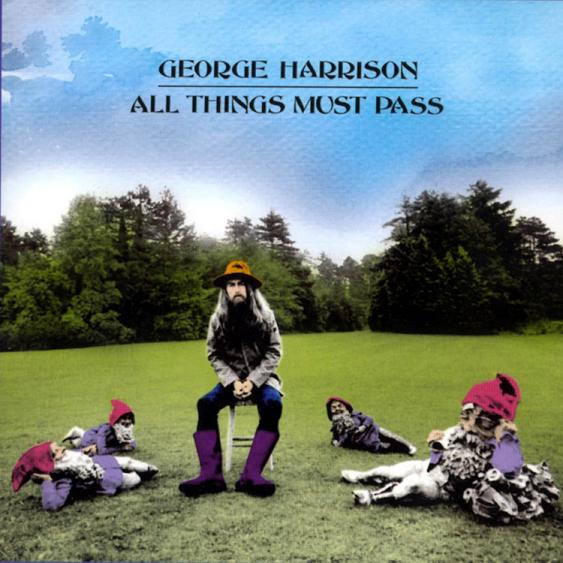
      In the mind of the spiritual man, God and the Father are interchangeable.  Questions of the nature and meaning of our existence are often posed to both the visible parent and the unseen creator; or, if the parent has passed, to both as one.  These questions are what drive us to grow, to pursue, to create, even if we know, instinctively, that the answers will remain forever elusive.  Questions are a great gift; the capacity to ask, to be curious, is the beginning of the journey to become greater than we are.  All Things Must Pass, George Harrison’s 1971 solo debut, is an album full of questions – questions, perhaps, that he had never felt comfortable asking in the company of John, Paul and Ringo.  The songs contained within are not the boy George who complained about the government on “Taxman,” or who idolized Pattie Boyd in “Something.”  These are the cries of a man deeply in tune with his spiritual nature, who is looking both above and within for the answer, and challenging the rest of us to do the same.  George Harrison’s gift was the ability to blend the spiritual with the spirit of rock and roll, and as hard as the album rocks from track to track, even couched beneath producer Phil Spector’s reverb-drenched Wall of Sound, the thread of the pilgrim remains potent and strong – the road ahead clean and clear.  Rarely has a journey inside a man’s soul ever sounded so good.

      Monty Python alumnus Terry Gilliam, interviewed for the Concert for George film that documented a tribute put on by Harrison’s best friends one year after his death, described with glee the show’s juxtaposition of Indian ragas and the surviving Pythons’ rendition of “Sit On My Face,” calling it a perfect reflection of the heights and depths of George’s tastes.  I’ve written about my fascination with the contradiction in the human heart, and George Harrison is another shining example – a retiring, quiet soul most at home working in the garden who nonetheless chose a career that made him one of the most famous men in the world.  Gardens are a potent metaphor for George’s solo career; his songs can almost be thought of as seeds of thought he plants in your mind, that grow with care and attention each time you give them a listen.  From the gorgeous “I’d Have You Anytime,” his collaboration with Bob Dylan that opens the album, the beseeching mantra of “My Sweet Lord,” the electronic wail of “Wah-Wah,” the gently cautionary “Beware of Darkness” and the lush title track to name but a few, the music here is deep, layered and elegant.  “Stripped-down,” a favourite label among rock critics, does not apply here – some of the tracks even verge on operatic.  But that is only because of the sheer substance in each.  The album has been described elsewhere as an outpouring of material that George had been unable to showcase in his time with the Beatles because of the wattage of the Lennon-McCartney catalogue – an Old Faithful eruption of creativity, if you will.  Yet the songs are polished and crafted with a great deal of care, George having recruited many good friends, the best in their game (including Eric Clapton) to assist him in preparing his long-gestating message to the world.

      John Lennon asserted that all you need is love.  George Harrison agrees, but he views love differently.  To George, the love between a man and his god is just as important as the love between a man and his partner, while never suggesting that one should exceed the other.  “Awaiting On You All,” while superficially a rocking celebration of the perceived power of mantra, dares the listener to break free of the ritualistic trappings of religion and experience the purity of untethered spiritual love.  You come to realize as the album draws to a close that the questions George has been asking throughout are not necessarily directed at God, or a father – but at you.  Of course he still has doubt – “My Sweet Lord” and “Hear Me Lord” are cries of faith in crisis – but George is forcing you to confront your own as well.  In “Run of the Mill,” he sings that “With no one but yourself to be offended, it’s you that decides.”  He can’t answer the question for you, all he knows for certain is that you should be asking it.

      Paul McCartney once said that one of the things he was proudest of about the Beatles was that their music was positive; that it never called for anger or violence, but rather repeated, like a mantra, the need for and the power of love.  George Harrison ran with the torch following the split of the Fab Four, singing of the essence of love on a much more philosophical plane.  Throughout his life, George looked for answers in India, in the humor of the Pythons, and in the very fabric of creativity.  Yet he was aware of the transitory nature of existence, that seasons are forever changing, that the world remains in motion, and for him, it was a source of optimism.  “All Things Must Pass” says that “it’s not always gonna be this grey.”  Indeed, we may not find all our answers in this life.  The Greek philosopher Zeno postulated a theory of motion whereby one crosses a distance with each step exactly half the span of the step before, so that even though you never arrive at your destination, you are always moving forward towards it.  That was the life and career of George Harrison, forever questioning and somehow being okay with not ever truly learning what it’s all about – the sort of ego-free humility before the wonders of the universe that marks the purest, the most transcendent of souls:  the poets.

      Spread the word:

      • Click to email a link to a friend (Opens in new window) Email
      • Click to print (Opens in new window) Print
      • Click to share on X (Opens in new window) X
      • Click to share on Facebook (Opens in new window) Facebook
      • Click to share on LinkedIn (Opens in new window) LinkedIn
      • Click to share on Pocket (Opens in new window) Pocket
      • Click to share on Reddit (Opens in new window) Reddit
      • Click to share on Tumblr (Opens in new window) Tumblr
      • Click to share on Pinterest (Opens in new window) Pinterest
      Like Loading…
    • Us and them

      February 19th, 2012

      My better half and I were in a long line yesterday afternoon, waiting to purchase some chairs.  As we waited with our fellow consumers to plunk down our hard-earned pesos at the altar of the mighty Corporate Retailer, I chanced to overhear conversation from the front of the line – specifically, a mother telling her daughter, somewhat snippily, that daughter would have to get her eyebrows and nails done in advance of some event taking place a week hence.  Mother was what you might call rather well put together – styled blond hair, flawless makeup and manicure, fashionable ensemble.  Daughter was in sweats and looking rather unenthused.  I perhaps could have understood Mother’s point had the daughter’s eyebrows been a touch on the bushy side, if mayhap traces of the dreaded unibrow were evident.  But there was quite simply nothing wrong with said brows.  (Did not get a chance to perform similar scrutiny of subject’s hands.)

      Anyway, as is my wont on occasion, I uttered a few sarcastic remarks beneath my breath, expounding further to my better half as we left the store and the earshot of the woman in question, positing a preponderance of vanity on this stranger’s part, and essentially, summing up her life in a Holmesian leap of deduction after no more than a minute in her presence.  My better half, naturally, advised me to go stuff it.  (Not really, but it makes for a better story that way.)  What she did tell me was that I have a bad tendency to be very judgmental.  I didn’t know, she pointed out, if maybe daughter had been riding mother’s nerves all day long, if they had a long and complicated history, if myriads of nuanced emotional moments had crescendoed to and climaxed in that checkout line admonishment.  I was guilty of taking one look, or listen rather, and thinking I had them all figured out.  But I’m not Sherlock Holmes – indeed, his belief in his ability to read people is a deep flaw.  It is sheer folly to think we can ever know the heart of another.  We can come to love them deeply and intimately, to share each moment of our lives with them, but we can never truly understand what goes on in the space between the heartbeats.  Rather we tend to make these assumptions based on patterns, and we fill in what we can’t read with our own personality, our own morality and values, leading us, inevitably, to a conclusion that is totally wrong.

      When Whitney Houston died last week, predictable comparisons were made to Amy Winehouse, another deeply troubled singer who succumbed to her demons last year.  For much of her career, Whitney Houston was tabloid fodder, with endless judgments passed on her lifestyle, her choice of partner, her struggles with drugs that seemed endless.  The large-scale reaction at the end is not shock, not sadness, but a shrug. “It was only a matter of time,” say the cynical, the insensitive.  Why not just accept that none of us could have known what was going on inside her mind?  The struggle with illness, whether mental or physical, is the most solitary of fights, the lack of our ability to understand one another the barrier that keeps us alone on that terrible battlefield.  And yet the capacity of human beings for compassion – when they choose it – at least lets us stand against the storm knowing that our friends are at our back, cheering us on.  It’s too easy to let the beast schadenfreude take over, especially when celebrities are involved, this peculiar mix of envy and loathing that we assign to those who have achieved great success.  What’s important to remember, whether it’s Whitney Houston or a random woman in the line at the store castigating her daughter’s eyebrow issues, is that it is not a cipher we are looking at, a character from a soap opera defined by a consistent and cardboard trait, but that most beautifully complicated creature of contradictions, a human being.  Defining each other by single characteristics is what leads to the identification of the stranger as an other, an enemy.  It is what has divided us into camps and tribes for our entire history, and what divides us still.  You are not me.  Us and them.

      Yet we can overcome that.  It’s not necessary to form an opinion on the actions of every person we pass on the street, to compare their attitudes to our own.  We can leave them be.  We can replace judgment with respect, with empathy.  And our ability to do that, to recognize and to make the choice, is part of what makes us human.

      Spread the word:

      • Click to email a link to a friend (Opens in new window) Email
      • Click to print (Opens in new window) Print
      • Click to share on X (Opens in new window) X
      • Click to share on Facebook (Opens in new window) Facebook
      • Click to share on LinkedIn (Opens in new window) LinkedIn
      • Click to share on Pocket (Opens in new window) Pocket
      • Click to share on Reddit (Opens in new window) Reddit
      • Click to share on Tumblr (Opens in new window) Tumblr
      • Click to share on Pinterest (Opens in new window) Pinterest
      Like Loading…
    • Laughter is the best campaign slogan

      February 16th, 2012

      Canadians are funny people – we do not and never have taken ourselves seriously.  You would never hear true Canadians bellowing vainglorious pronouncements of superiority and boasting of Canadian exceptionalism and the divine right to apologize to no one.  Certainly we consider many things sacrosanct:  public health care being the most notable, and lately, what we do online.

      In a deeply cynical move marked by paranoia and shameless political calculation (par for the course from our feds lately), Vic Toews, the Minister for Public Safety, has introduced legislation that will allow police to spy on your Internet activities without a warrant.  Quis custodiet ipsos custodes, indeed; one does not need to have read Orwell to understand the implications.  The legislation has been given the Helen Lovejoy-esque moniker of the Protecting Children from Internet Predators Act, and the Minister himself raised the discourse to the highest echelons of intellectual debate by accusing those who didn’t support his draconian measures as supporters of child pornography.  I’m forced to question once again, as with the late Senator Ted Stevens and his infamous “series of tubes” comment, why it seems that those with the least knowledge of the Internet always seem to be the ones placed in charge of regulating it.

      The response to this act of political dumbassery has been swift.  Rather than rising up in anger, Canadians have responded in the way that is so uniquely their own – with biting wit.  A Twitter hashtag, #TellVicEverything, is trending as Canadian tweeps take to the popular microblogger to advise Vic Toews, since he seems so obsessed, of every mundane detail of their lives:  what they’re eating for breakfast, what shirt they decided to wear today, local weather updates, the weird look that teenager just gave them and even movie spoilers.  (Sheesh – Darth Vader is Luke’s father???  Damn you anonymous Tweeter!)  There is no weapon more lethal to a purveyor of anger than a good joke at their expense; as it says in my bio here, a belly laugh is more powerful than a hateful scream.  To the angry brain, laughter does not compute.  They are so resentful of the idea than anyone is allowed to be happy instead of them, that their souls have literally lost the capacity to process humour.  I would find it cause for pity were not so many of these people in positions of nation-wide leadership and influence, instead of where they belong:  in therapy.

      Why, if Canadians are such funny people, do we keep choosing the angriest among us to be our leaders?  Check out Wikipedia’s list of Canadian comedians, and then look at the list of members of the House of Commons and the Senate – you’ve never seen a dourer herd of sourpusses in your life.  You could suggest that national problems require a serious approach, and serious people.  I’m not questioning that – I just don’t think seriousness and the ability to laugh at oneself are mutually exclusive.  With the latter quality comes a sense of humility and appreciation for the weight of responsibility of the office; at least it does in every politician, every person, I’ve ever admired.  Whereas a complete lacking in the ability to recognize and find humour in one’s failings is a common trait held by every dictator in human history.  What remains frustrating is how the angry candidate wins and then everyone acts surprised when he gets into office and continues behaving like a sociopath.

      How wonderful would it be if the funniest candidate won for a change?  If we chose someone who reflected our actual laugh-loving values, instead of those of the embittered loner pissed off that he was picked last for gym?  At the risk of invoking a Bush-era campaign tactic here, if you wouldn’t invite the guy over for a beer because his silent brooding and inflammatory blog posts hating on everyone and everything that didn’t agree with his worldview creeped you out, why on earth would you assume he’d be a good leader?  I’d much rather have the guy who knows the airspeed velocity of an unladen African or European swallow.  One thing is for sure – they’d be a lot more fun to watch.

      Anyway, in case Vic is looking in, and in the spirit of being Canadian, I had chicken à la king without the noodles for lunch today, I’m trying to avoid carbs.  Kevin Spacey was Keyser Söze, Soylent Green is people, and Bruce Willis was dead the whole time.

      Spread the word:

      • Click to email a link to a friend (Opens in new window) Email
      • Click to print (Opens in new window) Print
      • Click to share on X (Opens in new window) X
      • Click to share on Facebook (Opens in new window) Facebook
      • Click to share on LinkedIn (Opens in new window) LinkedIn
      • Click to share on Pocket (Opens in new window) Pocket
      • Click to share on Reddit (Opens in new window) Reddit
      • Click to share on Tumblr (Opens in new window) Tumblr
      • Click to share on Pinterest (Opens in new window) Pinterest
      Like Loading…
    • There’s a bathroom on the right

      February 15th, 2012
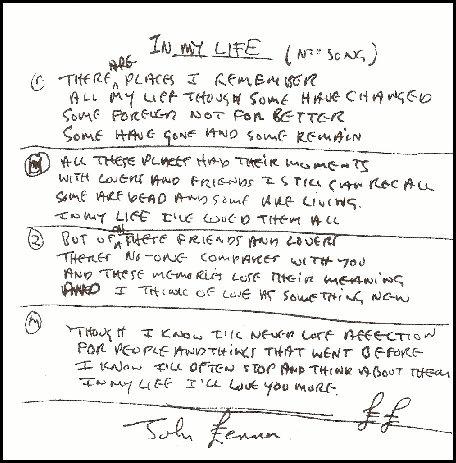
      John Lennon’s handwritten lyrics to “In My Life”

      Song lyrics have been on my mind a lot the last few days.  I’ve told you about how my father could recite the lyrics of every classic rock song ever written, even if sometimes his interpretation of what was being sung was somewhat out there.  In fairness to him, he certainly wasn’t unique in his lyric dyslexia, as anyone who’s ever scrunched their eyebrows to “Louie Louie” can attest.  (The FBI investigated the song for several years in the 60’s to try and determine if it was obscene – your tax dollars at work, folks.)  In an era where written verse has retreated to the obscure, impenetrable domain of the hipster, music lyrics are our most accessible form of poetry.  The trouble is, the stuff that is the most popular tends to function on a level no more complicated than “Roses are red, violets are blue.”  It is as though there has been a collective decision that nobody’s listening to what’s being sung, so it doesn’t matter what the words are.  The trouble is, blandness and vapidity doesn’t just drag the song itself down – it diminishes all of music.

      Recently, I was struck by a verse from a song that you’ve heard if you saw The Adjustment Bureau – “Future’s Bright,” by film composer Thomas Newman and Richard Ashcroft.  Presented for your consideration:  “When Icarus fell from the sky, the plough still turned the field and the child still cried.”  The song isn’t the greatest ever written, nor is this the most inspiring lyric ever growled by a semi-obscure Brit alt-rocker.  But it’s stuck with me regardless, I think because it is at the least an attempt at poetry inside a very commercial product.  It’s plain language, but still evokes strong imagery and draws allusion to classical myth – challenging the listener, in effect, to find out who Icarus was and why his fall is significant, particularly in the context of the greater message about the optimism inherent in looking forward at a life filled with possibility.  How refreshingly old-fashioned, when the lion’s share of popular music these days seems devoted to discussing the shapely undulations of a female’s hind parts in da club.

      Elvis Costello said recently that his favourite couplet in all of music was Cole Porter’s line from “I’ve Got You Under My Skin”:  “Use your mentality, wake up to reality.”  My personal favourite is Paul McCartney’s famous closing statement, “And in the end, the love you take is equal to the love you make” – an incomparably beautiful, spiritual, philosophical reflection on the meaning of life, one whose genius even the compliment-stingy John Lennon was able to admit.  Both songs come from an era where more was expected from music.  There has always been an element of sales and the view of songs strictly as product, particularly in the halcyon days of Tin Pan Alley, but it seems to me that writers just used to try harder.  These days?  Three writers to declare “Pedicures on our toes, toes, trying on all new clothes, clothes, boys blowing up our phones, phones” and then misspell the Kesha song’s title, “Tik Tok.”  (Were we under the mistaken impression beforehand that pedicures could be applied to the elbow?)  It took nine writers – nine independent minds, collaborating, just ponder that for a second – to string together the pronouncement, “Don’t be fooled by the rocks that I got, I’m still, I’m still Jenny from the Block.”  Yet it only took Freddie Mercury to write all of “Bohemian Rhapsody.”  Whiskey Tango Foxtrot indeed.  When did it become acceptable to settle for so much less?

      Don’t get me wrong – there are plenty of great songwriters out there still giving their all and trying desperately to earn space on the radio alongside Selena Gomez declaring over and over, in a blinding flash of self-referential insight, that she loves you “like a love song, baby.”  No doubt in the classical music era there were a hundred failed composers for every Mozart or Beethoven.  The difference between then and now, is that the democratization of media – as beneficial as it is in some respects – has led to the mediocre stuff attaining heights of popularity deserved only by the brilliant.  The hacks of the 18th Century music scene are long and deservedly forgotten.  Rebecca Black got a music career in spite of, and in fact because of being dreadful.  We can’t blame the artists (or wannabes) for this, as much as we may feel like stabbing out our ears with icepicks rather than endure Bieber whining “baby, baby,” one more time.  We’re the ones who decided to stop demanding better – we decided that French fries were preferable to vichyssoise, regardless that the musical equivalent of saturated fat does nothing but make our brains lethargic and stupid.

      Part of the fun of trying to figure out the lyrics of some of those older songs was the premise that whatever was being warbled beneath overdubs of guitar and keyboard was something worth discovering.  Creedence Clearwater Revival’s “Bad Moon Rising,” the gold standard for misheard lyrics along with Jimi Hendrix’s “Purple Haze,” is a rollicking, foot-tapping number whose words, while straighforward, still manage to function on the level of metaphor.  You can at least sense that there is an inquisitive mind behind the syllables, not a soulless, management-appointed committee more interested in demographics than saying anything substantial.  That’s why no one really cares that much what “Hey Mister DJ, come pon de replay” means.  It’s got a good beat and you can dance to it, but it’s not one you’ll ever want to sing to yourself in the shower.

      Spread the word:

      • Click to email a link to a friend (Opens in new window) Email
      • Click to print (Opens in new window) Print
      • Click to share on X (Opens in new window) X
      • Click to share on Facebook (Opens in new window) Facebook
      • Click to share on LinkedIn (Opens in new window) LinkedIn
      • Click to share on Pocket (Opens in new window) Pocket
      • Click to share on Reddit (Opens in new window) Reddit
      • Click to share on Tumblr (Opens in new window) Tumblr
      • Click to share on Pinterest (Opens in new window) Pinterest
      Like Loading…
    • Valentine’s Day, massacred

      February 14th, 2012

      It’s probably not a good thing to read “Happy VD” in a friend’s status update and think, based on their general tone, that they’re referring to venereal disease (which can be many things, the least of which I suspect is happy).  Valentine’s Day is one of those concepts that provokes divides akin to red state/blue state – yer either fer it or agin it.  People in love use it to shower their special somebody with gifts and affection.  Single people decry it as a Hallmark holiday and bemoan the cringe-inducing cheese of cutesy heart-clutching teddy bears and diabetic chocolate overdoses.  No matter your take on February 14th, we can probably all agree that in a world whose history has been defined largely by how much we hate each other’s guts – and finding new and inventive ways to take out that frustration via ever more powerful killing tools – it’s nice that we can still devote one day out of the 365 (or in this year’s case, 366) to celebrating the idea of love.  On February 15th we can go back to pissing all over the douchebags – just give it a rest for twenty-four hours, please.  And yet it still seems that the majority of what you’ll read about Valentine’s Day is penned by misanthropes who feel especially entitled on this day of all days to vent their contempt about ex-partners, abysmal dates or the fact that they have no partner at all.  They’ll portray it as a vast conspiracy of impatient family members, bachelors/bachelorettes, the greeting card industry, chocolate makers, Kenyan Islamofascisocialists, Republicans and the military/industrial complex (because those guys are always behind everything) directed specifically at making their lives miserable.  In the ultimate of ironies, snark flows more freely today than love.  Not exactly what the secret cabal of Illuminati, Bilderbergers and Commie-Nazis who came up with Valentine’s Day in the first place had in mind when they forced this nonsense upon us.

      Look, I’ve been there.  I was Forever Alone Guy.  And yes, it sucks being the only single person at the table.  You can argue that it’s is an artificial holiday, the date picked to ameliorate a slow retail season between Christmas and Easter; well, it’s not like nature notices the difference and remembers to create an especially beautiful day, she was planning on doing that (or not) anyway.  You can carp about the in-your-face syrupy public demonstrations of affection, the dreadful Sarah Jessica Parker “comedies” Hollywood rolls out during this season and the abundance of red and pink heart-shaped paper cutouts stuck all over your supermarket cashier’s kiosk that are not, truly, shaped like actual human hearts.  What puzzles me is how the purveyors of such cynicism think they’re unique, that they’re the very first to vent such incisive wit for the world’s bemusement.  How soon we forget that we heard all of this last year, and the year before.  I very well might have been the one making those points in the late 1990’s.  But I can admit that I was wrong, and that I shouldn’t have let my gloom about a lack of successful romantic escapades rain over the proverbial parade of those souls lucky enough to manage to connect amidst the random permutations of the universe.

      For many of us, Valentine’s Day is actually special.  Not because society told us it should be.  Because like Captain Picard, we made it so.  VD wasn’t anything remarkable for me either, until I decided to make it the day I proposed to the wonderful lady who became my wife.  Had she said no, I might have had a new reason to hate it – as it turns out, I was one of the lucky ones.  And that is sort of the point – what else is a holiday, at its core, other than a celebration of one’s fortune?  Even the single are fortunate – they are alive, healthy and free, and many are clearly very gifted with words.

      My suggestion is this:  let’s have an anti-Valentine’s Day too.  We could stick it in the middle of August, say on the 23rd, when it’s hot and sticky, the Back to School sales are in full vigor, the political conventions are happening and love is the furthest from anyone’s mind.  Hallmark can stock “To My Scumbag Ex” and “Never Liked Your Rihanna-Loving Ass Anyway” cards, frowny-faced teddy bears and Cupids with their heart arrows shoved where the sun don’t shine.  It can be a day when we let our dogs befoul our loud neighbour’s lawns and cut each other off on the highway with no road rage reprisals – an occasion to let the finest examples of man’s contempt for his fellow man shine forth like so much radioactive waste.  And all the eternally single bloggers and columnists can use it to spew forth their laments for their failed attempts at romance to their heart’s discontent.  But please, for the love of love, leave Valentine’s Day alone.

      Spread the word:

      • Click to email a link to a friend (Opens in new window) Email
      • Click to print (Opens in new window) Print
      • Click to share on X (Opens in new window) X
      • Click to share on Facebook (Opens in new window) Facebook
      • Click to share on LinkedIn (Opens in new window) LinkedIn
      • Click to share on Pocket (Opens in new window) Pocket
      • Click to share on Reddit (Opens in new window) Reddit
      • Click to share on Tumblr (Opens in new window) Tumblr
      • Click to share on Pinterest (Opens in new window) Pinterest
      Like Loading…
    • Han

      February 13th, 2012
      "It's a state of mind. Of soul, really."

      Overwhelmed is a good way to describe myself after yesterday, and yet, even that somewhat hyperbolic word seems strangely inadequate.  I am so deeply moved and touched by the response to my post about my father – some of the comments left by friends and strangers quite literally brought forth tears.  And that is all my Dad, proving that what I said yesterday is true, that even twenty-five years gone he retains the ability to move and inspire everyone he touches.

      Some of you shared your own inspiring stories of your parents, and of your own losses.  I think it’s important to remember in times like these that which connects us all as members of the human race; our emotions.  In our darkest and our brightest moments, we all feel the same way.  We can look at someone who is suffering and understand the depth of their pain.  More than that, we can share in our joy and celebrate mutual triumphs.  We can feel so alone in this vast universe, and yet we never are.  We have each other.  We will always have each other.  A man who was equal parts president and philosopher, John F. Kennedy, said that “we all inhabit this small planet; we all breathe the same air, we all cherish our children’s futures, and we are all mortal.”  The possibility of our greatness is tied to our capacity for empathy, the knowledge of and the desire to do good, not out of a wish for personal gain, but because we know that it is right, and that the mere doing of good makes us all better.

      There is a Korean word, han, which first came to my attention when it was used on an episode of The West Wing.  There is no English translation, but it was described on the show as “A sadness so deep no tears will come, and yet still there’s hope.”  I’m not sure if I’m using it here exactly in the way a native Korean would, but for my own purposes, it captures my state of mind this morning in a way that overwhelmed does not.  I still mourn my late father, but I am lifted, given great hope indeed, by the supportive thoughts of friends, family and strangers; the great tapestry of emotional connection that binds us all in a universal truth.  Maybe that’s a lesson to take from this experience, is that even in the depths of despair, there is always hope.  And we need not look far to find it.  It’s in me; it’s in you.  It’s in us.  It is us.

      Spread the word:

      • Click to email a link to a friend (Opens in new window) Email
      • Click to print (Opens in new window) Print
      • Click to share on X (Opens in new window) X
      • Click to share on Facebook (Opens in new window) Facebook
      • Click to share on LinkedIn (Opens in new window) LinkedIn
      • Click to share on Pocket (Opens in new window) Pocket
      • Click to share on Reddit (Opens in new window) Reddit
      • Click to share on Tumblr (Opens in new window) Tumblr
      • Click to share on Pinterest (Opens in new window) Pinterest
      Like Loading…
    • Twenty Five

      February 12th, 2012

      Nothing can prepare you for the news that your father is gone.  It doesn’t matter if it’s expected, the inevitable conclusion of a long terminal illness, or sudden, like the turn of a page.  You are spending the afternoon in the snow with your friends when someone comes to you and tells you to be brave.  And then they lead you to a room where your mother is sitting, her face the picture of devastation.  There is no easy way to tell you, but she tries to ease into it as smoothly as she can – mindful of the fragile heart of an eleven-year-old boy.  The fateful words come.  “I’m afraid he died.”  The rest of the moment is lost in a torrent of sudden tears wailed into her arms.  It can’t be, you think in the spaces between the sobs.  Not him.  Not my dad.

      That boy was me, twenty-five years ago this afternoon.  More than any other day, February 12th, 1987 has shaped who I have become, because it was the day I lost my best friend in the world, the man I admired above all others.  He was everything I ever wanted to be, a legacy to which I still aspire, and if I live another sixty years and achieve half of what he did I can leave this life content with how I’ve used my precious time on this little rock.  Was he a famous man, an influential man, a man of letters or worldwide renown?  Google his name if you want; you won’t get any hits.  But that doesn’t matter to me.  My father remains the ideal of what it means to be a man.  Without his guidance this past quarter-century I have looked to other mentors from time to time and each has come up a distant second (and occasionally further back even than that) through no fault of their own.  They’re just not and will never be my father.  Growing up without your dad is a bit like trying to canoe on your own against a heavy wind.  Without him in the stern guiding you with his steady paddle, you’re often blown far off course and will struggle to find your way back – perhaps never.

      My father never judged me.  He never forced me in a direction I didn’t want to go.  When I was abjectly miserable following my first-ever hockey practice, humiliated by kids who were bigger and better at it, he told me I didn’t have to go back.  And yet he wasn’t a coddler or a helicopter father.  In the junior soccer league in which I played, it was something of a running joke that it was customary for the coach’s son to win the Most Valuable Player Award every year – predictable nepotism from showbiz dads convinced their kid was the next Beckham (or Pele, if we’re using a decade-appropriate reference).  But not the year my dad coached my team.  He wasn’t going to give me something I hadn’t earned.  I got Most Improved Player – because despite my total lack of athletic skill, I worked incredibly hard, suffering skinned knees and bruised shins, for him.  (Most Injured Player would have been more apt.)  Making him proud was more than enough for me.  An interesting aside to this story is, that year our team lost every single game except the three my father wasn’t able to attend.  My teammates begged him not to come to the championships.  He did regardless – and we won the whole blessed thing.  I still have the trophy.

      Dad taught me baseball, he taught me to ski, he taught me to love the Beatles.  Where other kids recited “Old McDonald Had a Farm,” I sang “Norwegian Wood” to perplexed relatives and he beamed.  I laughed at his inability to decipher song lyrics and the comical nonsense words he came up with instead.  I watched my cousin tear up on her sixteenth birthday as she listened to the playlist of 50’s jukebox classics he had assembled for her big day.  I watched his delight at the smile on my face as I tore open the newest box of space Lego.  I watched him shrug off with a smile the time I embarrassed him in front of our entire church congregation.  He had a rare capability to spread joy, and he did so whenever the opportunity arose.  He could befriend complete strangers in minutes.  You could not walk down the main street of our home town with him without running into someone he knew.  And you always got the sense that everyone he did know, whether casually or intimately, cared deeply about him as well.  He had that effect on people.  When I was struggling with bullies or simply trying to figure out my place in the world, his arm around my shoulder assured me that everything was going to be okay, because he had my back.  No matter how dark the night, the voice of my father was the light.  One of his last gifts to me was in the early stages of my figuring out that I wanted to write.  On weekends, or in the summer, he’d take me to his office and park me in front of the old Xerox computer with its floppy discs the size of pizza boxes and encourage me to type and just dream.

      The last time I saw him, he wasn’t feeling well.  He’d taken the morning off and was still in bed as I got ready to head off to an overnight stay with my weekly enrichment class at a nature park a few hours north of us.  I went into the bedroom to say goodbye, never imagining this would be our last moment together.  I gave him a kiss on the forehead and said I would see him in a few days.  When I saw him those few days later he was lying silent and cold on a table in the funeral home.  And I still expected him to open his eyes and look at me and smile, and tell me that it would be all right.  It felt like we had so much left to do together.  The Blue Jays were going to be starting a new season in a few months and there was a new Bond movie coming out in July that he’d promised me he’d take me to see.  Wake up, Dad.  I still need you.

      For twenty-five years there has been a father-shaped hole in my life; I have lived far longer without him than I did with him.  I am only five years younger now than he was when he died, and not a day passes that I don’t think of him, and miss him.  I reflect on some of the disastrous decisions I’ve made in my life and think if he had been here, maybe he could have steered me away from those rocks and shoals.  Age has made me look more like him too; there are moments when I see pictures of myself now and shiver a little at the uncanny resemblance.  I have felt for much of my life like a mere echo of his voice, my path ever uncertain, every step of the way wondering what he would think of the choices I’ve made, if I have lived up to the example he laid down in his too-brief journey.  I am not really a spiritual person, but I feel the same longing to be able to ask the absent Father if I am all that I am meant to be.  If I am worthy of his name and of his love.  I feel it so acutely of late, like a needle twisting in my heart, and today most of all.  I want to hear him say he’s proud of me.  That’s all I’ve ever asked.  It is all the validation I’ll ever need.

      After my mother passed away several years later, we had a small ceremony to place her ashes with his.  As we left the cemetery, a pair of geese from a nearby hill took off and soared away into the sky.  The timing was eerily serendipitous; it was almost as if they were together again now, reunited in a new life and heading off to adventures bold.  One could even imagine that they were bidding me a last goodbye, secure that they had done all they could and were letting me go now to face the challenges of the future with the strength and the values they had instilled in me.  Values of kindness, respect, compassion, empathy and love.  Everything I am I owe to them, and through the sadness, I feel gratitude.  I wish I could tell them that.  I wish I could toss the ball around in the backyard with Dad and complain about the lack of depth in the Jays’ pitching staff and ask him what he thinks of Daniel Craig as James Bond.  I wish I could introduce him to my beautiful wife and listen to them sing together – they’d sound terrific, I’m sure.  As amazing as my wedding was, Dad leading the guests in a round of “Yes, We Have No Bananas” with half the words wrong would have made it even more memorable.

      There is an old saying that a candle that burns half as long burns twice as bright; I have to believe that in the eleven short years I had with my father we burned brightly indeed, and that we loved each other as much as a father and son could.  Perhaps I don’t have his counsel anymore, or his arm around my shoulder on those darkest days, but I have the life he gave me, and the road ahead that is his greatest possible bequest.  I don’t think I’ll ever stop missing my dad, but when I get up tomorrow and start my twenty-sixth year without him I will try to carry the best parts of who he was through all the rest of my days, and live the life he would have wanted for me.  And I hope that’s tribute enough.

      I love you, Dad.

      Blain William Milne

      1945-1987

      Spread the word:

      • Click to email a link to a friend (Opens in new window) Email
      • Click to print (Opens in new window) Print
      • Click to share on X (Opens in new window) X
      • Click to share on Facebook (Opens in new window) Facebook
      • Click to share on LinkedIn (Opens in new window) LinkedIn
      • Click to share on Pocket (Opens in new window) Pocket
      • Click to share on Reddit (Opens in new window) Reddit
      • Click to share on Tumblr (Opens in new window) Tumblr
      • Click to share on Pinterest (Opens in new window) Pinterest
      Like Loading…
    ←Previous Page
    1 … 30 31 32 33 34 … 39
    Next Page→

    Blog at WordPress.com.

    Privacy & Cookies: This site uses cookies. By continuing to use this website, you agree to their use.
    To find out more, including how to control cookies, see here: Cookie Policy
     

    Loading Comments...
     

      • Subscribe Subscribed
        • Graham's Crackers
        • Join 6,281 other subscribers
        • Already have a WordPress.com account? Log in now.
        • Graham's Crackers
        • Subscribe Subscribed
        • Sign up
        • Log in
        • Report this content
        • View site in Reader
        • Manage subscriptions
        • Collapse this bar
      %d