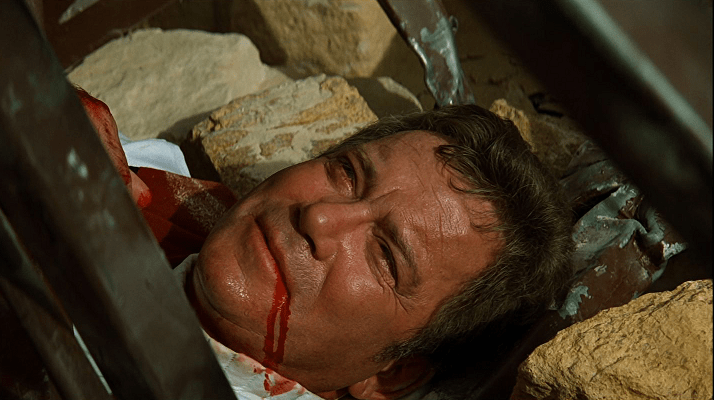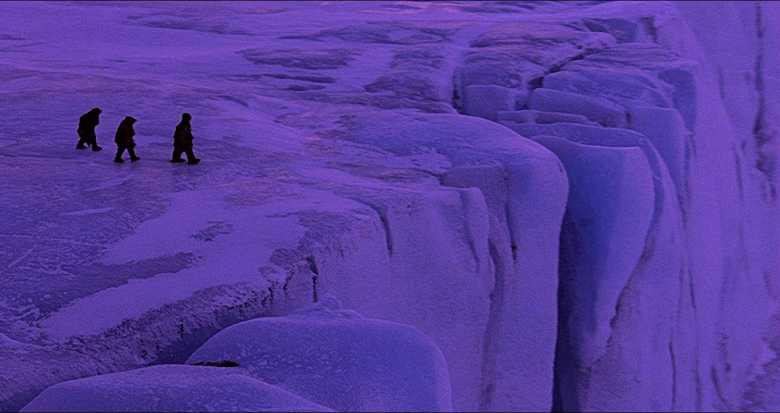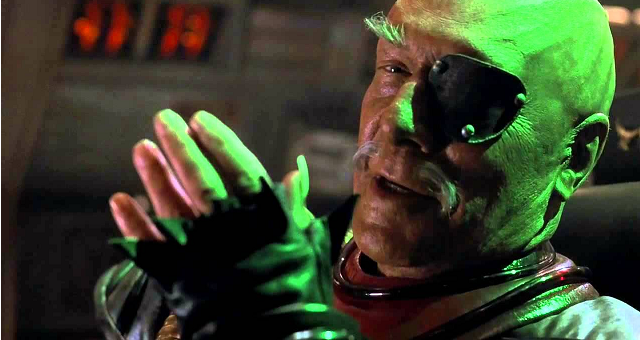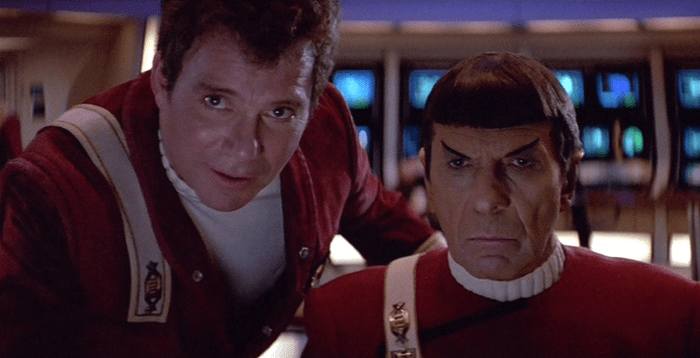
The original blog of writer Graham Milne – content published from 2011-2017

Graham's Crackers

    • Countdown to Beyond – Star Trek: Insurrection (1998)

      July 8th, 2016

      insurrection

      What does the ninth Star Trek movie have in common with Apocalypse Now?  Would you believe they were based on the same book?  Those of you who have read Joseph Conrad’s Heart of Darkness may be pained to recall any stretchy-faced aliens in it, but the concept of going up the river to find a long-lost colleague who has gone native is indeed what sparked the imaginations of producer Rick Berman and screenwriter Michael Piller as they bandied about concepts for what Captain Picard and company, triumphant in their victory over the Borg, could do next.  The dark tone, elements of horror and catastrophic stakes in the previous film had proven very successful, but no one on the production side, studio side or even the acting side wanted to explore down that alley any further.  (Piller, in his unpublished book Fade In, likens it to pitching.  No successful pitcher can get away with only throwing fastballs; sometimes you have to throw a curve.  Patrick Stewart, for his part, used a cricket analogy of a shot straight back at the bowler.)  Early discussions were geared more towards emulating the tone of The Voyage Home, which remained the shining pinnacle that every subsequent Star Trek movie had attempted and failed to reach.  Piller wanted to tap into Star Trek‘s optimism, and, inspired by the Rogaine he was spraying on his bald patch one morning, decided to do a Fountain of Youth story and blend it with Heart of Darkness – “Heart of Lightness,” as he called it.

      In Piller’s initial treatment (called Star Trek: Stardust after the Hoagy Carmichael song) the movie would open with a flashback to a young Picard at Starfleet Academy with his libertarian best friend, Hugh Duffy, and then fade to thirty years later, where, in the midst of a galaxy-wide shortage of an important medical ore called “sarium krellide,” Duffy has gone rogue on an alien planet and begun attacking Romulan ships and colonies.  Picard is assigned to hunt him down through a treacherous area of space known as the Briar Patch, accompanied by a smarmy half-Romulan, half-Klingon named Joss who likes to leer at Troi and pick fights with Worf.  When Duffy/Kurtz is found, he looks as young as he did at the Academy, because the entire planet is made of this sarium krellide stuff and it turns out the Federation has made a deal with the Romulans to exploit the planet for its ore, displacing the natives that Duffy is trying to defend.  Picard and crew turn their backs on the Federation and help the natives repel the Romulans and kill Joss, at the cost of Duffy’s life, and in an epilogue Picard has a speech-off with a Vulcan admiral (whom Piller hoped could be played by Ian McKellen) about morality and so on, fade to credits.  Berman didn’t like the politics in the story and requested that Duffy be changed to Data to keep the drama within the established family.  He also worried that the de-aging story might be offensive to Patrick Stewart, as it was essentially telling him that he was an old man.  Piller’s rewrite eliminated the fountain of youth aspect and instead played up the aliens on the planet, a race of telepathic mutes without immune systems who are protected from illness by the much-needed sarium krellide.  This version was more warmly received by almost everyone… except the man who was going to have to say the lines.
      stewartonbridge

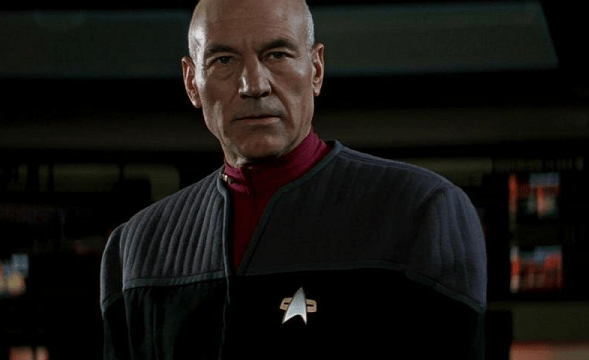
      Patrick Stewart, named an associate producer on this movie in thanks for his work on First Contact, was uncomfortable with almost everything.  He did not want Picard in deep emotional turmoil for a third straight movie (this time about possibly having to kill Data), he thought the Romulans (and particularly Joss, as conceived) were uninteresting villains, he didn’t think there were any compelling guest roles to attract decent actors, he criticized the sarium krellide concept as asking the audience to get excited about a bunch of rocks, etcetera, etcetera.  Ironically, Stewart turned out to be tremendously excited about the dropped fountain of youth idea, and the actor laughed off any concerns as to how his age would be portrayed.  The Romulans and the widely panned character of Joss were replaced with a race of tremendously old aliens called the Son’i (ultimately changed to the Son’a to avoid sounding like Sony Pictures) and their leader Ru’afo (played by Academy Award winner F. Murray Abraham), the telepathic mutes were made plain humanoids called the Ba’ku, and the magic rocks became the more intangible “metaphasic radiation” present in the rings of the Ba’ku planet which would create a fountain of youth effect.  The plot would now revolve around a “Sorvino Switch” (a reference to a Next Generation episode, “Homeward,” where Worf’s foster brother played by Paul Sorvino tries to save a doomed alien culture by beaming them into a holographic recreation of their planet).  The Federation would be conspiring with the Son’a to forcibly relocate the Ba’ku in order to exploit the rejuvenating properties of the planet’s radiation.  Data would discover this and go rogue trying to protect the aliens, and Picard would disobey direct Starfleet orders to do the same.  With Jonathan Frakes back as director, and an increased budget of $60 million in place, the ninth Star Trek film was ready to go, even if no one could agree on a title yet.
      datasings

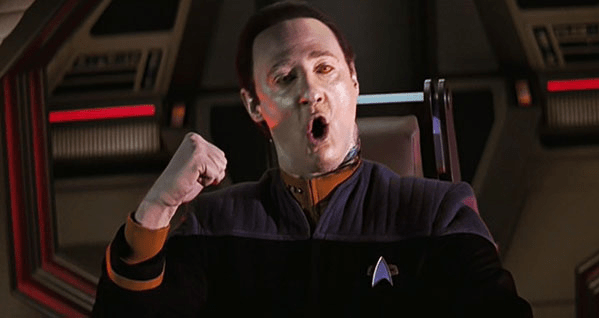
      Fade in on a Vietnamese forest that explodes into flame as Jim Morrison sings “this is the end…”  sorry, no.  Wrong Heart of Darkness.  Fade in on a utopian lakeside village on the world of the Ba’ku, where the inhabitants are tending to their morning chores while a beautiful woman strolls about and children play in the fields.  The pastoral scene is being observed in secret by Starfleet in invisible isolation suits, managed from a “duck blind” concealed by holograms.  The Starfleet crew are being supervised by aliens we have never seen before:  the Son’a, beings with sagging skin stretched taut over aging faces.  A sudden explosion, and panic, as one of the crew begins attacking the others.  It’s Data (Brent Spiner), who rips off his invisibility suit and fires his weapon at the duck blind, exposing it for the frightened villagers to see.  In another sector of the galaxy, Captain Picard and the Enterprise crew, including Worf who has stopped by from Deep Space Nine, are hosting a reception when they receive a message from Vice Admiral Dougherty (Anthony Zerbe) aboard a Son’a ship in the middle of a turbulent area of space known as the Briar Patch, advising that Data has taken the planetary observation team hostage.  Picard decides to bring the Enterprise into the Briar Patch to see for himself.   Descending to the surface in a shuttle, he and Worf are attacked by Data in a scout ship.  Picard tries appealing to Data by engaging him in a singing round of Gilbert & Sullivan’s “A British Tar,” which distracts the android long enough for Worf to subdue him.  Picard then leads a “rescue mission” to the Ba’ku village, finding both the Starfleet personnel and their Son’a allies sitting down with the Ba’ku for a cordial dinner.  He is introduced to Sojef (Daniel Hugh Kelly), the friendly leader of the small settlement of 600, and the lovely Anij (Donna Murphy), who is suspicious of off-landers.  The Ba’ku are as technologically sophisticated as the Federation, but have chosen to eschew such advancement and live a simple agrarian life instead.  Admiral Dougherty is satisfied that there has been no violation of the Prime Directive, and is eager for the Enterprise to be on its way, even though he and the Son’a will be remaining – to tie up “loose ends,” as Dougherty puts it.

      bubblebath

      As the Enterprise lingers in orbit around the Ba’ku planet, the crew start behaving oddly:  Worf gets zits and oversleeps, Riker and Troi flirt like teenagers and even Picard notices a spring in his step.  Geordi discovers that Data’s odd behavior was triggered when his program was reset to function on strict interpretations of right and wrong – by being shot by a Son’a weapon.  Data is returned to normal and he and Picard head back down to the surface.  Journeying to the last location Data remembers, and accompanied by Anij, they discover neutrino emissions coming from the middle of a lake, which turn out to reveal a cloaked ship.  Inside the ship is a holographic recreation of the Ba’ku village, the purpose of which seems to be to move the Ba’ku off the planet; they would go to sleep one night and be beamed into this holo-ship, then flown to another, similar planet and left there without ever knowing what had happened.  Picard does not understand why, and the camera lingers on Anij’s face just as they are attacked by Son’a soldiers.  Picard and Data overpower them, and Picard orders them taken into custody until he can speak with Dougherty and the Son’a leader Ru’afo, who are on their way back from the outer rim of the Briar Patch.
      picardanij

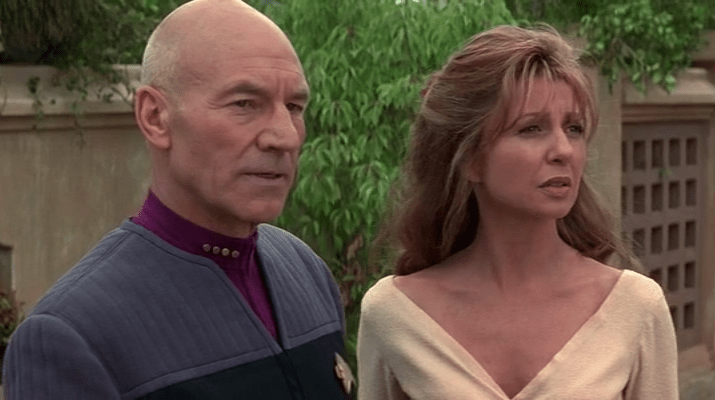
      A midnight walk with Anij reveals the reason why the Federation and the dying Son’a are so interested in this planet:  she and the other Ba’ku are centuries old.  They came to this world from the ruins of their warring civilization to establish a new life, and found that the metaphasic radiation from the planet’s rings slowed their aging and led them to develop tremendous mental acuity; Anij herself has the power to slow down time.  Picard is envious of the existence that the Ba’ku lead and suspects that someone is planning to take it away from them.  After watching Geordi witness a sunrise with restored eyes for the first time in his life, Picard confronts Ru’afo and Dougherty aboard the Enterprise and is informed of the truth:  the Son’a have developed a method to collect the metaphasic particles from the planet’s rings for individual medical use, but the process will render the planet itself uninhabitable.  The Ba’ku world is in Federation space, and so the Federation Council has authorized Dougherty to transport the Ba’ku off the planet aboard the holo-ship before collection begins.  Dougherty argues the revolution in medical science that metaphasics could bring, doubling lifespans and curing disease.  Picard says that forcibly relocating the Ba’ku will destroy their culture.  Dougherty says that they are only moving 600 people; Picard asks how many people it takes before it becomes wrong.  Dougherty shuts down the debate by ordering Picard and his ship out of the Briar Patch.  A chastened Picard returns to his quarters and removes the pips from his uniform, deciding to betray his government to save the Ba’ku.

      ruafodougherty

      Picard leaves Riker and Geordi to take the Enterprise to the edge of the Briar Patch to call for help, while he and the rest of the crew descend to the surface aboard the captain’s yacht.  Figuring that the Son’a will not begin their procedure while the planet is still populated lest a public relations disaster result, Picard’s people set up transport inhibitors and lead an evacuation of the Ba’ku village.  With Dougherty’s consent, Ru’afo sends drones to tag the villagers with homing markers that will allow them to be beamed up, and orders two of his ships to stop the Enterprise before it can reach communications range with the outside.  A battle in space leaves the Enterprise without its warp drive, but some fancy maneuvering by Riker destroys one of the Son’a ships and leaves the other crippled.  On the Ba’ku world, Sojef is taken by the drones, leaving his young son Artim (Michael Welch), who fears technology, in the care of Data.  The Ba’ku are shepherded into caves where the mineral deposits will blind the Son’a sensors, but the Son’a begin dropping charges on the mountainside to force them out, and a resulting cave-in crushes Anij.  Picard helps her to use her time-slowing power to keep her alive until medical help arrives.  Anij is saved, but shortly afterwards she and Picard are tagged by drones and beamed aboard the Son’a ship.  There, Picard reveals the final twist to Dougherty and the assembled group:  the Ba’ku and the Son’a are the same race.  Sojef says that a century earlier, a group of Ba’ku youth eager to embrace technology again tried to take over the colony, and were exiled when they failed.  Those youth have become the decrepit Son’a.  Dougherty has been unwittingly helping the embittered Son’a take revenge on their forebears – in the name of the Federation.  Ru’afo decides to go ahead with collecting the metaphasic radiation even if there are still people on the planet, and murders Dougherty to keep him from telling anyone.
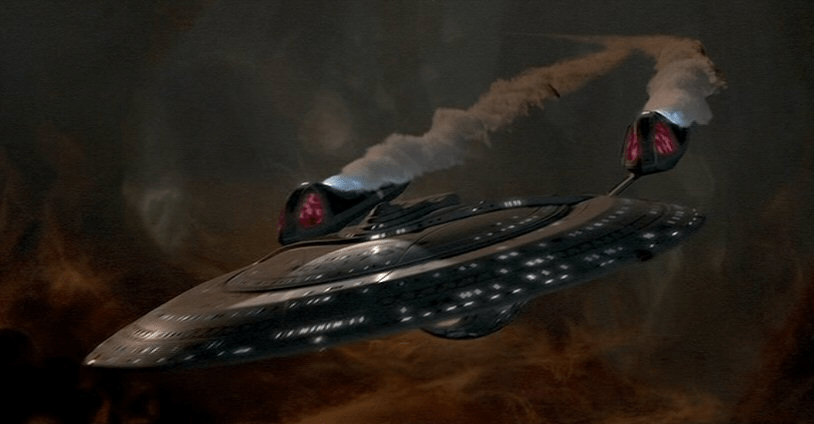
      briarpatch

      Picard manages to sway Ru’afo’s second in command, Gallatin (Gregg Henry), who was once known as Gal’na when he lived among the Ba’ku and clearly has misgivings.  With the assistance of Gallatin, Data and Worf, Picard has Ru’afo and his crew beamed to the holo-ship and presents them an illusion of the collector activating and draining the metaphasic particles.  But the savvy Ru’afo realizes it is a trick, and figures out a way to escape the holo-ship and transport to the collector to restart the countdown for real.  Picard beams over as well and the two leaders battle it out with fists, with Picard quoting Danny Glover, saying “we’re getting too old for this.”  Ru’afo’s crew manages to recapture his ship’s bridge and take Worf and Gallatin prisoner, but the Enterprise returns from the edge of the Briar Patch and disables them.  Picard activates the collector’s self-destruct just in time for the Enterprise to beam him off and leave the mad Ru’afo to be consumed by the explosion.  The remaining Son’a surrender before their air supply gives out, and Riker advises that the Federation Council has called an indefinite halt to the Ba’ku relocation project.  On the surface, the aging Gal’na is reunited with his still-youthful mother and they share a tender, forgiving embrace.  Artim bids goodbye to his new friend Data, Picard promises Anij that he has nearly a year of shore leave he’d like to spend with her, and the Enterprise crew beams away to head home as Marlon Brando whispers “the horror, the horror…” – sorry, I did it again.  Bad reviewer.

      Something has puzzled me ever since I first saw this movie in December of 1998:  why don’t I like it more?  It captures and reflects the optimism that makes Star Trek endearing, it has an intelligent script, it tells a fast-paced adventure story without racking up an enormous body count, it asks ever-timely and relevant questions about the needs of the many vs. the needs of the few, it has good performances, it has villains but not people being nasty just for nasty’s sake, it has a lot of sweet and funny and even touching moments, it has a Jerry Goldsmith score, and the gorgeous Donna Murphy steals breaths in every frame she’s in (and you get to see Marina Sirtis covered in soap bubbles, if that isn’t additional inducement!)  But for some reason the entire affair falls a bit flat.  I’ve wondered if it’s perhaps because there’s nothing here that is surprising, and it raises the question of whether surprises always require the risk of making people uncomfortable.  This movie, by contrast, was designed from the outset to be light-hearted and breezy, and anything that could have represented audience discomfort was snipped out.  (A scene was filmed where Riker and Troi went to the ship’s library to do research on the Son’a and were shushed by an elderly, glasses-wearing caricature of a librarian; deeming this possibly offensive to real librarians, director Frakes deleted it from the final cut.)

      Making audiences uncomfortable doesn’t have to mean assaulting their senses and morals with blood and guts and sex and swears, but it does mean thwarting expectations by introducing irrevocable changes to the characters and the universe they inhabit, consequently leaving the audience actively guessing at what could possibly happen next.  This movie never does that.  It has the visual aesthetic and sweep of a major motion picture, but the play-it-safe mentality of an average TV episode.  When Picard, Data and Anij find the holo-ship and Picard describes the “Sorvino Switch,” we’re deflated because what is supposed to be a major plot twist turns out to be a retread of an episode we just saw a few years ago.  We don’t want the movies to recycle the TV plots; we expect better, more consequential events than that.  We’re paying to be here, after all.

      Even the final title of Star Trek: Insurrection is a promise not kept.  I hear “insurrection” and I’m thinking wide-scale galactic rebellion among dozens of starships across hundreds of worlds, not just Picard and his crew disobeying the orders of one misguided Starfleet admiral – especially when there is never any legitimate doubt that Picard is in the right (wouldn’t it have been a more gripping  ethical dilemma if the audience were to question if the “insurrection” was valid?)  Part of the problem could be that, Donna Murphy’s beauty aside, the Ba’ku are not really that compelling an alien species to spin a story around.  We don’t always have to put Earth itself in jeopardy to have drama – witness Avatar – and we don’t even have to make the aliens eight-foot-tall and blue either, but they should have a little more meat to them than just coming off like a commune of well-manicured hippie California Democrats.  Call it a failure of worldbuilding, as my fantasy-writing friends will appreciate.  It’s unfortunate too that the Ba’ku were cast all white, which represents a deep valley in Star Trek‘s otherwise proud tradition of diversity, and I can’t find a logical reason as to why it was done that way.

      Look, to echo Michael Piller’s baseball analogy, sometimes a curveball finds the strike zone, and sometimes, as Brett Cecil of the Blue Jays could tell you, the hitter smacks it over the left-field fence.  That doesn’t diminish the worth of the pitch, nor does it mean the curve won’t be more effective the next time you throw it.  Star Trek‘s curveball, Insurrection, isn’t a bad movie, but it never risks enough to potentially become a great one.  Yet you can’t bring yourself to hate it or its creators.  Everyone is trying very hard, and the effort is obvious.  But its greatest sin is in wanting so much to make us smile that it trips over its own good intentions.
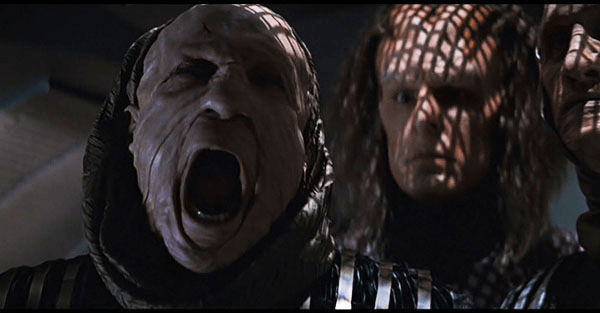
      ruafoscreams

      In summary:  This curveball, sadly, veers too far off the plate.

      Next time:  The world gets its first major look at an up-and-coming actor named Tom Hardy.  Pity it’s in one of the worst Star Trek movies ever made.

      Final (Arbitrary, Meaningless) Rating:  2 out of 4 stars.
      Spread the word:

      • Click to email a link to a friend (Opens in new window) Email
      • Click to print (Opens in new window) Print
      • Click to share on X (Opens in new window) X
      • Click to share on Facebook (Opens in new window) Facebook
      • Click to share on LinkedIn (Opens in new window) LinkedIn
      • Click to share on Pocket (Opens in new window) Pocket
      • Click to share on Reddit (Opens in new window) Reddit
      • Click to share on Tumblr (Opens in new window) Tumblr
      • Click to share on Pinterest (Opens in new window) Pinterest
      Like Loading…
    • Countdown to Beyond – Star Trek: First Contact (1996)

      July 5th, 2016

      firstcontactteaser

      You remember that great movie Star Trek: Renaissance, right?  The one where the Enterprise crew fights zombies on the streets of 1400’s Florence and Data teams up with Leonardo da Vinci?  Hmm, not quite.  Yet if not for a series of mindful rewrites and a certain actor’s demands regarding his costume, that’s very possibly the mess of a movie we might have been served in the winter of 1996 instead of what we and the people involved remember as the generally agreed-upon high-water mark of the four Next Generation features.

      From humble beginnings, as the saying goes.

      Star Trek Generations had the same aim (and issues) as Star Trek: The Motion Picture fifteen years earlier – get the awkward first inevitable stumbles from television to silver screen out of the way in a modestly entertaining fashion, and clear the decks for a carte blanche story going forward through the sequels.  With Captain Kirk laid to rest, the TV Enterprise in pieces and no requirement (or lingering desire for that matter) to shoehorn in the ancestral cast again, Captain Picard’s crew could go, much like in the Nexus, anywhere, any time.  Producer Rick Berman, given the green light to begin work on another sequel just as Generations finished its run in theaters, took this literally.

      Recalling that time travel had been an element of some of the most successful Star Trek stories, including all-time top grosser The Voyage Home, Berman approached his Generations screenwriting team of Ronald D. Moore and Brannon Braga and requested that they dream up a time travel plot.  The two writers had been contemplating using the Borg instead; a virtually unstoppable cybernetic alien race whose modus operandi was not to kill, but to assimilate other beings and cultures into its hive mind.  They had become The Next Generation‘s most popular, catchphrase-ready villains, thanks largely to the third season’s famous cliffhanger finale episode, “The Best of Both Worlds,” in which Picard himself was transformed into a Borg.  So Moore and Braga wrote a story in which the Borg would travel back to the Italian Renaissance to disrupt humanity’s emergence from the Dark Ages.  The Enterprise crew would pursue them and battle Borg drones in Florence while Data assisted Leonardo da Vinci in his earliest breakthroughs.

      This treatment was rejected for two reasons:  first, a survey showed that general audiences weren’t terribly familiar with what the Renaissance was (I’m guessing most replied that they thought it was a hotel), and second and most importantly, Patrick Stewart advised that under absolutely no circumstances would he be induced into wearing tights.

      stewartintights
      Patrick Stewart in Robin Hood: Men in Tights.  Clearly once was enough.

      Forced to pick another era, Braga and Moore delved into Star Trek‘s own history instead and selected what they called its birth:  the moment in our immediate future when humanity broke the light speed barrier and contacted aliens for the first time.  The original series episode “Metamorphosis” had introduced a character named Zefram Cochrane, played by Glenn Corbett, who was credited with having invented warp drive; the revised story, now titled Star Trek: Resurrection (because somebody at Star Trek in those days had a fixation with titles ending in “-tion”) would see the Borg going back in time and attacking the missile complex in the town of Resurrection, Montana where Cochrane was assembling his prototype warp ship.  Cochrane would be injured, and Picard and Geordi La Forge would take his place at the controls for his historic first warp flight while Riker and the rest of the crew battled with the Borg aboard the Enterprise in orbit.

      There were a few problems with this version; namely, that the character with the most personal involvement and history with the Borg never had anything to do with them over the course of the plot, and that Cochrane was a one-dimensional and disposable prop.  It was a simple matter of switching Picard and Riker’s respective places, and putting Cochrane back in the pilot’s seat of his own ship, with the twist that he starts out not as a divinely inspired legend but rather as a flawed, drunken mess more interested in money and women than achieving a place in history.  A savvy (for once) studio executive also observed that the Borg were essentially zombies (a decade before our collective cultural obsession with them began) and requested that there be a central character who could command them – from that directive arose the Borg Queen, the first (and to date, only) female villain in a Star Trek movie.

      queen

      Impressed, Paramount boosted the movie’s budget.  While Generations had been made for a modest $26 million, the new movie’s bottom line was penciled in at $45 million, allowing for more location shooting, more imaginative set pieces, more impressive visual effects, and – potentially – pricier, in-demand talent.  But as pre-production continued, a reminder of the Eddie Murphy debacle on The Voyage Home surfaced when the studio requested that the now-major guest part of Cochrane be offered to an A-list star; depending on whose account you believe it was one of the Toms (Cruise or Hanks).  Different era, but identical concerns that such a presence would eclipse the regular cast.  Attempts to land an A-list director were equally fruitless, as top choices like Blade Runner‘s Ridley Scott and Die Hard‘s John McTiernan were far too expensive or not the slightest bit interested in Star Trek.  Berman eventually assigned the movie to Jonathan Frakes (Riker), who had cut his teeth directing multiple episodes of The Next Generation and Deep Space Nine, and clearly knew Star Trek top to bottom.  Given a hand in assembling the guest cast, Frakes suggested his godmother Alfre Woodard as Cochrane’s assistant Lily, who would act as an audience surrogate for the non-Star Trek fans as she accompanied Picard in his battle against the Borg.  But someone still needed to play Cochrane.

      cromwell

      It was never a question of going back to Corbett, as he had died three years earlier.  And with neither famous Tom willing, able or available, James Cromwell auditioned for and was awarded the part instead.  At the time, Cromwell was not nearly as well known as he is now; a veteran of decades of small parts across both TV and movies (including three different guest roles in The Next Generation and Deep Space Nine), his star-making, Oscar-nominated turn as the kindly farmer in Babe was just peaking.  Alice Krige was cast as the Borg Queen, and Neal McDonough (a.k.a. Dum Dum Dugan for you Marvel Cinematic Universe fans) received a plum early role as the unfortunate redshirt, Lt. Hawk.  In a replay of The Wrath of Khan‘s title woes, “Resurrection” was dropped from the movie after Alien Resurrection was announced, and a couple of lousy interim titles (including the particularly uninspired Star Trek: Borg) finally gave way to Star Trek: First Contact.

      enterprisee

      Aboard the newly-commissioned, Sovereign-class, U.S.S. Enterprise NCC-1701-E, Captain Jean-Luc Picard is having nightmares of his assimilation by the Borg several years earlier, triggered by their entry into Federation space on their way to Earth.  Initially ordered to stay on the sidelines because of his personal involvement, Picard disobeys and charges into battle, identifying a key weakness that allows the Starfleet armada (including the Millennium Falcon, which you can spot if you have a Blu-ray copy and a good pause button), to destroy the Borg cube and rescue Worf (Michael Dorn, dropping by from his regular duties on Deep Space Nine).  A spherical escape vessel emerges and plummets towards Earth while opening a temporal vortex to travel back in time, catching the Enterprise in its wake.  The effects are immediate:  the Borg change history, transforming Earth into an entirely Borgified planet.  Protected from the alteration in the timeline by the temporal wake, the Enterprise follows them back three hundred years to the night of April 4, 2063, where the Borg are attacking the Montana installation where the famous Dr. Zefram Cochrane is scheduled to make his warp flight aboard his converted nuclear missile, the Phoenix, the very next morning, which will lead to first contact with an alien species.  A spread of super-duper quantum torpedoes destroys the Borg ship, and Picard and crew beam down to the surface.  Many are dead, Cochrane is missing and his assistant Lily has radiation poisoning from the damaged Phoenix.  Picard leaves Riker in charge of repairs and returns to the Enterprise, where the environmental systems are haywire and crewmembers are going missing.

      The drunken Cochrane is finally located hitting on Counselor Troi (Marina Sirtis) in a bar, and he is informed of the importance of his journey in the morning.  A skeptical Cochrane, summing up our heroes as “astronauts… on some kind of star trek,” agrees to help, but is overwhelmed by the attention and adulation he draws from the Enterprise crew – including the nervous Lt. Barclay, in a cameo from Dwight Schultz reprising his character from The Next Generation.  Aboard the Enterprise, as Lily is treated for her injuries, Picard figures out that the Borg have sneaked aboard and are working on assimilating the ship.  Data (Brent Spiner) quickly locks out the main computer and comes up with a plan to stop the invaders by puncturing the plasma coolant tanks around the warp core, which will liquefy the Borg’s organic components and kill them.  But when a team descends to engineering, Data is captured, and a mysterious woman’s voice taunts him as the Borg begin to experiment on him.  The voice is revealed as the Borg Queen (Krige), who, apart from trying to obtain the command codes to release access to the main computer, has a personal interest in Data as well, and offers him the temptations of the flesh – literally, in the form of organic skin grafted to his exoskeleton – to sway him to her side.  Meanwhile, Picard is also separated from the group and runs into Lily, and once he is able to convince the frightened 21st Century woman of her surroundings and the present situation, the two of them ambush a pair of Borg in the holodeck, where Picard’s long-simmering rage against them starts to emerge.  By analyzing a piece of circuitry from a fallen Borg – a former member of the crew now transformed – Picard discovers that the Borg are building a transmitter on top of the Enterprise‘s deflector dish to contact their home system and summon reinforcements.

      spacesuits

      As repairs on the Phoenix near completion, Cochrane finds he cannot handle the burden of history and tries to flee the missile complex only to be stopped by Riker with a phaser stun.  He complains that he is nothing like the person that the Enterprise crew have read about, and admits that he built his warp ship only with the hope of financial reward.  Riker quotes Cochrane’s (eventual) words back to him:  “Don’t try to be a great man, just be a man, and let history make its own judgments.”  Cochrane grins, shakes off his hangover, and begins readying his ship for launch.  On the Enterprise, Picard, Worf and Hawk suit up and spacewalk onto the deflector dish, where the Borg are assembling their transmitter.  Worf’s suit is punctured and Hawk – befitting his red uniform – is captured and assimilated.  Picard is able to sever the deflector dish and the Borg transmitter from the ship, and Worf, who has tied his suit closed with a cable from a dead Borg’s arm, blows it into a bajillion pieces.  But the Borg are still advancing, and Picard’s officers recommend that he set the Enterprise‘s self-destruct mechanism as a last ditch effort.  Picard is incensed, and even calls Worf a coward for suggesting it.  After a tirade in which Picard reveals his history with the Borg and gloats in how he will exact vengeance upon them, Lily, who is not obligated to follow orders, takes Picard to task and compares him to Captain Ahab.  Picard comes to his senses, activates the self-destruct and orders the crew to abandon ship.  However, he remains behind to try to save Data.  Arriving in the completely Borgified engineering section, Picard encounters the Queen, who reveals their history:  it was she who arranged his assimilation years ago as she wanted a partner instead of another drone.  Picard volunteers to exchange himself for Data, but Data, now with human flesh covering half his face, is having none of it.  He wants to be the Queen’s counterpart.

      dataqueen

      On the morning of April 5, as the Phoenix launches from Earth with Cochrane at the controls (blaring a Steppenwolf tune) and Riker and Geordi as his co-pilots, Data releases control of the computer to the Queen and locks torpedoes on the warp ship.  Humanity’s future is on the cusp of vanishing forever when the torpedoes abruptly miss their target, and Data, hissing the Borg’s catchphrase “resistance is futile,” smashes the coolant tanks and floods engineering with the deadly plasma.  Picard climbs out of reach while Data pulls the Queen down into the toxic soup, which tears her to pieces and causes all the remaining Borg to short out and perish.  The Phoenix blasts away into warp speed as it was always intended.  Surveying the remains of the invaders, Picard and a wounded Data contemplate the uniqueness of the deceased Borg Queen, and Data reveals that he had been tempted by her offer for a grand total of 0.68 seconds.  That evening, Picard and his crew witness the arrival of the alien ship that detected the Phoenix‘s warp signature, and its crew – revealed as Vulcans – step out to meet Cochrane and spark humanity’s future.  After Picard exchanges a final goodbye with Lily, the Enterprise slips away in the night sky toward its restored future as Cochrane entertains the Vulcans with his vintage jukebox recording of Roy Orbison, and the camera pulls back and pans up into the stars.

      vulcangreeting

      During filming, Jonathan Frakes was nicknamed “Two Takes Frakes” for his efficiency in getting scenes in the can without the sort of Kubrickian perfectionism (and the emulation of such by insecure and considerably lesser directors) that can have productions dragging on for months and leaving everyone involved hating each other.  This movie, then, proves quite nicely that endless retakes are not the harbinger of quality, as there isn’t a single scene here that rings false or isn’t performed well.  Rather than just shoot the movie with the same subdued TV blocking and pacing as David Carson did on the previous installment, Frakes did his homework by screening Alien, 2001: A Space Odyssey and Close Encounters of the Third Kind and borrowing some of those techniques to bring much more life to his camera, assisted by his DP Matthew Leonetti.  Indeed, First Contact is full of dynamic shots and imaginative sequences that you would never, ever get on the TV series, and everyone involved from the screenwriters to the last guy clicking the last CGI pixel into place seems to be much more aware that they are making a movie on this go-around, and consequently giving each moment their all.

      I remember seeing it for the first time, arriving at the scene when Picard says the Borg are building a transmitter on the deflector dish, and thinking okay, there’s no way they’re going to show that, they’ll probably just talk about it on the bridge and push a few buttons, problem solved.  I was gobsmacked to see the characters put on spacesuits and actually walk outside on the hull of the ship for the very first time, and when they put a button on a wonderfully suspenseful scene by having Worf do his best Schwarzenegger and growl “assimilate THIS!”, you couldn’t wipe the grin from my face.  We’ve become accustomed to Star Trek letting us down when it comes to the idea of spectacle, but this movie never does; instead, it doubles down every chance it gets.  The benefits of an expanded budget and an experienced crew are all there, bursting from each and every frame, with none of the obvious cost-cutting measures like re-used sets and recycled effects shots we so often find ourselves shrugging at over the course of these films.  And there are so many little treats for folks in the know:  Barclay’s cameo, for one; Ethan Phillips’ (Neelix on Voyager) uncredited appearance as a holographic maitre d’, Robert Picardo showing up as the Enterprise‘s version of Voyager‘s sardonic emergency medical hologram.  Everyone seems to be enjoying themselves, and the energy radiates from the screen.

      magiccarpetride

      Brannon Braga and Ronald Moore’s screenplay is so sharp and cracking after the plodding effort of Generations that I was certain – no disrespect intended – that someone else (maybe Carrie Fisher?) had done an uncredited polish.  The story benefits immensely from the characters of Zefram Cochrane and Lily as the outsiders and foils to our regulars, never afraid to poke a few sarcastic holes in the immaculate conception that is the Star Trek universe as we understand it (“Borg?  Sounds Swedish.”  “Don’t you people in the 24th Century ever pee?”) and Cromwell and Woodard are both perfect, especially the former as a revered Professor Stephen Hawking revealed as more of a crazed Doc Emmett Brown, who is wisely allowed to retain his lead role in history rather than being replaced by perfect people who’ve already saved the galaxy a hundred times over – as was the intention in the original draft.  Krige is very good as well, with the Borg Queen ranking ahead of Chang but just a shade shy of Khan in Star Trek villains, and certainly the most unique, bringing an unsettling mix of ice-cold technology and red-hot sensuality to what in lesser hands could have been a dreadful cliché.  And there is little more to be added to the copious esteem reserved for Sir Patrick Stewart, who carries the movie on his surprisingly muscular back (seriously – check out the guns in this movie) and gets to own the camera with some tour de force acting and character development as he reveals to us the flaws in the heart of our intrepid starship captain.  (I do wish, given that Moby Dick had been so notably employed in The Wrath of Khan, that Moore & Braga had gone to another text for Picard’s big emotional scene, but Stewart sells it so well this is a minor gripe.)

      drawtheline

      In its latter years (seasons 5 to 7), the Next Generation‘s music was notorious for relying solely on repetition of bland, undulating, occasionally atonal strings, with percussion considered verboten by Berman.  But after a two-film hiatus, the legendary Jerry Goldsmith is back at the podium, assisted by his son Joel, and what a pure delight to the ears it is to have his music backing the twists and turns of this crew, from the surprisingly low-key yet melodic main title theme to the pulsing, metallic clangs of the relentless march of the Borg, and a welcome return of the Klingon fanfare to give Worf his very own taste of heroic leitmotif.  Goldsmith pere et fils deliver the scope and sweep that we’ve been so desperately craving, and was a bit beyond the reach of the well-intentioned Dennis McCarthy (who was perhaps still too locked into the style of the series in his thinking) on the last movie.  Thankfully, Goldsmith would continue scoring Star Trek movies until his death in 2004.

      If there is fault to be found in Star Trek: First Contact, it’s that the movie is much darker than its predecessors, with scenes (and an enemy) that can be genuinely frightening to younger viewers, and that quite a lot of people die in pretty awful ways before the triumphant and hopeful conclusion (in the time-honored tradition of Star Trek, most of these are unmourned extras without dialogue).  If memory serves, it was the first Star Trek movie to be rated PG-13 for that very reason.  But for someone who grew up with these movies and watched them rise and sink in both their quality and ability to reach beyond their ambitions, this is a true peak in Star Trek‘s cinematic history, an occasion where everything went right and you are left wanting nothing more.  Until 2009, Star Trek: First Contact ranked second only to The Voyage Home in total Trek box office earnings.  The wild and snaking creative process that began with zombies on the streets of Renaissance Florence led us to the best Next Generation movie ever made.

      And thank whomsoever you want to thank that we didn’t have to see Patrick Stewart in tights.

      In summary:  I’m deducting half a point for the cribbing of Wrath of Khan, but otherwise, yeah, they nailed it.

      Next time:  Building on the revelatory success that is First Contact, the Star Trek production team goes and does the exact opposite.

      Final (Arbitrary, Meaningless) Rating:  3 1/2 out of 4 stars.

      Spread the word:

      • Click to email a link to a friend (Opens in new window) Email
      • Click to print (Opens in new window) Print
      • Click to share on X (Opens in new window) X
      • Click to share on Facebook (Opens in new window) Facebook
      • Click to share on LinkedIn (Opens in new window) LinkedIn
      • Click to share on Pocket (Opens in new window) Pocket
      • Click to share on Reddit (Opens in new window) Reddit
      • Click to share on Tumblr (Opens in new window) Tumblr
      • Click to share on Pinterest (Opens in new window) Pinterest
      Like Loading…
    • Countdown to Beyond – Star Trek Generations (1994)

      July 1st, 2016

      generationsteaser

      Back in 1991, as the Presidency of George H.W. Bush wound into its final year, and Canadians were still grumbling about Brian Mulroney and smarting that the Toronto Blue Jays had choked again in their third League Championship Series, Star Trek VI: The Undiscovered Country made just shy of $100 million worldwide against a budget of $30 million and proved to the folks who track such things that Star Trek was a fairly dependable, if not exceptional, mid-grade box office earner.  Its fans were a solid bloc who could be counted on to swarm the multiplexes in regular numbers every couple of years as long as there was something with the Trek name on it to entice them.  As ’91 rolled into ’92, the movie series looked certain to continue, but the question was, with whom?  Shatner, Nimoy et al were considered too old and too expensive now, and The Undiscovered Country had been deliberately designed to close the book on their adventures.  With Gene Roddenberry dead and gone, and Harve Bennett alienated after his aborted Starfleet Academy project, the title of franchise guardian drifted to Star Trek: The Next Generation executive producer Rick Berman.  He was approached in the middle of TNG‘s fifth season to begin planning for Star Trek VII, to feature Captain Jean-Luc Picard (Patrick Stewart) and his crew transitioning to the cinema.  Paramount was not keen on releasing a movie while people could still watch new episodes of the show for free on television, so the series was capped at seven seasons, to conclude in the spring of 1994, with the movie to follow that same Christmas.

      Berman wanted to include the original cast in some capacity to make this event a true passing of the torch, and for the story he commissioned two different scripts, written independently, from which he could select the best.  Maurice Hurley, who had been the showrunner for TNG in its first two tumultuous seasons, penned one, while the prolific young team of Ronald D. Moore and Brannon Braga, who wrote TNG‘s series finale “All Good Things,” collaborated on the other.  (A third was to be written by Michael Piller, but disliking being pitted against friends, he declined the invitation; Piller would write the screenplay for Star Trek: Insurrection four years later.)  Moore and Braga’s script was the winner.  Their original concept was based on an imagined poster of the two Enterprises battling each other, but, finding themselves unable to make that work, the duo instead came up with the idea of a mystery that would begin in Kirk’s time and end in Picard’s, with the character of Guinan (Whoopi Goldberg) – already established on the show as an enigmatic, extremely long-lived alien – as the link between the two.  The movie’s prologue would feature the entire original cast (pared down through budget-conscious rewrites to only Kirk, Spock and McCoy), and then Kirk would return to team up with Picard at the film’s climax.  Of course, that would depend on whether or not the old gang was up for yet another “last ride.”

      thethree

      Leonard Nimoy was sent a copy of the script and presented with an offer to direct as well, given his sublime track record.  However, this time Nimoy was not being invited to contribute to the story; he was being asked only to come in and shoot somebody else’s finished script, which were hardly his ideal creative circumstances.  After all of his extensive proposed changes were vetoed by Berman, Nimoy declined both the top job and the chance to wear the pointed ears on camera again, citing that Spock didn’t serve much of a purpose in the movie.  DeForest Kelley also turned Berman down, feeling that he’d already said his farewells in The Undiscovered Country.  James Doohan and Walter Koenig were hired in their place and Scotty and Chekov were assigned Spock and McCoy’s respective lines (which is why Chekov is the one to take charge of the unstaffed sickbay in the prologue despite no hints he’s ever had medical training).  But William Shatner was in, intrigued by the notion of playing Captain Kirk’s final hurrah, and admittedly flattered by Moore & Braga’s deliberate inclusion of several horseback riding scenes, Shatner being known for his love of horses and his expert riding skills.  At the request of the studio for a dastardly villain to rival Khan (a recurring theme, you’ll start to see), A Clockwork Orange‘s Malcolm McDowell was enlisted as an alien mad scientist, and David Carson, who had helmed several acclaimed TV episodes including “Yesterday’s Enterprise,” and the two-hour pilot of Star Trek: Deep Space Nine, was named the movie’s director.  To help set it apart from its predecessors, the number VII was dropped from the title and it became Star Trek Generations.

      To assist Carson, Berman brought most of the behind the scenes personnel from Star Trek: The Next Generation onto the movie with him, including line producer Peter Lauritson, production designer Herman Zimmerman (who had designed the last two Star Trek movies, so he was not entirely new to features), makeup designer Michael Westmore, costume designer Robert Blackman and composer Dennis McCarthy.  Several actors and extras who had appeared in TNG as guest characters over the years were given bit parts in the movie, notably Tim Russ, the runner-up for the role of Geordi LaForge and the future Lt. Tuvok on Star Trek: Voyager, who played a human member of the Enterprise-B bridge crew.  (Completing an interesting circle, Jenette Goldstein, best known as uber-tough space marine Vasquez in James Cameron’s Aliens, was cast as the Enterprise-B’s communications officer; during the development of The Next Generation, Vasquez had inspired the creation of the Enterprise-D’s security chief Macha Hernandez, who then became Tasha Yar when Denise Crosby got the part.)  In fact, the only member of the lead crew with significant feature film experience (but no Star Trek experience) was cinematographer John A. Alonzo, who had received an Oscar nomination for lensing Roman Polanski’s classic Chinatown and had also shot such notable films as Harold and Maude, Norma Rae and Scarface.  Alonzo’s list of credits was so long and his work so esteemed that he could get away with calling Shatner and Stewart “Billy” and “Patty” on set.  He was hired to ensure that although this was essentially an expanded TV production made by TV people featuring TV stars, it would at least look as much like a movie as it possibly could.

      Whether it felt like a movie was another matter…

      yessssss

      In the late 23rd Century, Kirk, Scotty and Chekov are invited to the dedication of the U.S.S. Enterprise-B, under the command of freshman Captain Cameron Frye… er, John Harriman (Alan Ruck), and piloted by Ensign Demora Sulu (Jacqueline Kim), daughter of Hikaru.  Kirk himself is invited to give the order to get underway, but he is feeling restless and out of place on a bridge that clearly no longer needs him.  A few moments into the Enterprise‘s “quick run around the block,” a distress call comes in from two transport ships trapped in a strange, pulsing ribbon of energy that is traveling through the galaxy at high speed.  Harriman’s inexperience leads the young captain to set pride aside and ask for Kirk’s help.  Kirk advises the risky maneuver of moving the Enterprise into transporter range, where Scotty manages to beam forty-seven survivors aboard, including a wild-eyed man who pleads to be allowed to go back, and a silent, shaken woman we recognize as Guinan.  The Enterprise is caught in the wake of the energy ribbon, and without photon torpedoes, the only chance to escape is to reconfigure the deflector dish to simulate a torpedo blast.  Kirk volunteers to descend to the lower decks to carry out the last-ditch repair, and he succeeds in helping break the Enterprise free and clear – but a last charge from the ribbon blows apart the section of the ship in which Kirk was working, and he is sadly presumed lost.

      picardriker

      Seventy-eight years later, the crew of the Enterprise-D is celebrating Worf (Michael Dorn)’s promotion to Lieutenant Commander on a high seas holodeck simulation when Captain Picard receives a message advising that his brother Robert and nephew Rene have been killed in a fire.  The Enterprise also intercepts a distress call from a stellar observatory in the Amargosa system that is under attack.  The only survivor is the same wild-eyed man who was rescued in the prologue:  Dr. Tolian Soran (McDowell), a 300-year-old scientist who lost his family when his world was destroyed by the evil cybernetic Borg.  Soran asks to be allowed to return to the observatory to complete an experiment he is running.  Picard is reluctant until his crew’s investigation is finished, but Soran preys upon Picard’s obviously troubled feelings (“They say time is the fire in which we burn”).  Aboard the observatory, android commander Data (Brent Spiner) and chief engineer Geordi LaForge (LeVar Burton) have uncovered some mysterious equipment hidden behind a secret panel when they are interrupted by Soran, who knocks LaForge out and pulls a weapon on Data.  Data, having recently undergone the implant of a chip that allows him to feel emotions, is frightened into submission.  Back on the Enterprise, an equally emotional Picard is confessing remorse over his lost family and his increasing feelings of mortality to ship’s counselor Deanna Troi (Marina Sirtis) when the Amargosa star abruptly goes nova.  First Officer Riker (Jonathan Frakes) and Worf beam over to the observatory to rescue their comrades, but Data is scared and cannot help.  Soran and LaForge are beamed away aboard a Klingon vessel that appears out of nowhere, the others return to the Enterprise and Picard orders it to warp speed as the shock wave from the dead star blows the observatory to atoms.

      soranbetor

      Soran has allied himself with the nefarious Klingon sisters Lursa and B’Etor, bargaining transportation and equipment in exchange for information on how to make a weapon capable of destroying stars.  Guinan, who is from the same alien race as Soran, tells Picard that Soran’s true ambition is to return to the Nexus, a timeless dimension that is accessed by way of the mysterious energy ribbon and feels like being enveloped in perpetual joy.  By destroying the Amargosa star, Soran has altered the ribbon’s course.  It will pass through the Veridian system, and if Soran destroys the Veridian star, come into direct contact with Veridian III, allowing Soran to be swept into it since flying into it with a ship is impossible.  However, the star’s destruction will obliterate the entire system and its population of two hundred thirty million.  The Enterprise warps to Veridian, where the Klingon ship is already in orbit.  Picard proposes a prisoner exchange whereby the sisters return LaForge and Picard agrees to be their hostage provided he can speak with Soran first.  The Klingons agree, Picard heads to the surface, and LaForge is sent home – but the visor that allows him to see has been reprogrammed to transmit his field of vision to someone else.  The Klingons use it to discover the frequency of the Enterprise‘s shields and begin firing directly through them, battering the ship irreparably.  Our heroes manage to exploit a technological vulnerability and destroy their attackers, but not before the Enterprise’s warp core is critically damaged.  While the saucer section separates safely, the explosion of the warp core knocks it out of orbit and sends it down to a spectacular crash landing on the planet’s surface.

      crashedenterprise

      Elsewhere, on a mountaintop on Veridian III, Picard attempts to talk Soran out of his plan, and when that fails, to fistfight him out of it, which also fails.  Soran launches a probe into the Veridian star, which goes dark, and the energy ribbon blankets the mountain, whisking Soran and Picard into the Nexus just before the star’s explosion destroys the planet and what is left of the Enterprise with it.  Picard awakens on an idyllic Christmas morning, with a loving wife and family and a very much alive Rene.  The illusion is seductive given Picard’s recent losses, but he soon realizes that something is not right, and suddenly Guinan appears; an echo of herself left behind when she was beamed away in the prologue.  Guinan explains that time has no meaning here, and Picard declares his intention to return to Veridian III and stop Soran – but he knows he can’t do it alone.  Guinan’s echo can’t return, but she knows someone else who can:  James T. Kirk, who survived the mission of the Enterprise-B after all.  Kirk is also initially reluctant to leave the Nexus, where it seems that he can right all the wrongs he ever committed in his life, and have a future with a woman named Antonia whom he wished he had married instead of returning to Starfleet.  But a leap on horseback across a gully that sparks no emotional response makes Kirk realize that the Nexus is an ultimately empty experience.  He agrees to help Picard to try to make a difference one last time.

      breakfast

      Time resets itself, the Enterprise crashes again, and the two captains emerge on Veridian III before its destruction, tag-teaming their wits and fists against Soran.  Kirk makes a daring – and real – leap across a chasm to retrieve a control pad from a collapsing bridge, giving Picard the chance to reprogram Soran’s probe to destroy itself on launch, and take the mad doctor with it.  The Veridian system is saved and the Nexus ribbon passes by harmlessly.  But what finally defeats the seemingly immortal Captain Kirk is rusty steelwork and gravity, and Picard bids him a thankful goodbye as he contemplates the undiscovered country and whispers an awed “oh my” before breathing his last.  Picard buries Kirk on a hilltop.  Later, he and Riker comb the ruins of the Enterprise‘s bridge for Picard’s treasured family photo album, and Picard speaks of time not as a predator but as a companion who reminds us to cherish our memories.  They beam away from the wrecked captain’s chair, and three starships carrying the survivors of the Enterprise careen away at warp speed to the triumphant sound of the Star Trek fanfare.

      When I was fourteen, and Star Trek V had just come out, I tried writing a fan fiction story where Kirk and Picard’s crews would meet each other in a dimension outside space and time, and collaborate to defeat some Klingons and escape back to their respective eras.  It was called Star Trek: The Two Generations, and I don’t mind admitting that it was pretty dang bad.  I’d also be willing to bet that there were hundreds of fans just like me over the years prior to the release of this movie writing their own fan fiction versions of “Kirk meets Picard,” and no doubt the quality would vary from exceptional to barely literate.  It is a great disappointment that this movie, written and assembled by the professionals, also feels like fan fiction, pegged squarely in the middle of that range.  The best you can say of it is that it is competent, that it hits the marks you would expect it to hit, but it does so much like a puppy led by a leash from point A to point B, begging with wide eyes for an approving belly rub.  The screenplay bears the obvious trait of the committee approach, resulting in so many mandated events to plod on through that nary a single scene has the chance to breathe and register any emotional impact.

      Not that any scene would anyway, given that the arcs for our characters are perfunctory and come off as though they were written by people who have only studied emotions rather than felt them (a common issue with young screenwriters).  In this series I have lauded the depth and literacy of the Star Trek screenplays written or co-written by Nicholas Meyer; Moore and Braga are simply not in his league.  They’re the Lansing Lugnuts to his Toronto Blue Jays.  We get technobabble about gravimetric distortions and confluxes of temporal energy instead of meaningful allusions to Shakespeare and Sherlock Holmes – dialogue that is so hard to render truthful that the otherwise skilled cast are left flailing and sounding like amateur dinner theater hams.  (We are left to wonder at the substance of Leonard Nimoy’s extensive notes on the script as mentioned earlier.)  In syndicated television like The Next Generation, writers are generally not allowed to write serial arcs where a story builds from one episode to the next because the networks buying the episodes want the freedom to air them in whatever order suits them.  As a result, characters in syndication usually deal week-to-week with basic, surface problems that will have no lasting effect on them (Billy needs to study for his test but wants to go the baseball game instead!  Dad wants to have a romantic dinner with Mom but keeps getting sidelined by his boss!)  While Star Trek Generations tries to give us big events like the destruction of the Enterprise (in a sequence that is way too long and doesn’t advance the plot one millimeter) and the death of Captain Kirk, it handles them with all the gravitas of Marcia Brady worrying that she can’t go to the prom because she’s having a bad hair day.

      kirkdeath

      We felt the death of Spock.  It hurt.  Even in hindsight when you know he’s coming back, The Wrath of Khan hits hard.  That movie lets the emotions play out and follow us to the end of the credits and even into the theater lobby.  With Kirk’s death, we just shrug and get on with it, as do the other characters, who are back to wisecracking in the very next scene as if the loss of the great and storied hero was no more relevant than the loss of a pesky hangnail.  (Worse – Kirk’s death is juxtaposed with and given the emotional equivalence of Data finding his lost cat.)  I don’t know whether the movie would have benefited from an extended eulogy and funeral scene, given that nothing in the preceding hour and thirty minutes had legitimately led us to that.  Indeed, Star Trek Generations is a movie absent of consequence, refraining in every frame from asking us to dip deep into the emotional well, either because the storytellers simply aren’t that skilled, or because in its blatant desperation for the pat on the head, it’s afraid to.  Spock’s sacrifice meant something because it was to save people we knew and loved.  Kirk’s sacrifice (and that of the Enterprise herself) is to save two hundred and thirty million aliens we don’t know, don’t ever see, and can’t get worked up about.  Generations also owes too much to the continuity of the TV series, dragging arcs like Data’s emotion chip, the Klingon sisters and even Worf’s promotion in front of audiences who should not be expected (or even asked) to remember exacting details of episode five of season four in order to understand the plot.  Combine that with TV director Carson’s TV pacing and you get, sadly, what many critics of the time referred to this movie as:  an extended episode of The Next Generation, and not even one of the better ones at that.

      In his review in 1994, the late Roger Ebert made special note of the extreme low-tech climactic battle between Soran and the two captains, observing that it seemed to be drawn from old Westerns, and accusing the writers of a failure of imagination.  And this was actually the second ending to the movie, re-shot in pickups months after principal photography after the first version, in which Kirk took a phaser blast from Soran to the back, blew chunks with test audiences.  It does seem strange that with the broad canvas of the entire galaxy to choose from, this was the best they could come up with for the long dreamed-about meeting of our two storied captains, shoving it out in front of us and hoping that the spectacle of “SHATNER!  STEWART!  TOGETHER!” would be enough to keep us from picking out the numerous flaws (including the legitimate question of why, if Picard can leave the Nexus and go anywhere at anytime, he doesn’t go back a month and have Soran arrested, instead of only giving himself a ten-minute window?)  Maybe Star Trek Generations was never going to be that great because there was too much riding on it; too many people with their own opinions of Kirk vs. Picard and how an onscreen meeting should unfold.  The movie is not entirely without its charms:  Brent Spiner is very funny as Data gets his emotion chip and becomes the comic relief, Stewart is typically brilliant and sells flimsy dialogue as though it were the most weighty words ever assigned to paper. The production gets more than its money’s worth out of John Alonzo who creates some lovely color palettes and brings fresh life to old cardboard sets.  And as weak as the overall execution is, only the irredeemably cynical Star Trek fan doesn’t feel a few goosebumps seeing Shatner and Stewart together.  But that old adage holds true:  if it ain’t on the page, it ain’t on the stage.  Poor writing is the downfall of Star Trek Generations, and we shudder to think at how bad the Maurice Hurley version was if this script was the one that beat it.

      In summary:  Watch “Yesterday’s Enterprise” or “All Good Things” instead.

      Next time:  The Next Generation crew stands on its own as Moore and Braga get it right on their second try, ably aided by actor-turned-director Jonathan “Two Takes” Frakes.

      Final (Arbitrary, Meaningless) Rating:  1 1/2 out of 4 stars.

      P.S. Happy Canada Day!  🙂

      Spread the word:

      • Click to email a link to a friend (Opens in new window) Email
      • Click to print (Opens in new window) Print
      • Click to share on X (Opens in new window) X
      • Click to share on Facebook (Opens in new window) Facebook
      • Click to share on LinkedIn (Opens in new window) LinkedIn
      • Click to share on Pocket (Opens in new window) Pocket
      • Click to share on Reddit (Opens in new window) Reddit
      • Click to share on Tumblr (Opens in new window) Tumblr
      • Click to share on Pinterest (Opens in new window) Pinterest
      Like Loading…
    • Countdown to Beyond – Star Trek VI: The Undiscovered Country (1991)

      June 28th, 2016

      startrekvi

      William Shatner’s documentary Chaos on the Bridge is a fascinating look into the first season of Star Trek: The Next Generation and why, to be blunt, it sucked.  A revolving door of writers that couldn’t handle the miserable working conditions imposed upon them by the increasingly ailing Gene Roddenberry and his impish lawyer Leonard Maizlish, and a novice cast struggling to navigate through the inconsistent, dramatically dull scripts that dribbled out, resulted in a mediocre series clinging to existence only by the loyalty of its fans.  But by the commencement of the third season in late 1989 and the arrival of new showrunner Michael Piller who moved the series away from aliens-of-the-week plots toward stories centered on the characters, momentum began to shift.  The Next Generation got good.  Really good.  And with Star Trek V:  The Final Frontier having proven a massive box office disappointment, the burden of leading the franchise itself had seemingly shifted to the new, fresh and suddenly vigorous series.  Was there room for another silver screen adventure for the aging Captain Kirk and company?

      Producer Harve Bennett, who had shepherded the movie series since The Wrath of Khan, did not think so.  Asked to come up with an idea for a sixth film, Bennett enlisted The Final Frontier‘s screenwriter David Loughery to write an origin story that would involve the first meeting of Kirk and Spock at Starfleet Academy and let them be played by younger and presumably cheaper actors (John Cusack as Spock was floated as a possibility – get your heads around that one.)  Paramount executives were keen but wondered if it would be at all possible to include the original stars in some way.  Loughery added book-ending scenes that would feature Shatner and Nimoy in cameos, and set the main story instead as an extended flashback.  Bennett received the green light and was beginning pre-production when he found himself victim to the Wrath of the Fans.  Roddenberry, who had learned of the concept as it was developed, railed against it at conventions as akin to the execrable Police Academy movies.  The supporting cast (Doohan, Koenig, Nichols and Takei) who would find themselves out of work if this movie went ahead, were equally and publicly disdainful.  Pressure began to build.  Finally, when studio head Martin Davis was informed that the next Star Trek movie would not involve the regulars but rather a new group of younger actors with Shatner and Nimoy appearing only briefly, he put his foot down and demanded a full classic Star Trek movie.  Bennett was asked to shelve his Academy concept for the time being and produce Davis’ requested movie first.  Bennett chose to walk.  In a panic to try and put a movie together in time for Star Trek‘s 25th anniversary in the fall of 1991, Paramount went back to the man who had had a direct creative hand in each of the most successful Star Trek movies to date:  Leonard Nimoy.

      Appointed the executive producer of Star Trek VI, Nimoy reached out to Nicholas Meyer to collaborate on a story ripped from the headlines of the day:  the Berlin Wall coming down in space, with the role of the Soviet Union being played by the Klingon Empire.  Nimoy was also the first choice of the studio to direct, but as Shatner was also alleged to be keen on another shot to atone for the misfired Star Trek V, Nimoy suggested Meyer as a compromise instead of himself to avoid bruising his longtime friend’s ego.  That would not be the toughest battle the movie would face before a single frame could be filmed, and in our blissful ignorance as fans merely waiting out the expected few years before the inevitable next movie, we came very close to not getting a Star Trek VI at all:  studio politics reared its hideous hydra head, with meddling executives forcing Nimoy to accept a pair of unproductive writers he didn’t want to work with (the writers and the executives were eventually fired, though the former did ultimately get screen credit thanks to the rules of the Writers’ Guild), and nickel-and-dime bickering on the budget between Meyer and other studio suits until finally, the entire production was cancelled.  In a last ditch effort to salvage the movie, Meyer went hat-in-hand to Paramount president Stanley Jaffe, who in a snap gracious decision granted him every cent of the budget he needed – and shortly thereafter, the suits who had tried to strangle Star Trek VI in its crib were themselves shown the door.  Nimoy, Meyer, and screenwriter Denny Martin Flinn could get on with the business of crafting the script to everyone’s satisfaction.

      Not that this was any easier.  This was to be a movie about the old soldiers of the Federation coming to terms with their prejudices about their mortal enemy, and as such, the script included our heroes speaking racist dialogue about the Klingons – an unappetizing task for the minority actors in the cast.  Nichelle Nichols refused to say lines like “Would you want your daughter to marry one?” and “Guess who’s coming to dinner,” while Brock Peters, returning from The Voyage Home as Starfleet Admiral Cartwright, could not get through his speech about Klingons as alien trash and bringing them “to their knees” in a single take.  For his part, William Shatner had huge problems with his line “Let them die!” and asked for a reaction shot to indicate that Kirk was embarrassed at having blurted that out (it wasn’t – the movie cuts immediately to Spock).  Gene Roddenberry, his health giving out after decades of living large, was appalled by the militaristic and angry tone of the script – hard not to empathize with if you were watching the characters you had created being turned into bigots – and he was especially upset at the proposed reveal of Lt. Saavik as a traitor.  Meyer dismissed Roddenberry’s objections, arguing that he created Saavik and could do whatever he wanted with her, but the point was rendered moot when Kirstie Alley declined to return, Robin Curtis was not even asked, and Saavik became Valeris when Kim Cattrall was cast instead.  Roddenberry’s objections were noted and filed, and shooting finally commenced in April 1991, on re-dressed sets from The Next Generation, while it was on its summer hiatus.  Roddenberry would get one last look at the nearly-completed film in late October; he was wheeled into a screening attached to an oxygen tank, and while he left giving a positive review, he immediately got his lawyer Maizlish involved and tried to have almost a quarter of the movie cut out.  Two days later, Roddenberry was dead, and Star Trek VI: The Undiscovered Country premiered in December 1991 without any cuts, but with a brief opening dedication:  For Gene Roddenberry. 

      kirkonbridge

      Taking the suggestion that one should always start a story with a bang somewhat literally, Star Trek VI opens with a massive explosion amidst an endless backdrop of stars:  the Klingon moon Praxis, the Empire’s key energy production facility, goes full Chernobyl (a deliberate allusion) and disrupts the travels of the starship U.S.S. Excelsior, now under the command of Captain Hikaru Sulu (George Takei) on a mission to catalogue gaseous planetary anomalies.  Two months later, Captain Kirk and his remaining, soon-to-retire crew are summoned to a briefing at Starfleet Headquarters in San Francisco, where the Federation’s special envoy – Spock – advises that the Klingon economy has been crippled by the Praxis explosion and that they have requested negotiations with the Federation to end the fifty-year cold war between the two galactic superpowers.  Captain Kirk and the Enterprise have been assigned to escort the Klingon Chancellor to Earth for a peace summit, despite Kirk’s history with the Klingons, because of the old Vulcan proverb, “Only Nixon could go to China.”  Kirk berates Spock for putting him in this position, when as the father of an only son who was murdered by Klingons, he is content to let them all die.  Orders are orders however, and the Enterprise, with its new helm officer (and Spock protégé) Lt. Valeris (Kim Cattrall) sets a course for the Neutral Zone.  The first meeting with Gorkon (David Warner), his daughter Azetbur (Rosana DeSoto) and his Shakespeare-quoting chief of staff General Chang (Christopher Plummer) is an uneasy one:  despite Gorkon’s progressive outlook toward the “undiscovered country” of the unknown future, old prejudices simmer during a diplomatic dinner, and Gorkon advises a wary Kirk that if there is to be a brave new world, their generation will have the hardest time living in it.

      In the middle of the night, the Enterprise abruptly seems to fire two photon torpedoes at Gorkon’s ship, crippling its gravity.  Two men wearing Starfleet uniforms and walking with magnetic boots beam aboard, murder several of its crew, and gravely wound the chancellor.  An enraged Chang threatens to fire back; Kirk keeps the Enterprise‘s shields down and surrenders, then beams over with Dr. McCoy to help.  Gorkon’s wounds are too deep and McCoy doesn’t know the Klingon anatomy.  Gorkon dies, but not before pleading with Kirk with his last breath, “Don’t let it end this way, Captain.”  Chang has Kirk and McCoy immediately arrested for Gorkon’s murder, and Azetbur, appointed chancellor in her father’s place, agrees to continue with the peace talks in his memory at a secret location, but on the promise that the prisoners will not be extradited, and Starfleet will make no attempt to rescue them.  At a subsequent show trial where they are defended by the same-named grandfather of The Next Generation‘s Worf (Michael Dorn), a recording of Kirk’s log in which says he will never trust or forgive the Klingons for the death of his son is played, and he and  McCoy are found guilty.  They are spared the usual sentence of death and instead condemned to the prison planet Rura Penthe, the “alien’s graveyard.”

      Back on the Enterprise, Spock and the remainder of the crew play for time with Starfleet Command by claiming engine trouble.  They still have a full complement of torpedoes, so someone else must have fired on Gorkon’s ship from beneath them to make it seem as though it was the Enterprise.  Because the Klingons did not notice it, it might have been a cloaked Bird-of-Prey; normally Birds-of-Prey cannot fire when cloaked, but this (hypothetical) one can.  And since someone altered the computer records to indicate the Enterprise fired the torpedoes, there must be a conspirator or conspirators in their very midst.  The search is on for the two pairs of magnetic boots the killers were described by witnesses to have been wearing, and when Chekov discovers a trace of Klingon blood on the Enterprise‘s transporter pad, the search expands to uniforms.  The boots are subsequently found in the locker of an innocent alien ensign (whose broad webbed feet reveal he couldn’t possibly have worn them), stalling the investigation.

      glacier

      Meanwhile, Kirk and McCoy struggle to survive the harsh conditions of Rura Penthe, with some unexpected help from a beautiful shapeshifting alien named Martia (the late David Bowie’s wife Iman).  She uses her abilities to facilitate their escape from the underground prison camp and across the glaciers beyond the magnetic shield that prevents transporter beaming, while the Enterprise warps through Klingon territory to find them before they freeze to death, aided by a tracking patch Spock placed on Kirk’s back before they boarded Gorkon’s ship.  It turns out Martia is a plant, offered a pardon to make it look like Kirk and McCoy were killed attempting escape, and the prison warden arrives with his men and disintegrates Martia for her trouble.  Before the warden can reveal who wants them dead, Kirk and McCoy are beamed to safety aboard the Enterprise.  Scotty finds the missing uniforms stained by Klingon blood, and the bodies of the two assassins are discovered:  two racist, low-ranking crewmembers we saw being berated by Valeris earlier, phaser-stunned to the head at close range.  Kirk tries a gambit of broadcasting a bluff over the ship’s intercom indicating that the two assassins are alive in sickbay and ready to give statements, and when someone arrives to finish the job, it turns out to be Valeris herself.  Valeris arranged for Kirk’s log to be used at his trial, and reprogrammed the computers to suggest the Enterprise had fired the torpedoes.  Spock is angrier than we have ever seen him at his student’s betrayal, and when Valeris will not reveal her co-conspirators, he extracts the names from her mind via mind-meld:  General Chang, Starfleet Admiral Cartwright and the Romulan ambassador.

      plummer

      Kirk contacts Sulu to learn the location of the rescheduled peace conference which is beginning today:  Camp Khitomer, near the Romulan border.  The two ships proceed to Khitomer at maximum warp, but as another assassin sets up his sniping post in the Khitomer auditorium, our heroes are waylaid in orbit by Chang and his cloaked Bird-of-Prey, which batters them invisibly until Uhura has the notion to use the gaseous planetary anomaly cataloguing equipment (there’s a mouthful!) to sniff out the Bird-of-Prey’s tailpipe.  Spock and McCoy reprogram a torpedo as the Enterprise‘s shields collapse and the assassin takes aim at the Federation’s President (Kurtwood Smith).  The torpedo is fired, Chang sees it coming and with a last quote of Hamlet (“To be… or not… to be”), his ship is destroyed by a barrage from both the Enterprise and the Excelsior.  Kirk beams down to the conference and jumps on the President to knock him out of the way of the fatal phaser shot.  Scotty stuns the assassin and knocks him from his perch to a plunging death, and Sulu arrests the fleeing Admiral Cartwright.  Kirk addresses Chancellor Azetbur and the assembly and gives a conciliatory speech in which he admits his faults and says that for some people, the future and change can be a very frightening thing.  Azetbur replies that he has restored her father’s faith.  Kirk says that she has restored his son’s.  The assembly – including a reluctant Klingon delegation – gives them a standing ovation.

      In orbit again, Kirk says thank you and farewell to Captain Sulu and the Excelsior, and when a message from Starfleet comes in ordering the Enterprise home for decommissioning, Spock advises a cheeky reply of “go to hell.”  Kirk asks for a course set “second star to the right, and straight on until morning.”  In a shoutout to The Next Generation, his final log entry addresses a future crew who will continue the voyages to all the undiscovered countries and boldly go where no man… “where no one…” has gone before.  And in a final “sign off,” the signatures of the original cast of seven fly across the screen before the credits roll.

      enterpriseexcelsior

      As a finale to the adventures of the original Star Trek crew, and one that studio meddling almost kiboshed before it even began, The Undiscovered Country is an immensely satisfying experience, proving that the stumbles of the previous movie aside, there was still a fair chunk of dilithium left in the tank.  I wouldn’t even say it’s bittersweet, in that there is very little bitterness left once the last credit slides by.  As fans, we knew it couldn’t go on forever, and this is a near-perfect goodbye.  In a time when The Simpsons was airing Star Trek XII:  So Very Tired gags, this movie uses the advanced age of its cast as a starting point for its story, asking – even point-blank in one third-act scene between Kirk and Spock – if we are all fated to reach a point in our lives where we become so entrenched in our ways that we cannot adapt to an era that is starting to evolve beyond us, and if that constitutes a joke.  It would not have done to have these people running around acting like twenty-year-olds; not only would that be embarrassing, but a waste of a storytelling opportunity that is rarely presented in films that are so often geared largely toward the appetites of the young.  Nimoy, Meyer and Flinn aren’t afraid to talk about the challenges of growing old, and the accordingly assured cast is not afraid to play it either, framed by a whodunit, a morally ambiguous mystery that is unique among Star Trek films usually more straightforward in their narratives with the roles of good and evil clearly defined.  With Meyer’s hand in the script, we can again play our game of Spot the Literary Reference with nods to Sherlock Holmes, 20,000 Leagues Under the Sea and Peter Pan, as well as almost the entirety of the First Folio thanks to the verbose General Chang.  Meyer includes nods to recent history as well, evoking Hitler, Nixon and even Adlai Stevenson, and the screenplay sounds so much richer for it, making this a high-stakes, consequential drama populated by intelligent, educated characters pitted against one another by political point of view.

      Talking of the characters, there seem to be so many of them even given the movie’s restricted budget, and this is arguably the deepest bench of guest cast in any Star Trek film before or since.  After being a glorified prop as a human ambassador in Star Trek V, David Warner gets a second try in the Trekverse as the Klingon Chancellor Gorkon (named after Gorbachev) and brings great gravitas to a brief role; we wonder how this thoughtful liberal ever managed to achieve the premiership of the extremely conservative Klingon Empire, and lament his not seeing his last dream made real.  Rosana DeSoto as his daughter-turned-successor effectively brings the inspired yet weary qualities of a born statesperson to her role as well.  The lithe and lovely Iman injects a welcome dose of sinister sex appeal into the second act – even in yellow contact lenses – and Kurtwood Smith, who had just scared the hell out of everyone in Robocop, makes for a contemplative and believable Chief Executive of the Federation.  Kim Cattrall as Valeris does well in charting a transformation from a young idealist to an embittered cynic undone by the perversion of her idealism – and she wears the Vulcan ears rather beguilingly at that.  The biggest accolades do of course go to Christopher Plummer as the everything-dialed-up-to-11 Chang, who sinks his teeth into each Shakespearean tidbit, tears off the flesh and gnashes it into powdery bits, becoming the most grandly theatrical villain of the Star Trek canon.  Where Kirk recognizes his prejudices and refuses to let them interfere with his sense of morality, Chang is Kirk tipped over that fuzzy gray border, sticking to the hardest of lines even in the face of death.  Unlike Khan, Chang’s history doesn’t matter.  He just blows onto the screen and (nearly) blows everyone else off it.  There is also something patriotically amusing in watching the fate of the galaxy being played out between two legendary Canadian actors.

      The movie is often described as one of Star Trek‘s darkest – it probably has the highest on-screen body count, the sets are cold and metallic and lit dimly, and Cliff Eidelman’s score begins with an ominous main title theme reminiscent of Holst’s Mars movement from The Planets and rumbles about the bass side of the scale for most of the running time.  The shift in comportment of our main family of characters is a bit jarring, too.  We’ve seen them in conflict with the Klingons before, but we’ve never seen them this embittered:  you’ll recall Kirk tried to help pull Kruge up from the collapsing cliff on Genesis even after he’d ordered the death of Kirk’s son.  Here, we get Klingons compared to animals and derided for their smell, and even lovable old Scotty casually refers to Azetbur as a bitch.  It’s difficult given those examples not to agree with the late Gene Roddenberry’s objections to the tone of the screenplay.  But confronting one’s prejudices is always uncomfortable, and recognizing the swaths of ugliness present in otherwise beautiful and beloved characters is a challenge to ourselves, the audience, to dislodge our own asses from the well-shaped groove of stereotypes that we may hold regarding some of our fellow human beings.  Roddenberry harbored a hope that in the future we would evolve beyond our pettiness, and seeing his aspirational creations fall back into those hated patterns must have represented an infuriating triumph of everything he had fought against during his years of battling with the studio to protect what remained of his vision.  However, in that Star Trek VI shows Captain Kirk learning to grow beyond hatred of even his most reliable enemy, it stands as a tribute to what Roddenberry wanted for humanity, and what he wanted Star Trek to be.  It is a more than fitting farewell to both the original cast and the man who first brought them together.

      lastshot

      In summary:  Points for the unique mystery aspects of the story, the amazing guest cast (even Christian Slater’s cameo is fun!) and a tremendously exciting, edge-of-your-seat finale coupled with a poignant and hopeful goodbye.  Points against:  the obvious budget-saving reuse of too many Next Generation sets (the President’s office is just Ten-Forward with some drapes), the fairly obvious reveal of the lone new character on the bridge as the traitor.  But we digress, the movie is still one of the best of the bunch.

      Next time:  Captain Kirk passes the baton to Captain Picard and then has a bridge dropped on him as The Next Generation makes an awkward transition from small screen to big.

      Final (Arbitrary, Meaningless) Rating:  3 out of 4 stars.

      Spread the word:

      • Click to email a link to a friend (Opens in new window) Email
      • Click to print (Opens in new window) Print
      • Click to share on X (Opens in new window) X
      • Click to share on Facebook (Opens in new window) Facebook
      • Click to share on LinkedIn (Opens in new window) LinkedIn
      • Click to share on Pocket (Opens in new window) Pocket
      • Click to share on Reddit (Opens in new window) Reddit
      • Click to share on Tumblr (Opens in new window) Tumblr
      • Click to share on Pinterest (Opens in new window) Pinterest
      Like Loading…
    • Countdown to Beyond – Star Trek V: The Final Frontier (1989)

      June 24th, 2016

      trekvteaser

      “‘Why are they putting seatbelts in theatres this summer?’  To keep the audience from leaving!” – a critic, dissing Star Trek V‘s tagline

      Star Trek‘s popularity has waxed and waned over its five decades of existence (!), but one indisputable zenith was late 1986/early 1987, when it was the reigning king of filmed sci-fi entertainment, with rival franchise Star Wars in the midst of a long coma.  Not only had The Voyage Home been a critical and box office success, drawing in new fans who previously couldn’t have told you the difference between tribbles and Triskelion, but appetites were further whetted by the announcement of Star Trek‘s return to weekly series television in the form of The Next Generation, scheduled to premiere in September with an all-new cast aboard an all-new U.S.S. Enterprise.  The film series was certain to continue as well, to capitalize on this new, warp speed momentum.  However, there would be a shuffling of creative personnel behind the scenes first.  On the strength of both The Voyage Home and the massive comedy hit Three Men and a Baby, Leonard Nimoy had become one of the hottest, most in-demand directors in Hollywood, and his schedule didn’t permit assuming the reins for the long production process that a new Star Trek movie would entail.  Not only that, someone else was champing at the bit to step behind the camera.

      kirknspock

      William Shatner and Leonard Nimoy’s respective contracts with Paramount Pictures included what Shatner called “favored nations” clauses, where whatever one received, be it in terms of salary or specific privileges, so would the other.  Since Nimoy had now directed two Star Trek movies in a row, Shatner exercised the clause to secure himself the director’s chair for Star Trek V.  Freed of the story constraints of the concluded “Genesis Trilogy,” his pitch for a fresh adventure was based on a very 80’s phenomenon:  the rise of the televangelist.  Though it’s hard to imagine now when a vast majority of us recognize them as money-swindling charlatans, there was a time when the likes of Jim Bakker, Jimmy Swaggart and Jerry Falwell were ubiquitous on the airwaves and exerted tremendous influence on the course of world events, with politicians eager to cozy up to them and the ranks of voters they commanded.  Shatner had in mind an alien holy man named “Zar” who would be such a powerful, persuasive presence that he would even be able to turn the crew of the Enterprise against each other, with only Kirk able to resist his influence.  Zar would engineer a hostage-taking in order to commandeer the ship and set it on a course for the center of the universe to find God – who would turn out to be the Devil in disguise, and Kirk would have to descend into the depths of Hell to rescue Spock and McCoy.  Star Trek had employed subtle Christian allegories before, but this was going full-tilt Old Testament, and while Shatner’s story was accepted by the studio higher-ups, it was abundantly clear that elements would have be toned down to satisfy the broadest possible audience.  Especially since Paramount was more or less insisting on another movie in the light, airy and funny mode of The Voyage Home – hard to reconcile with Shatner’s operatic vision of winged cherubs transforming into monstrous demons.

      Favorite son Nicholas Meyer was unavailable, so Shatner and returning producer Harve Bennett, after approaching acclaimed fantasy novelist Eric van Lustbader (who allegedly wanted an unaffordable $1 million for his services), hired David Loughery (Dreamscape, Flashback) to write the script.  The three began extensive revisions on Shatner’s initial treatment to soften the potentially offensive religious tones and inject the laughs deemed critical to retaining the crossover fans who had embraced The Voyage Home.  Zar was made less overtly villainous to avoid duplicating elements of Khan, and the revelation of the object of his quest was moved to later in the movie to address Bennett’s caveat that the concept might come off like “Tonight on Star Trek:  Captain Kirk meets God!”  At one point God was removed entirely, as Bennett and Loughery did a rewrite without Shatner’s participation that had Zar looking for the galactic equivalent of Shangri-La instead, a place they named Sha Ka Ree (a takeoff of the name of Sean Connery, who was Shatner’s first choice to play Zar.)  In an echo of Zar’s ability to sway people to his cause, a determined Shatner turned his collaborators one by one back toward his original vision, and they compromised by having Sha Ka Ree become the name of the mythical planet at the center of the galaxy (since there is no scientifically identifiable center of the universe) where God was fabled to reside.

      One obstacle the charismatic actor-director couldn’t overcome was his old friend Nimoy.  As originally scripted, Spock and McCoy would betray Kirk to aid Zar, and only by healing the rift in their friendship would the three be able to escape Hell in the movie’s climax.  Nimoy said there was simply no way Spock would ever betray Kirk, and no matter how much Shatner argued for the potential dramatic impact of the twist, Nimoy was firm.  Even changing Zar to Sybok and making him Spock’s half-brother couldn’t persuade Nimoy otherwise – in his view, the bond between Kirk and Spock could not be broken by anything or anyone.  DeForest Kelley was equally adamant about McCoy, and so the script was changed again to have Kirk, Spock and McCoy braving the unknown together as always.

      campfire

      With the script – interrupted briefly by the 1988 Writers’ Guild strike – finally taking something resembling shootable shape, the next challenge was the movie’s budget.  Like many first-time directors, Shatner was awash in dreams of grand, sweeping camera moves and thousands of extras swarming massive DeMille-inspired sets, a wave which soon broke against the unyielding wall of the studio bottom line.  With a relatively modest total of $32 million allocated for Star Trek V, and $12 million of that split by the two lead actors, Shatner had only $20 million for everything else – the rest of the regular cast, any guest stars, and the entirety of the production.  Quashed immediately were any illusions of casting the pricey Sean Connery, or Max von Sydow (Shatner’s second choice) as Sybok.  Armies of extras were reduced to handfuls.  Sprawling sets and scenic vistas would have to be replaced by matte paintings and camera cheats.  And in a crippling blow, the visual effects would have to be provided by someone other than the reliable, gold-standard Industrial Light & Magic.  Bran Ferren and his Hoboken, New Jersey-based company Associates & Ferren, best known for the trippy visuals in the weird Ken Russell movie Altered States, were hired instead after impressing Shatner and Bennett with a lower-cost, “in the camera” approach where effects could be shot live on stage instead of being added in later.  Concerns lingered at how the Raiders of the Lost Ark-esque finale would be pulled off, but time was growing short and shooting had to commence in order to make the movie’s June 1989 release date.  In late 1988 Shatner finally got to call action on the movie’s first scheduled scene:  unlikely for Star Trek, it was a commercial featuring a skeezy, Herb Tarlek alien type selling worthless plots of land on an alien planet.

      Perhaps it was a harbinger of how audiences would eventually receive the movie.

      sybokjonn

      A cold open places us on Tatooine… er, sorry, Nimbus III, the “Planet of Galactic Peace,” a dried out wasteland of a world in the Neutral Zone between the three dominant galactic powers:  the United Federation of Planets, the Klingon Empire and the Romulan Empire, who have agreed to develop it together but have instead let it fall into disarray.  A mysterious Vulcan named Sybok (Laurence Luckinbill, the son-in-law of Lucille Ball and Desi Arnaz), arrives and begins gathering followers, converting them by using his mental abilities to free them of their innermost pain.  Sybok and his army storm Paradise City, the capital of Nimbus III, take hostage the Federation, Klingon and Romulan ambassadors, and demand that a starship be sent to negotiate their release.  On Earth, Captain Kirk is enjoying a vacation in California’s Yosemite National Park with Spock and McCoy, while Sulu and Chekov are getting lost exploring Mount Rushmore and Scotty and Uhura are left to patch up an Enterprise which has revealed itself to be a lemon following its shakedown cruise.  While free-climbing the forbidding face of El Capitan, Kirk loses his grip and falls to a certain death… until he is saved by Spock with the aid of some rocket boots.  Kirk ruminates later by the fireside that he knew he wouldn’t die because Spock and McCoy were with him, and that he’s always known he’ll die alone.  A round of “Row, Row, Row Your Boat,” whose lyrics Spock struggles to understand, is interrupted by Uhura, who brings word of the hostage crisis on Nimbus III.  Despite its mechanical issues, the Enterprise is chosen for the rescue mission because it has the most experienced commander.  The starship warps to Nimbus III, while Spock is haunted by the familiar face he sees in the hostage video but is elusive in explaining who it is.  Meanwhile, Klaa, a young Klingon captain craving glory in the possibility of defeating the legendary Captain Kirk is ordered to take his ship to Nimbus III as well, and if all else fails, to destroy the planet.

      moonenterprise

      With the transporters out of service thanks to them still running Windows Vista, one supposes, Kirk leaves Chekov to masquerade as the Enterprise‘s captain and stall for time while he leads an “old-fashioned” commando raid aboard the shuttle Galileo down to Paradise City to rescue the hostages.  Kirk’s marines attack the compound on (alien) horseback, but swiftly lose the battle with Sybok’s army when the three captive ambassadors reveal themselves to be in league with the renegade Vulcan – who is excited to see Spock again, hinting at a deeper connection between the two.  As the Galileo, now under Sybok’s command, returns to the Enterprise, Klaa’s ship arrives, and Kirk orders Sulu to execute a risky maneuver to rocket the shuttle manually into the hangar bay while dodging a Klingon torpedo.  In the aftermath of the crash, Spock grabs a weapon, aims it at Sybok and orders him to surrender.  Sybok refuses, and despite Kirk’s direct order, Spock cannot bring himself to shoot.  Kirk, Spock and McCoy are thrown in the brig, and Sybok takes his followers to the bridge to seize control of the starship, seduce the crew to his cause, and set them on a course to the Great Barrier at the center of the galaxy and the fabled planet of Sha Ka Ree rumored to lie beyond it.  Behind bars, a furious Kirk cannot believe that Spock would betray him, and Spock finally admits the truth:  he and Sybok are brothers.  They have the same father, but different mothers; Sybok’s mother was Sarek’s first wife, a Vulcan princess.  Sybok has rejected the Vulcan way of logic and embraced emotions, for which he was banished from the planet.  While the three heroes sulk, a Morse code message tapped on the wall advises them to stand back, and an explosion set off by Scotty sets them free.  Spock suggests sending a distress signal using the emergency equipment in the forward observation room, but that’s several dozen decks above them, and the crew, including Sulu, Uhura and Chekov, is now entirely under Sybok’s influence.  Spock’s handy-dandy rocket boots prove the solution, and the signal is sent – only to be intercepted by the Klingons and their excitable captain who is determined to have Kirk’s head.

      Sybok tries to sway McCoy and Spock by showing them visions of their innermost pain:  McCoy’s decision to euthanize his dying father, and Spock’s rejection by his own father for his human half.  He then tries to do the same for Kirk, who refuses by insisting that pain isn’t something to be taken away, it’s what makes us who we are.  Spock also tells Sybok that he has long since resolved his inner conflict about his heritage and found his place, and McCoy realizes that he too belongs with his friends.  Kirk insists that the ship will not survive the passage through the Great Barrier, while Sybok believes otherwise because of a vision he has received from God, who awaits them there.  Sybok’s faith proves the winner as the Enterprise breaches the Barrier with only a mild bit of shaky-cam turbulence and arrives in safe orbit of the glowing blue world of Sha Ka Ree.  Sybok permits Kirk, Spock and McCoy to accompany him by shuttle to the surface, which appears at first to be an abandoned, rocky landscape until the sky suddenly darkens, stone pillars shoot up from the ground and a shaft of light bursts into space, inside which appears a figure seemingly drawn from the ceiling of the Sistine Chapel itself.

      glowygod

      Is this God?  An enraptured Sybok seems to think so.  God asks how the foursome came to find him, and declares his intention to make use of the Enterprise to carry his “wisdom” beyond the Barrier to the rest of the galaxy.  An abruptly skeptical Kirk asks the pertinent question, “what does God need with a starship?”  God responds with a blast of Force lightning into Kirk’s gut.  It becomes clear that this is no god, but rather a malevolent alien who has been imprisoned on the planet behind the Great Barrier and wants to use the starship to escape.  A remorseful Sybok takes responsibility and challenges “God” to share his pain, sacrificing himself to allow the others to escape as the Enterprise fires on the entity.  The transporter is only partly functional (only upgraded to Windows 7), and Kirk orders Scotty to beam up Spock and McCoy first, leaving him alone on the planet with the alien who has been weakened by the torpedo strike but is still very much alive.  Before Scotty can beam Kirk up, the Klingon ship commanded by Klaa arrives and attacks the Enterprise, destroying the transporter.  Spock tries to persuade the Klingon ambassador, who outranks Klaa, to order his subordinate to stand down.  Down on Sha Ka Ree, Kirk runs from the angry “God” alien right into the hovering Klingon vessel, which delivers a crippling blow to the entity before beaming Kirk aboard.  Kirk is shocked to receive a formal apology from Captain Klaa, and to see Spock in the gunner’s chair.  Kirk says he thought he was going to die, and Spock assures him that he was never alone.  Back aboard the Enterprise at a friendly reception, Kirk, Spock and McCoy contemplate notions of friendship, family, and whether God is really out there among the stars.  Kirk offers the moral of the movie by opining that maybe the true location of God is within the human heart.  A reprise of “Row, Row, Row Your Boat” around the campfire, this time with Spock leading the refrain on his Vulcan harp, sends us up into the stars and into the strains of the end credits march.

      Good storytelling should always raise questions, but when the answers aren’t forthcoming, or they are answered by way of cop-out, the storyteller should be well prepared to dodge the incoming barrage of rotten vegetables.  Accordingly, Star Trek V was a voyage of the damned.  Gene Roddenberry’s initial concept for Star Trek: The Motion Picture, The God Thing, involved the crew’s encounter with an alien intelligence that would be revealed to have inspired the entire concept of religion on Earth and taken many forms throughout the centuries, including that of Jesus Christ.  Captain Kirk would then destroy the alien, thereby “killing God” and establishing that humanity had outgrown the need for religion and the belief in supreme beings.  No studio was going to try to sell an atheist treatise in the most evangelical market on the planet, and so when William Shatner tried telling his variation on the same story in Star Trek V with the full intent of having Kirk encounter the real God (who would turn out to be the Devil), he too had to water it down to the idea of a mere alien impersonator instead.  When Sybok announces that his vision was “given to me by God.  He waits for us on the other side,” we’re as skeptical as Kirk, not because we’re siding with the hero but because our suspension of disbelief has suddenly been shattered.  There’s no way they’re going to meet the actual God, we say to ourselves.  This is a Star Trek movie, not The Passion of the Christ.  They don’t have the balls to go there, not for real.  For Shatner and his storytelling partners, it’s lose-lose.  Depicting the Judeo-Christian God just upsets everyone who isn’t Judeo-Christian.  Depicting God at all upsets humanists.  Not depicting Him/Her/Them when you announce you’re going to smacks of cowardice, even if the assertion that God is to be found in the heart is a worthy observation.  There’s simply no way for this story to end in a satisfactory manner, and so the entire journey to The Final Frontier has ultimately been a wasted trip.  You can’t fault William Shatner for his ambition, indeed, there is a certain amount of admirable daring in the choice to pursue these sorts of questions in a popular studio franchise film.  But the execution just isn’t there; flawed, weak writing (and dodgy special effects compounding its sins) undermines the best efforts of the rest of the cast and crew.

      elevator

      Despite what general consensus would have you believe, this is not a movie without a solitary ounce of merit or virtue.  There are a few standouts to appreciate herein and make it worthy of a rewatch or three on a rainy day.  Some of the location shooting is quite lovely, and it’s always welcome in a franchise usually restricted to soundstages.  Laurence Luckinbill, a veteran stage actor who was cast as Sybok after Shatner saw him on PBS in a one-man show about Lyndon Johnson, projects a great deal of charisma and surprising empathy as the ostensible villain.  When Sybok is persuading others to share their pain, yes, he’s doing it to manipulate them into helping him, but you still get a strong sense that he genuinely cares about the people and wants to free them of their burdens.  He is, in his Vulcan heart, a good man doing the wrong thing for noble reasons, and his recognition that he has erred and placed possibly the entire galaxy in jeopardy makes him not so much a villain but a tragic, misguided hero.  This creates a rather paradoxical effect where Sybok becomes in fact the protagonist of the movie, as it is his arc pushing the plot forward, while Kirk, Spock and McCoy become the antagonists trying to stop him at every turn.  This reversal of roles didn’t sit particularly well with the audiences of the day as it’s not the position we’re comfortable seeing our heroes in.  We want them leading the adventure, not dragged along by somebody else.  But if we have to be, then we’re at least glad to have the legendary Jerry Goldsmith scoring our journey.  His music is more romantic and melodic here, with a few pops of ethnic percussion instruments for alien flavor, rather than the icy, electronic tones that backed the voyage of V’Ger in The Motion Picture, and Goldsmith, unlike his immediate predecessor Leonard Rosenman, knows when to stay the hell out of the way of the action and when it’s appropriate to strut boldly to the forefront.  Goldsmith also provides some welcome musical continuity by reprising both the opening march and the Klingon theme from his first effort.

      Ultimately though, and disappointingly, the virtues of the movie are too few to rate a final judgment in favor.  Bran Ferren’s spare effects are no substitute for ILM’s mastery of the sci-fi genre, and his low-cost approach only makes the movie look patched together and small.  This is particularly glaring once “God” enters the scene, and the final chase between “Him” and Kirk is a haphazard mess of flipped shots and half-finished effects that are substituting for an even worse effect that never made it to the screen – where “God” was to assume the form of a hulking, lumbering creature of living rock that would have embarrassed Ed Wood (photos of it do exist online – Google and beware).  When the whole movie has been building to this point, and we’re still prepared to grant it some goodwill, to have it finish so crappily and cheaply is a huge letdown.  The decision to include humor in the screenplay again wasn’t necessarily misguided, but the approach certainly is, with the warm character-based humor of The Voyage Home being usurped by lame wisecracks about “marsh melons” and slapstick gags that have us laughing at our heroes, not with them.  I recall many guffaws seeing Scotty knock himself out on a pipe in the trailer, but in the movie the moment just seems sad, as does watching the noble and inspiring Uhura (Nichelle Nichols) reduced to doing a naked fan dance.  This character inspired Martin Luther King, for God’s sake – she deserves so much better than what probably split sides in the all-male writers’ room but is a real embarrassment to Star Trek as a whole.

      climbarock

      Audiences of the day agreed, and Star Trek V, released in the same summer slot as Batman and Indiana Jones and the Last Crusade, took in less than half the box office of Star Trek IV, with critics panning it top to bottom and William Shatner earning the dubious honor of that year’s Golden Raspberry Awards for Worst Actor and Director.  Unlike Nimoy, Shatner would never get the chance to direct another major feature, and would turn his attention instead to television and documentaries.  Piling on to The Final Frontier is easy – as I said it’s the go-to punch line for all that was ever terrible about Star Trek, but I certainly wouldn’t categorize it as the worst would-be blockbuster movie released in 1989 (Ghostbusters II was pretty phone-it-in abysmal); in the end the best that can be said of it is that it is something of a noble failure.  You certainly get the sense that everyone involved (except maybe Ferren) is trying their absolute best to make a great movie that is telling a meaningful story.  But the odd-number curse holds true here, and with The Next Generation slowly increasing in popularity it seemed for a time that The Final Frontier would be the final frontier for the original cast.

      In summary:  Points for ambition, Luckinbill, Goldsmith, location shooting and the best of intentions.  Major demerits for making fun of our characters instead of embracing them, Ferren’s shoddy effects work, and a leaden premise with an unsolvable ending.

      Next time:  First inklings of an origin story for Kirk and Spock give way to an exciting whodunit that brings the original cast together for the last time, led by the redoubtable Nicholas Meyer in his (then) farewell to Star Trek.

      Final (Arbitrary, Meaningless) Rating:  2 out of 4 stars.

      Spread the word:

      • Click to email a link to a friend (Opens in new window) Email
      • Click to print (Opens in new window) Print
      • Click to share on X (Opens in new window) X
      • Click to share on Facebook (Opens in new window) Facebook
      • Click to share on LinkedIn (Opens in new window) LinkedIn
      • Click to share on Pocket (Opens in new window) Pocket
      • Click to share on Reddit (Opens in new window) Reddit
      • Click to share on Tumblr (Opens in new window) Tumblr
      • Click to share on Pinterest (Opens in new window) Pinterest
      Like Loading…
    • Countdown to Beyond – Star Trek IV: The Voyage Home (1986)

      June 21st, 2016

      tvh

      Before we begin:  the Star Trek universe was rocked with a tragedy this week, as actor Anton Yelchin (Pavel Chekov in Star Trek, Star Trek Into Darkness and Star Trek Beyond) passed away suddenly at the age of 27.  This post and the remainder of the “Countdown to Beyond” series are dedicated to his memory.

      Star Trek III:  The Search for Spock made $76.4 million at theatres in 1984, which was only a slight dip from the $78 million pulled in by The Wrath of Khan.  Paramount Pictures’ studio executives, sensing a reliable trend and being notoriously averse to change, greenlighted a fourth movie with the same production team in place:  Leonard Nimoy directing, Harve Bennett producing and supervising the writing.  One would also think that the aforesaid suits would expect a story in a similar vein as the previous two films:  grand, epic struggles with life and death, steered by an implacable villain seeking to rain galactic destruction down upon the intrepid crew of the U.S.S. Enterprise.  However, Nimoy was having none of that.  Tired of dramatically heavy outings, he wanted to go in the opposite direction and tell a story where nobody died, nobody fired any weapons, nobody beat each other up, and there would be no “villain of the week.”  Nimoy also wanted to go back to the social commentary that the original series had become known for, and push a strong environmental message in the guise of a sci-fi action adventure.  He and Bennett came up with the notion of a time travel story in which the crew would have to go back to our present to retrieve something that had gone extinct.  (Gene Roddenberry, upon hearing that the focus of the new movie would be time travel, tried to pitch his JFK assassination story again, but was ignored.)  An initial concept revolved around the sudden strike of a plague whose cure had been wiped out centuries ago with the Amazon rainforests, but the spectacle of people coughing and dying wasn’t going to make for a very uplifting story.  Instead, Nimoy hit upon the idea of going back to retrieve a pair of extinct animals, and humpback whales were chosen because of their size (creating logistical problems for the crew to solve) and for the mysterious nature of whalesong.  Development was proceeding, ahem, swimmingly, until Nimoy and Bennett were advised that a certain famous comedic actor and Star Trek fan had requested a role in the film.  His name:  Eddie Murphy.

      Star Trek has dallied with the idea of huge stunt casting in its movies, and it has never panned out, often for the same reasons.  This was the first (and regrettably not last) attempt.  In the mid-1980’s, after the success of Beverly Hills Cop, Eddie Murphy was arguably the biggest movie star in the world, and he also happened, like Star Trek, to be under contract to Paramount.  The possibility of combining these two proven moneymakers must have indeed been tantalizing; Murphy might bring in an entirely new audience for what was being counted on as one of Paramount’s tentpole productions for 1986, boosting its ticket sales.  At the same time, would the end result really be a Star Trek movie, or would it be an Eddie Murphy movie with the Star Trek characters in it?  Regardless of those misgivings, a screenplay was duly crafted by two comedy writers that would have Murphy playing a marine biologist and staunch believer in aliens who sees the Klingon bird-of-prey flown by our heroes de-cloaking over the Super Bowl and is the only person to realize it isn’t a mere stunt.  After a series of comic misunderstandings he winds up helping Kirk and Spock and returns with them triumphant to the 23rd Century.  Depending on whose account you believe, Murphy either didn’t like the script or was talked out of appearing in the movie, and went on to star in The Golden Child instead.  The comedy writers were fired and Nicholas Meyer, considered Star Trek‘s own golden child after saving The Wrath of Khan, was brought in to rewrite the screenplay from scratch with Harve Bennett.

      Following a dedication to the crew of the lost space shuttle Challenger, we begin again in the 23rd Century, where a massive probe is heading toward Earth broadcasting an unintelligible signal and rendering every vessel that comes into contact with it inert (echoes of Star Trek:  The Motion Picture).  Upon arrival at the planet, its transmissions begin to tear apart the Earth’s ecosystem and vaporize its oceans.  Meanwhile, still in exile on the planet Vulcan from the end of the last movie, Admiral Kirk (William Shatner) and the rest of the crew have decided to return to Earth to face judgment for their illegal actions in rescuing a still-recovering Spock (Nimoy).  En route aboard their salvaged Klingon bird-of-prey, cheekily renamed the Bounty, they intercept a distress call sent by the President of the United Federation of Planets advising any passing vessels to avoid Earth at all costs.  When Spock makes note of the effect of the probe’s transmissions on the oceans, Uhura modifies the signal to reveal what it would sound like underwater:  the songs of humpback whales.  Unfortunately, humpback whales have been extinct since the 21st Century, so there is nothing on Earth that can respond.  Spock suggests, and Kirk concurs, that with defeating the probe impossible, the only option is to find some humpback whales – in the distant past.  The Bounty rockets around the sun at high warp (faster than 88 miles per hour, presumably) and plunges back 300 years.

      ksstreet

      Arriving in the “extremely primitive and paranoid culture” of San Francisco in 1986, the crew is presented with a number of dilemmas:  the ship’s power is giving out, they’ll need to construct a whale tank in the cargo bay, and oh yes – they need a pair of humpback whales.  Scotty plays fast and loose with history (conjuring the formula for “transparent aluminum” on a first-generation Macintosh) to acquire a supply of six-inch plexiglass for the tank, Chekov and Uhura come up with a plan to extract fuel from the nuclear reactor of the aircraft carrier Enterprise, and Kirk and Spock visit a local aquarium where they are introduced to a pair of humpbacks, George and Gracie, by a marine biologist named Dr. Gillian Taylor (Catherine Hicks, playing the role originally written for Eddie Murphy).  Spock causes a scene by swimming in the tank to mind-meld with Gracie and ask for the whale’s help, which Kirk is forced to defuse by awkwardly invoking his patented starship captain’s charm and inviting Gillian for dinner.  There he learns that George and Gracie are scheduled to be released from the aquarium at noon tomorrow and shipped to the Arctic to spend the remainder of their lives in the wild – presuming that they can elude the widespread whaling fleets.  Gillian is shocked when she returns to work the next day to find that the whales were released ahead of schedule.  She pleads for Kirk’s help and finds herself beamed about the Bounty, where a more immediate crisis is pressing:  assumed to be a Soviet spy, Chekov has been captured and wounded while stealing fuel from the Enterprise and is scheduled to undergo surgery under heavy guard.  Kirk, McCoy and Gillian have to break into the hospital’s operating theater to save him from what McCoy calls “dark ages” medicine before the ship can go anywhere.

      birdofprey

      With everyone back on board, the Bounty races to the Arctic to find George and Gracie, who are already being chased by a whaling vessel.  After planting the ship in the path of the harpoon – and decloaking overhead to give the whalers the fright of their lives – the crew beam the whales up and prepare to make the hazardous trip back to the future with Gillian in tow (handwaving the potential impact on history by pointing out that she will be the only person in the future with any experience with living humpback whales).  The return to the 23rd Century is more than the old Klingon ship can take, and it crashes in San Francisco Bay in the middle of a hurricane, where Kirk has to swim deep into the sinking Bounty to release the whales before they drown.  He is successful, and in a poetic, dialogue-free sequence, the whales sing to the probe and convince it to depart and leave the Earth unharmed.  The day is saved, and at their subsequent hearing, Kirk and crew are pardoned of all charges except one:  Kirk is held responsible for disobeying orders of a superior officer, reduced in rank to Captain and granted command of a starship:  the brand new U.S.S. Enterprise, registration NCC-1701-A.  “Let’s see what she’s got,” says Kirk, and the ship blurs away into warp and whatever new adventures await.

      The Voyage Home completes what is called the “Genesis Trilogy” by fans, by picking up exactly where The Search for Spock ended and tying off each loose thread laid beginning with The Wrath of Khan.  As the film begins, following the appearance of the probe, the story starts to feel very much like a serialized, exposition-heavy episode, with the Klingons lodging formal protests at the Federation Council regarding Kirk’s actions and the Genesis Project, following a replay of the footage of the Enterprise being blown up (though likely unknown to the writers at the time, plot elements are also being laid here for what occurs later in Star Trek VI: The Undiscovered Country).  Even as the action shifts to Vulcan and the introduction of our heroes, we are still dealing with fallout from II and III – they’re even still wearing the same outfits from the last movie, and we get a very awkward, extraneous moment with Lt. Saavik (Robin Curtis) as she tells Kirk how brave his son David was in facing his death (it was implied in scenes eliminated from the final cut that Saavik was pregnant with Spock’s child).  Perfectly fine if you’ve invested in the previous films, not so great if you’re coming to this universe for the first time.  But as the crew finds out about the probe and the wheels of the plot start to turn, the film’s energy picks up, and once they arrive in San Francisco, it explodes into fireworks.

      punkonbus

      Tonally, The Voyage Home couldn’t be more opposite to The Wrath of Khan, but what makes it work isn’t the fact that there are a lot of laughs, it’s that those laughs are not gained at the expense of the characters.  No one is made to look foolish or subjected to dumb gags; it’s true character-based humor which we laugh at because we love these people and we get a kick out of watching the advanced humans of the future being stymied by the likes of fascist bus drivers, oblivious pedestrians, bureaucratic government functionaries, unhelpful doctors and in one particularly memorable sequence, an obnoxious punk rocker (featuring the immortal song “I Hate You”) – the same infuriating types every one of us has had to deal with at some point in our lives.  (Seriously – who has not ever wished they could neck pinch the odd mouthy yahoo into oblivion?)  Refreshingly for a time travel movie, and coming on the heels of Back to the Future, which came out just a year earlier, the plot has nothing to do with changing or restoring history.  Earth of 1986 is merely another alien culture for the Star Trek crew to explore – possibly the most alien one they’ve ever faced, and the foibles of 80’s culture are duly poked with the skewers they deserve, most notably our complete (and sadly lingering into 2016) disregard for our environment, in the movie’s strongest and most lasting message.

      As a director, Leonard Nimoy has shed his training wheels here, and he feels more confident to let the camera run and let his actors enjoy the material that they are clearly having a lot of fun with, with each of the supporting players given his or her individual moment to shine.  Nimoy also populates his movie with a terrific guest cast and a refreshing dose of diversity:  we have our first black female starship captain (Madge Sinclair), our first captain from India (Vijay Amritraj, whom you may remember from Octopussy) and Starfleet Command itself headed by a black man (Brock Peters from To Kill a Mockingbird).  Catherine Hicks, later to be best known as the mom from 7th Heaven alongside Star Trek: The Motion Picture alumnus Stephen Collins, is a sharp and bright sorta-love interest for Shatner’s Kirk, and it’s always clear that whatever feelings she may have for the admiral are absolutely secondary to her passion for her work and her devotion to see her beloved whales kept safe.  I like the way that Kirk, the 23rd Century’s greatest womanizer, seems a bit stunned at the dismissive little kiss on the cheek and “see ya ’round the galaxy” line she lays on him at the end of the movie, as if he can’t believe that she’s turning him down – a remarkably progressive and feminist character beat given the era.

      Afforded the privilege of shooting outdoors and in environments that for once don’t have to be redressed to hide the evidence of modern life, Nimoy and director of photography Don Peterman, who got an Oscar nomination for his work here, are able to give the movie a visual depth and sweep that shooting on soundstages in front of fake trees and matte paintings just can’t match.  There’s a shot in the movie that really stands out for me, and it’s not even that remarkable a moment:  Kirk and Spock walking along the shore of San Francisco Bay with the Golden Gate Bridge far in the background, where you can really sense the scope of the whole world here, and Star Trek suddenly feels out in the open in a way it never has.  Claustrophobia worked for The Wrath of Khan, but hindered The Search for Spock and made the latter feel like a glorified made-for-TV movie.  No such criticism can be leveled legitimately at The Voyage Home, even if the odd fan would be happier exploring strange new (artificial) worlds rather than wheeling a gurney wildly down hospital corridors.

      Speaking of artificial – the footage of the whales, created entirely through models and special effects work as real life whales don’t like posing for the camera, is flawless and absolutely convincing, and garnered the effects team a well-deserved Oscar nomination (which it lost to Aliens).  Stunningly, the Paramount higher-ups, presumably the same types who thought putting Eddie Murphy in the movie was a brilliant idea, insisted that subtitles be added to the scenes in which the whales are speaking to the probe, worried perhaps that the rubes in the theater seats would not be able to infer what was going on.  Nimoy hit the roof.  He was right, of course; Spock points this out when he says on screen that “only human arrogance would assume the message must be meant for Man.”  We don’t need to have what is being said spelled out for us – it would utterly compromise the movie’s message that there are things in this world beyond what we can understand and that we should not be so callous and cavalier in how we treat them.  Thankfully, Nimoy, coming off the success of The Search for Spock, had sufficient clout to win that battle.  (If you were really desperate to know what the whales were saying, down to the very last syllable, writer Vonda McIntyre provided one possible interpretation in her novelization of The Voyage Home, but her take is not any grand revelation.)

      whales

      This was the very first Star Trek movie I ever saw in the theater, in December of 1986, when I was all of eleven.  None of my family had any interest in Star Trek.  I seem to recall I had to offer to pay for their admission to get anyone to come with me, but my grandfather finally took one for the team and decided to tag along (and buy my ticket).  I was absolutely riveted.  I bounced back through the door and recapped the plot and all the great jokes at a mile a minute to a gaggle of uninterested ears.  I bought McIntyre’s novelization and read it obsessively until the spine cracked into shards, while waiting a desperately long year for the movie to come out on the pay TV channels (which we naturally didn’t get) so a friend could procure me a static-ridden, warbly, Betamax bootleg copy that I could screen over and over again until the tape demagnetized.  I was absolutely enthralled with this movie in a way that only kids can be, and I often wish that movies today could make me feel again.  Forty-year-old eyes can of course recognize the flaws in the film, forty-year-old ears can cringe at the blatty and occasionally goofy Leonard Rosenman score, and familiarity from having seen it probably thirty times since that cold 1986 night naturally softens the impact that it once had.  But the goodwill it engendered thirty years ago resonates today.

      There is a popular Christian allegory that likens The Wrath of Khan to Easter, with Spock’s sacrifice on Good Friday and resurrection on Easter Sunday.  If we carry that a step further, then The Voyage Home is Christmas Day – complete with chimes and bells announcing its opening title march.  It is a gift to the Star Trek fan – a movie that succeeds in its director’s intentions to be positive and uplifting in every frame and sends us out cheering with a healthy dose of hope that we can correct the destructive course we have set upon in our treatment of Nature.  In 1986, that appeal extended far beyond merely the dependable core of Star Trek fans, as audiences responded to the tune of a whopping $109 million at the box office, cementing The Voyage Home‘s position at the top of Star Trek‘s cinematic earners and placing it as an aspirational benchmark for the other films to follow.

      enterprise

      In summary:  Big points for sweep and scope, a lasting positive message and a great sense of fun that suits the aging, beloved characters like old, comfortable leather.  A smidge of a point off for getting bogged down in the beginning by too much exposition, and Rosenman’s take-it-or-leave-it score.  Overall though, the happiest time you’ll have watching a Star Trek movie.

      Next time:  Captain Kirk goes looking for God, only to be thwarted by budget cuts as first-time director William Shatner’s reach exceeds his grasp and the otherwise dependable Star Trek franchise receives its go-to punchline.

      Final (Arbitrary, Meaningless) Rating:  3 1/2 out of 4 stars.

      Spread the word:

      • Click to email a link to a friend (Opens in new window) Email
      • Click to print (Opens in new window) Print
      • Click to share on X (Opens in new window) X
      • Click to share on Facebook (Opens in new window) Facebook
      • Click to share on LinkedIn (Opens in new window) LinkedIn
      • Click to share on Pocket (Opens in new window) Pocket
      • Click to share on Reddit (Opens in new window) Reddit
      • Click to share on Tumblr (Opens in new window) Tumblr
      • Click to share on Pinterest (Opens in new window) Pinterest
      Like Loading…
    • Orlando

      June 16th, 2016

      pride

      There is no feeling of such spectacular impotence as the one that wilts your heart after a tragedy has occurred and you have nothing with which to respond but a keyboard.

      Grieving is not something anyone does well.  It isn’t a skill you can hone.  Emotions churn into a veritable hash of sorrow, fear, despair and unbridled anger, flailing about in wild, unfocused directions. Certainly not with the clarity one needs to assign them into a logical order of words.  There is so much I want to say and writing this post has been an exercise in deliberate procrastination because I feel the thoughts rolling around in my head and I’m afraid of saying them clumsily and badly, in a way that will somehow further tread upon the broken feelings of those who are closer to what happened in Orlando than I am.  Be that as it may, I would like to take a few moments to talk about it.  Every member of the human family needs to grieve, either publicly or quietly.  Callous leaders bought by lobbyists can only offer the oft-repeated, ready-for-prime-time pablum of “thoughts and prayers” to assuage their guilt, to feign the appearance of caring. To mollify the simmering masses in the hope that this too shall pass and they may return to their regular agenda of screwing the people who voted for them with due dispatch – after the duly required moment of silence.

      I don’t pray.  So here are my thoughts.

      I think about our LGBT friends and family and I feel sorrow.  I think about those 49 people who were at Pulse that night to celebrate life and love in the arms of their partners and never imagined what was to come.  I think about the dozens more who will carry the trauma and scars of that night to the last days of their lives.  It is painful to know that despite recent steps there are still too many human beings throughout the world who have to rely on safe spaces in order to be who they are and to be with the person they want to be with.  As Lin-Manuel Miranda so beautifully put it, love is love is love is love is love.  It is a divine gift, beyond anyone’s capacity to define, and certainly not within anyone’s rights to deny to anyone else.

      I dream of a day when queer men and women can live their entire lives without having to ever stop and wonder, even once, if there is something wrong with them.  When a teenage boy never has to feel ashamed about the crush he has on the guy he plays football with; when a teenage girl can easily summon the courage to approach the beautiful young woman she’s written about longingly in her diary.  When a queer couple stealing a kiss in the park is regarded with as much indifference as the sight of a straight couple cuddling on the bench across from them.  When the closet is a long-forgotten memory of an ancient, more primitive era, regarded as foolishly as the time when the earth was flat.  When gender fluidity is merely a fact as indubitable as the turning of the seasons, and never derided by tiny minds as a “lifestyle choice.”

      When safe spaces aren’t needed anymore because every space is safe.

      Week after week, the people of Pulse had a small part of that world for their very own, until hate stole it away.  I hope that if we reach that world in my lifetime, we will stop to remember those who did not live to see it, and dedicate that future time to their memory.

      I think about the state of humanity and I feel fear.  I see the hatred rippling on the edges of the fraying seams of civilization, I see the insatiable greed driving every transaction, and I wonder about the planet my son will inherit.  I see one of the loudest voices in the aftermath of Orlando belonging to a clueless, catastrophically incompetent, badly spray-tanned demagogue who stands within a horrifyingly short leap of becoming the leader of the free world.  A vile ogre utterly bereft of any redeeming features, who draws his support by appealing to the worst of human instincts and who cares little for the consequences of the bile spraying from his mouth wherever there is a microphone within spitting distance.  The idea that after eight years of progressive, steady and sane leadership under President Obama, the American people could swing the pendulum back so hard to put a moron in charge of their nuclear arsenal with the world trending ever more in the direction of powder keg, does little to reassure one’s faith.  I fear that we may look back on 2016 as a relative idyll in the face of what comes next.  I fear that fear will usurp rationality and compassion and that we will begin to regard everyone who passes by or gives us a sidelong glance as a threat to be immediately put down.  I worry about my darling, compassionate son trying to make his way in a world like that.

      I worry about watching this unfold with nothing I can respond with but a keyboard.

      I look at the legislative response to this massacre and I despair.  That after much sound and fury, nothing will happen, just as nothing happened after Sandy Hook and nothing happened after any of the mass shootings in the United States that have become too numerous to count.  As encouraging as last night’s filibuster on the floor of the U.S. Senate was to see, I despair that the final votes will fail and that insane, irrational adherence to the whims of the gun lobby will once again carry the day.  I despair that for millions of people, the right to possess a weapon that can shred precious human flesh into ribbons of bloody meat in milliseconds is more important than the rights of others to live their lives without being shot – more important than the rights of the children of Newtown to attend school safely, more important than the rights of the people of Pulse to have a safe night full of music and fun and love.  I despair at the bull-headed obtuseness of gun rights advocates (or ammosexuals, a favorite, well-suited term) bellowing on Twitter that this “isn’t the time” to politicize or even talk about guns, or suggesting that the answer to a gun massacre is always to increase the gun supply.

      I despair that certain American politicians and the people who support them are more worried about who goes into a bathroom than the fact that they can do so legally with an assault rifle strapped to their back.  I despair that no number of innocent people gunned down in the prime of their lives will ever be enough to turn back from this escalating path of self-destruction, that the odd mass shooting has merely been factored in as an acceptable cost of American freedom.  I despair that others with hate-consumed hearts will be emboldened by these acts and like an army of Mark David Chapmans, ratchet up the body count in order to secure themselves a piece of infamy.  I despair that what may very well be next is what Salman Rushdie once worried about – a mass shooting in a maternity ward, with calls to arm nurses and mothers and babies in response.

      I think about how we’ve arrived at this point and I’m angry.  I’m angry that it’s so easy to murder and so difficult to love who you want to love.  I’m angry at the right for throwing up roadblock after roadblock to gun safety and gay rights.  I’m angry at them for staging empty moments of silence when half of them are probably reciting Leviticus in their heads and thinking that those queers deserved it.  I’m angry at the voters who enthusiastically throw their weight behind unqualified, undeserving lightweights simply because there’s an (R) next to their name.  I’m angry at people who think it’s more important for their frail old grandma to have a handgun to protect her from a possible intruder rather than working to build a more equitable society where the guy doesn’t have to try to break in in the first place.  I’m angry at the uneducated “get your government hands off my Medicare” types who pledge allegiance to Fox News and mindlessly follow the subliminal orders of manipulative billionaires.  And I’m furious at the National Rifle Association for grinding progress to a halt in the name of preserving profits for merchants of death – for ensuring that the owners of Beretta and Glock and Smith & Wesson can continue to sip champagne on obscene yachts in the company of bikini-clad arm candy while the people of Pulse are cut to pieces.

      But I’m angry at the left too.  I’m angry at them for thinking that just one vote for Obama in 2008 and another in 2012 was enough to secure salvation.  I’m angry at them for not staying engaged, for not continuing to knock on doors, write letters, start petitions, stay involved at every single level of government.  I’m angry at them for sitting on their hands in non-presidential elections and allowing control of Congress to slip into the slimy hands of a jug-eared empty shirt and a turtle-faced, obstructionist jackhole.  I’m angry that with millions of people of all classes demanding gun control, there’s no massive, well-funded National Anti-Rifle Association lobby to wrest House and Senate seats away from small-penised dipshits who run boastful election ads where they blow away targets with assault rifles that have no purpose or place in civilian hands.  I’m furious at people who say they’re going to either stay home or vote Trump out of spite because Bernie Sanders isn’t going to be the Democratic nominee.  I’m angry at people who say that both parties are equally bad and that meaningful change isn’t possible so why even bother trying.

      I’m angry that people don’t understand that apathy lets the other guy win every single time.

      And I’m angriest of all at the irredeemable scumbag who did this.  The creature I won’t deign to call a man, whose name I won’t mention lest it grant him even a smidgen more of the fame he certainly must have craved in setting this atrocity in motion.  The hideous, hateful wretch who strolled into Pulse in the guise of a human being, whom dismissing as merely mentally ill is an insult to those who are genuinely mentally ill.  The thing who decided to turn his loathing and bitterness outward and murder everyone in sight, an embarrassment to humanity whose name should be scorned and forgotten, while we remember and celebrate these people forever:

      Edward Sotomayor Jr., 34
      Stanley Almodovar III, 23
      Luis Omar Ocasio-Capo, 20
      Juan Ramon Guerrero, 22
      Eric Ivan Ortiz-Rivera, 36
      Peter O. Gonzalez-Cruz, 22
      Luis S. Vielma, 22
      K.J. Morris, 37
      Eddie Jamoldroy Justice, 30
      Anthony Luis Laureano Disla, 25
      Jean Carlos Mendez Perez, 35
      Franky Jimmy Dejesus Velazquez, 50
      Amanda Alvear, 25
      Martin Benitez Torres, 33
      Luis Daniel Wilson-Leon, 37
      Mercedez Marisol Flores, 26
      Xavier Emmanuel Serrano Rosado, 35
      Gilberto Ramon Silva Menendez, 25
      Simon Adrian Carrillo Fernandez, 31
      Oscar A Aracena-Montero, 26
      Enrique L. Rios Jr., 25
      Miguel Angel Honorato, 30
      Javier Jorge-Reyes, 40
      Joel Rayon Paniagua, 32
      Jason Benjamin Josaphat, 19
      Cory James Connell, 21
      Juan P. Rivera Velazquez, 37
      Luis Daniel Conde, 39
      Shane Evan Tomlinson, 33
      Juan Chevez-Martinez, 25
      Darryl Roman Burt II, 29
      Deonka Deidra Drayton, 32
      Alejandro Barrios Martinez, 21
      Jerald Arthur Wright, 31
      Leroy Valentin Fernandez, 25
      Tevin Eugene Crosby, 25
      Jonathan Antonio Camuy Vega, 24
      Jean C. Nives Rodriguez, 27
      Rodolfo Ayala-Ayala, 33
      Brenda Lee Marquez McCool, 49
      Yilmary Rodriguez Solivan, 24
      Christopher “Drew” Leinonen, 32
      Angel L. Candelario-Padro, 28
      Frank Hernandez Escalante, 27
      Paul Terrell Henry, 41
      Akyra Monet Murray, 18
      Christopher Joseph Sanfeliz, 24
      Antonio Davon Brown, 29
      Geraldo A. Ortiz-Jimenez, 25

      And yet despite all of this, as I grieve I still feel hope.  I see lines around the block to donate blood for the survivors and I am lifted.  I see tributes offered by all castes of society and I am encouraged.  I watch the rainbow flag flying and see a lasting symbol of resolve.  I know, that as John Oliver said, the perpetrator of the Orlando massacre is vastly outnumbered.  Ultimately, the impotence the rest of us may feel in the aftermath is largely self-imposed.  The possibility of making things brighter awaits, and is a tantalizing prize we should all try to reach out for.

      Let’s do it.

      I want to close with a simple request.  Remember that tomorrow is promised to no one.  So forgive your loved ones and your friends, be grateful for the privileges you enjoy, and let slights slide off your shoulders.  And don’t let go of the hope that things can and will get better.  Because we’re all we’ve got, and the world will become what we make of it.

      Thanks for listening.

      The Star Trek Countdown series will return next week.


      Spread the word:

      • Click to email a link to a friend (Opens in new window) Email
      • Click to print (Opens in new window) Print
      • Click to share on X (Opens in new window) X
      • Click to share on Facebook (Opens in new window) Facebook
      • Click to share on LinkedIn (Opens in new window) LinkedIn
      • Click to share on Pocket (Opens in new window) Pocket
      • Click to share on Reddit (Opens in new window) Reddit
      • Click to share on Tumblr (Opens in new window) Tumblr
      • Click to share on Pinterest (Opens in new window) Pinterest
      Like Loading…
    • Countdown to Beyond – Star Trek III: The Search for Spock (1984)

      June 10th, 2016

      tsfs

      The Search for Spock is a bad title.  Not in the sense that it doesn’t look good on a poster, or that it doesn’t have a pleasant, iambic pentameter sort of lilt to it.  The biggest issue is that it represents a contract with the audience that the filmmakers have no choice but to fulfill.  You can’t label your movie as a quest to find one of the franchise’s most beloved characters without having that quest succeed, even if it’s after a few bumps and hurdles.  If none of the Raiders had ever found the Lost Ark, we would have been hurling our popcorn at the screen and kicking over trash cans whilst stomping our way out of the theater.  There is a certain sense of tedious inevitability that goes along with a story where you already know the ending.  I think this goes a long way towards explaining why if you ask a Star Trek fan which of the twelve movies is his or her favorite, The Search for Spock rarely, if ever, tops the list – nor does it fester with the dregs (reserved usually for Star Trek V).  It’s not a great movie, but there’s nothing in it that you can point to as spectacularly bad, either.  It’s serviceable entertainment, but at the same time feels like a stopover on a more interesting journey, a commercial break in between two much better acts; a push of the reset button on the growth and change in the characters we saw in Star Trek II and a way to assemble the gang back at square one for a (hypothetical at the time) Star Trek IV.

      In 1982, after The Wrath of Khan scored both critical and box office acclaim, there could be no doubt among the suits at Paramount Pictures, led now by Michael Eisner (of future Disney fame) that a Star Trek III was a done deal.  Harve Bennett was retained as the movie’s producer again and even though Spock had gone out in a blaze of glory, Leonard Nimoy was approached to gauge his interest in participating in the next installment.  Nimoy, who had enjoyed his time working on The Wrath of Khan, had begun to feel misgivings about walking away and so decided not only to glue on Spock’s ears one more time but to somewhat brazenly ask to direct the movie as well.  Eisner was agreeable at first, but began to waffle.  When Nimoy asked him why, Eisner explained that he could not support the notion of an actor who hated his character so much being placed in charge of a major production, citing Nimoy’s insistence at having Spock’s death guaranteed in his contract.  Nimoy, perhaps raising an eyebrow as Spock himself would have in the same circumstances, said there was no such clause and if Eisner didn’t believe him, to have a flunky go to Paramount’s legal department and pull the Star Trek II contracts to see for himself.  One quick visit to the archives later, Nimoy had the job and production could commence.

      spacedock

      Mourning the loss of Spock, a battered U.S.S. Enterprise limps back to Earth from its battle with Khan to grim tidings:  the aging starship is to be decommissioned and its crew split up.  Not only that, but Dr. McCoy (DeForest Kelley) is acting oddly, breaking into Spock’s quarters and mouthing oblique requests to be taken home to the planet Vulcan.  Admiral James T. Kirk (William Shatner) is facing the winding down of his career, until he is paid a visit by Spock’s father Sarek (Mark Lenard), who reveals that before dying, Vulcans are able to place the essence of themselves, their katra – or soul, if you will – into another being.  A quick scan of the Enterprise‘s logs reveals that the only person available was McCoy.  Kirk vows to retrieve Spock’s body from the Genesis Planet and bring them both back to Vulcan.  However, the controversial Genesis is currently restricted to scientific personnel, so getting there won’t be quite within regulations, and to complicate matters, McCoy’s loose lips in a local watering hole have landed him in the custody of Starfleet security.

      Meanwhile, Kirk’s son Dr. David Marcus (Merritt Butrick) and Lt. Saavik (Robin Curtis, taking over for Kirstie Alley) are part of the crew of the science vessel U.S.S. Grissom and are exploring unexpected signs of life on the Genesis Planet when they locate a Vulcan child sobbing in the snow.  David thinks that the Genesis wave could have regenerated Spock’s cells.  But the young Vulcan seems to have no consciousness, no awareness of who he is or any ability to communicate.  Before the three can beam safely off the planet, the Grissom is destroyed by a Klingon ship commanded by Kruge (Christopher Lloyd) who wants the secrets of Genesis for himself.  Kruge sends a team to the surface to locate the last survivors of the Grissom expedition.  As David and Saavik try to stay ahead of the marauders, they notice that the planet’s rotation is speeding up, periodic tremors are wracking the ground, and the mindless Spock has grown rapidly into an adolescent.  Something is not quite right, and David reveals that the instinct to change the rules runs deep within the Kirk bloodline – he used an unreliable, unstable substance called protomatter in the Genesis matrix, and that substance is now causing the entire planet to age at an accelerated rate.  They may have only days, perhaps even hours, until Genesis destroys itself.  As day breaks abruptly, David, Saavik and Spock are captured.

      klingons

      Back on Earth, Kirk and his crew break McCoy out of jail, hijack the Enterprise, sabotage their pursuers and make a warp speed beeline for Genesis – only to encounter Kruge’s ship and suffer an attack that cripples their patched-together ship beyond repair by even Scotty’s miracle-working hands.  Kruge forces Kirk’s surrender by ordering his men to murder David in cold blood.  Heartbroken, Kirk gathers himself and executes one final gambit, tricking Kruge’s crew into beaming aboard Enterprise under the pretense of surrender before using the self-destruct to destroy it.  The two commanders confront each other down on the planet, which is beginning to break apart.  Kruge has everyone except Kirk and Spock beamed up to his ship, and demands that Kirk give him Genesis.  In a fistfight echoing the mano a mano faceoffs on the TV series which would usually end with Shatner’s shirt getting torn, Kirk kicks the murderous Kruge into a sea of lava, grabs the now-adult Spock and does his best Klingon impersonation to get them beamed onto the Klingon ship.  The good guys seize the vessel, throw the last Klingon into the brig and flee the exploding Genesis planet on course for Vulcan, where a high priestess (Dame Judith Anderson) performs a ritual to extract the katra from McCoy and place it back into Spock.  Spock is still not quite himself, and is only vaguely aware of what has happened, but as he achieves a glimmer of recognition in remembering his friend – “Your name is Jim,” the movie comes to a close with everyone reunited and a subtitle indicating that the adventures will continue.

      yournameisjim

      Star Trek was born on television; it was created and designed for the limits of television, and while it is a universe rich enough to suit the broad canvas of a movie screen, it has often struggled to inflate itself to that larger, more theatrical sensibility.  The Wrath of Khan did that very well – that is a movie from top to bottom, and feels like a movie at every stage, both in the scope of its themes and in the execution of individual scenes.  The Search for Spock, while promising a grand adventure in its title, feels more confined, smaller in its ambitions and more hesitant to push against the frame.  Some of this can be traced to the respective screenplays:  Nicholas Meyer, who wrote The Wrath of Khan, is a more literate voice, steeped in traditions of the great novels and big operatic moments suited to motion pictures, while Harve Bennett, who penned The Search for Spock (and who commented that any one of a dozen people could have written it) approaches story with the TV producer’s mentality of hitting beats with clipped efficiency and never daring to stray from the path lest next week’s episode be compromised.  The character moments in Star Trek III are good, but fairly perfunctory, and we never really peel back more than the most superficial of layers.  We see TV tropes such as the “previously on…” recap that opens the movie and a reset button ending where the character evolution from II is completely dialed back.  As a first time director, Leonard Nimoy is effective at keeping things moving (albeit at a more leisurely pace), but there’s nothing here that suggests of daring, of risking alienating the audience with anything truly unexpected – not that we should have hoped for such with a gang of studio executives undoubtedly peering over his shoulder the whole time, worrying that the novice was going to cook their golden goose.

      killedmyson

      The same can be said of the performances that Nimoy elicits from the actors.  Meyer was able to get Shatner to dig deep beneath the persona of the movie star to get at the fragile human lying within; here, Shatner is back in his comfort zone puffing out his chest again and reaching for the rafters, and while it’s more in the vein of the Kirk persona we know and love, it’s still a letdown when we’ve seen the depth of his range in the previous entry.  (Admittedly, the scene where he collapses with grief upon learning of the death of David is a powerful moment, if a bit overwrought and too easily overcome.)  The standout among the cast is DeForest Kelley, and with Nimoy off camera for ninety percent of the running time, he gets a rare opportunity to show some versatility beyond McCoy’s usual single note of irascibility.  Gene Roddenberry once wrote that he expected Kelley would win an Oscar one day, and like the fate that befell many of the Star Trek cast, it’s lamentable that he had become so identified with the character of Bones McCoy that he never got a role that would give him the chance to earn one.  In The Search for Spock he’s the heart and soul of a movie that fundamentally doesn’t have much of either, and it’s fun to see him impersonate Nimoy in scenes where Spock’s personality has taken him over.   Everyone else is pretty forgettable:  the “other four” (James Doohan, George Takei, Walter Koenig and Nichelle Nichols) hit their marks with varying degrees of interest, and the supporting players are largely a who’s who of 80’s TV actors giving TV-caliber performances (Doogie Howser‘s dad shows up as the captain of the starship Excelsior, and Dan Fielding from Night Court is buried under makeup as the last surviving Klingon!).  Even the wonderful Christopher Lloyd as the Klingon captain Kruge, who won the role over runner-up Edward James Olmos, is a bland thug with little nuance to him, and Lloyd’s usual larger-than-life charisma buried under the latex.  Kruge is drawn from the TV model of the “villain of the week,” where a bad guy has to show up out of nowhere and be single-dimensionally evil because there simply isn’t the time nor the inclination to delve into his motivations.  He’s nothing but a plot obstacle, and as there are no lasting consequences to his actions (even David’s death is largely glossed over), we’ve forgotten about him the moment he plummets into that river of bluescreen… sorry, er, lava.  (On that point, a real weakness of the movie was the choice to shoot the entirety of the Genesis Planet on indoor sets.  I suppose you could say that this subtly reminds you that the planet was artificial in origin given that its environs look equally artificial, but it unfortunately just makes it seem like the budget couldn’t handle a location shoot.  Shame.)

      genesis

      Though it’s a well that has been plumbed deeply since (and appears to be again in the forthcoming Star Trek Beyond), this was the first time we saw the Enterprise destroyed on screen.  There was a reverence given to the big ol’ girl throughout the original series that has become less and less prominent as succeeding generations of writers have grown up farther removed from the era where the vessels in which men flew were as much a part of the humanity of the experience as the flesh and blood creatures at their controls.  In Star Trek:  The Motion Picture, the camera caressed the Enterprise as lovingly as it ever has any starlet.  In The Wrath of Khan, the ship protected its crew valiantly under blow after merciless blow.  Here, the Enterprise is pummeled into submission by one torpedo hit and sacrificed to take out half a dozen fairly clueless Klingon soldiers.  The problem isn’t necessarily the decision to destroy the ship – in a story about sacrifice, it’s a logical, important beat – as it is the precedent it set for lazier writers to rely on.  The characters should always be the heart of the story, not the surroundings, but in Star Trek, the ship has always been a character in itself, and to see it rendered as disposable as a redshirt in only the second act must have felt to Gene Roddenberry as if the inheritors of his legacy were doing everything they could to expunge him from it.  Like Spock, the Enterprise turns out to be a temporary sacrifice remedied by the end of the next movie – and in hindsight, this effectively neuters the impact of the moment.

      deathofenterprise

      By the end of The Search for Spock, the contract implied by the title has been fulfilled and everything is more or less back to normal.  The new members of the family we welcomed in The Wrath of Khan are gone, save one who has been recast and relegated to the sidelines, and one (Carol Marcus) didn’t even show up to the party.  The intriguing promise of the Genesis Project has been proven to be a fraud and the planet itself has been blown to smithereens.  The ship is gone, but the crew managed to score itself a temporary replacement.  The slate has been erased and the band is reunited and ready for a brand new gig – it’s a bit like the tale of the man who hears of a fabled land of prosperity down the river and sets out on a journey to discover it, only to find that the river is circular and has brought him back home.  As I said in the introduction, there is nothing egregiously wrong with any of this, it just makes the movie kind of a non-event.  There are certainly more than a few pluses within:  it’s great to see the planet Vulcan given a big-screen makeover, any movie earns points for a James Horner score (even if a lot of it is recycled from The Wrath of Khan), Sulu’s “Don’t call me tiny” scene is terrific, and that Klingon babe at the beginning was kinda fetching in a mysterious, alien sort of way.  And inasmuch as Star Trek III sets the table for the merry romp that is Star Trek IV:  The Voyage Home, it’s a necessary step – just not one that you find yourself compelled to take again and again.

      In summary:  Meh.

      Next time:  No dying, no sacrifice and not even a bad guy:  Star Trek takes a cinematic U-turn and hits new heights of popularity – after a momentary ill-advised detour with Eddie Murphy.

      Final (Arbitrary, Meaningless) Rating:  2 out of 4 stars.

      Spread the word:

      • Click to email a link to a friend (Opens in new window) Email
      • Click to print (Opens in new window) Print
      • Click to share on X (Opens in new window) X
      • Click to share on Facebook (Opens in new window) Facebook
      • Click to share on LinkedIn (Opens in new window) LinkedIn
      • Click to share on Pocket (Opens in new window) Pocket
      • Click to share on Reddit (Opens in new window) Reddit
      • Click to share on Tumblr (Opens in new window) Tumblr
      • Click to share on Pinterest (Opens in new window) Pinterest
      Like Loading…
    • Countdown to Beyond – Star Trek II: The Wrath of Khan (1982)

      June 7th, 2016

      wrathofkhan

      As they have unfolded on parallel big screen paths over the same four decades, Star Trek and Star Wars have competed for affections from the same pool of science fiction fans, often challenging said audience to pledge its troth to one or the other.  It’s rather like what Quentin Tarantino cannily observed in Pulp Fiction about the twin phenomena of Elvis Presley and the Beatles:  you can like them each to a certain degree but nobody likes both equally; in the end you’re either an Elvis person or a Beatles person.  From the perspective of the care and feeding of movie franchises, Trek and Wars are also case studies in how a series can evolve for the better beyond the participation of its creator.  We saw with Star Trek: The Motion Picture how the stoic and lyrical story that Gene Roddenberry wanted to tell ten years on from Star Trek‘s more colorful television inception was out of step with the fast-paced space battles that had enraptured the world in Star Wars.  A decade after Roddenberry’s passing we bore witness to George Lucas failing to understand what his audience wanted from Star Wars as well.  The Force Awakens clearly saw tremendous benefit from having Lucas hand over the reins, and bearing witness a Star Trek person would nod, smile and ask wryly, “where have I seen this movie before?”

      Star Trek: The Motion Picture made enough money for its studio to greenlight a sequel, but with a caveat:  factoring in the costs of the abortive attempts at a TV series relaunch that preceded it, the final budget came in at $45 million ($149 million in 2016 dollars), which for that era was demonstrably insane.  (By comparison, Star Wars in 1977 cost $9 million which is a paltry $35 million today when adjusted for inflation.)  It’s said that success has many fathers while failure is an orphan, but in this case, paternity was assigned, Maury Povich-style, to one Eugene Wesley Roddenberry.  It was determined by Paramount Pictures that Roddenberry would be removed from any future Star Trek movie and that responsibility for the series itself would be transferred to the more budget-conscious television division.

      Going forward, Roddenberry received a token screen credit of “Executive Consultant” and retained the right to comment on aspects of production, but for all intents and purposes he was a figurehead with any significant influence stripped away.  Harve Bennett, a veteran TV producer with credits like The Mod Squad and The Six Million Dollar Man, would take over the center seat, famously winning himself the job by speaking truth to power and telling then-studio head Charles Bluhdorn that TMP was really boring and that yes, he could absolutely make a better movie for less than $45 million.  Bennett watched all 79 episodes of the original series and found himself intrigued by a genetically-engineered villain from a first-season episode who had been left by Captain Kirk to fend for himself on a distant planet.  Thus were planted the first “space seeds” of what would become Star Trek II:  The Wrath of Khan.

      There was another wrinkle to be dealt with as well in that Leonard Nimoy had been a reluctant draftee to the previous film and showed even less inclination to sign on for the second.  Nimoy harbored a great animosity towards Roddenberry and the studio stemming from unpaid royalties for use of his image in officially licensed products over the years, and while this had largely been settled to his satisfaction prior to the commencement of production on TMP, he, like many fans, had found the movie a frustrating creative experience.  Bennett’s pitch to get the author of I Am Not Spock to sign on was to give him a great death scene, modeled after Janet Leigh’s in Psycho:  it would occur about half an hour into the movie and act as a shocking but memorable punch to the gut for the audience, raising the stakes of the final battle to come.  That would both limit the amount of time Nimoy would have to spend on set and give him a final, merciful out from a role he was ready to move on from.  Nimoy was amenable, and production could commence with the entire cast intact.

      Now, it was just a matter of coming up with a story.

      captainspock

      Roddenberry’s original proposal for the sequel was a time travel adventure that would see the Enterprise crew going back in time to prevent a malicious alien intelligence from interfering with the JFK assassination and thus corrupting human history.  After what was certainly a polite Hollywood “thanks but no thanks,” Bennett forged ahead on his own course instead, soliciting different writers to flesh it out into screenplay form.  What resulted was something of a mishmash:  one particular and no doubt peculiar draft involved the Enterprise crew going up against a superpowered alien man and woman from another dimension – think Captain Kirk vs. General Zod and Ursa from Superman II.  At one point there were five different versions of the same story floating about and nobody among the higher-ups was happy with any of them.  That’s when Nicholas Meyer came to Bennett’s attention.

      Having recently made the H.G. Wells/Jack the Ripper time travel fantasy Time After Time, Meyer was introduced to Bennett by a mutual friend, and as Bennett explained the ongoing scripting difficulties, Meyer made a bold suggestion.  Let’s look at every single draft, he said, and let’s make a list of everything we like, whether it’s a character, an event, or even a section of dialogue.  Meyer then proposed to take all those elements and weave them into a coherent screenplay.  Bennett explained the tremendous time crunch facing them:  in order to maintain the movie’s release date, the effects house (George Lucas’ Industrial Light and Magic) needed the script in twelve days.  No problem, said Meyer, I can write this in twelve days.  Bennett was skeptical but gave him the job, and indeed, twelve days later, Meyer finished his draft, Star Trek: The Undiscovered Country (a reference to Hamlet’s “to be or not to be” speech).  A few tweaks to satisfy the actors aside, the twelve-day wonder was very much what we ended up seeing on the screen – apart from the title, which became The Vengeance of Khan until it was reported that the third Star Wars movie was to be called Revenge of the Jedi.

      We all know how that turned out.

      Moody and restless on the occasion of his birthday, and much like Sherlock Holmes in the absence of a new case (a deliberate allusion made by Meyer, who had written a Holmes novel), Admiral James T. Kirk (William Shatner) is watching a new generation of Starfleet cadets, led by the bright young half-Vulcan Lt. Saavik (Kirstie Alley, in her first movie) usurp the place of his much older crew at the forefront of space exploration.  Those crew have largely gone their separate ways:  Spock (Nimoy) is now captain of the Enterprise and serving as an instructor to the cadets, and Commander Pavel Chekov (Walter Koenig) is first officer on the starship U.S.S. Reliant, which is searching a distant sector for a suitable lifeless planet on which to test the mysterious Genesis Project.  Apparently unable to read their star maps properly, Chekov and his new captain Clark Terrell (Paul Winfield) stumble into the clutches of the exiled Khan Noonian Singh (Ricardo Montalban), who had been left on what had originally been a lush and fertile world subsequently transformed by natural disaster into a wasteland, costing him the lives of many of his people, including his wife.  Khan uses the mind-controlling properties of a native eel to bend Chekov and Terrell to his will, commandeers the Reliant and sets a course to intercept the man he blames for his ruin:  James T.  Kirk.  But first, he wants the Genesis Project for himself.

      Genesis, it turns out, is like its Biblical namesake a “weapon of mass creation,” which can terraform a lifeless planet into an Earth equivalent in a matter of hours.  It is being developed by Dr. Carol Marcus (Bibi Besch), her son David (Merritt Butrick) and an elite team of scientists at Regula One, a space laboratory above a lifeless planetoid.  When an oddly monotone Chekov demands that Genesis be transferred to the Reliant, a suspicious Marcus calls her old flame James Kirk.  The transmission is jammed and Kirk assumes command of an Enterprise filled with a skeleton crew of green cadets to find out what’s going on.  They are intercepted by Khan, who gets the upper hand with a surprise attack, cripples the Enterprise (killing Scotty’s young nephew Peter in the process) and demands all information relating to Genesis.  Kirk’s superior knowledge of starship operations allows him to deal a desperate return blow, and the Enterprise limps to Regula to find the scientists murdered, Chekov and Terrell stuffed inside storage lockers, and Genesis gone.  However, the transporter was left on, suggesting that someone escaped, beaming deep into the planetoid.  Inside the Genesis cave, an oasis of life beneath the surface of the dead world, Kirk meets up with Carol and David, who is revealed as his estranged son.  Another betrayal looms as Chekov and Terrell suddenly turn on Kirk and company, revealing themselves still under the control of Khan.  Terrell kills himself to avoid murdering a fellow officer, Chekov is freed, and Khan steals Genesis from under their noses.  Kirk is at his lowest – defeated, outmatched, and feeling old and worn out.

      But thanks to some efficient repair work by Spock and Scotty, the Enterprise is patched up, rescues its commander and steals away to hide in a nebula where shields, visual readouts and weapons locks won’t work, and where they will be more of a match for Khan and the Reliant.  As the ships battle to a stalemate, Spock observes that Khan’s lack of experience shows in his two-dimensional perception of space.  Kirk orders the Enterprise to drop out of sight, only to rise again behind Reliant and deliver a punishing and fatal blow.  Khan will not be denied his wrath, however, and activates the Genesis countdown, knowing that the Enterprise won’t be able to outrun the blast without its warp drive.  Spock, mindful that logic demands that the needs of the many outweighs the needs of the few, subjects himself to a lethal dose of radiation in order to repair the engines and allow the Enterprise to escape, as the Genesis detonation gives life to a new planet inside the nebula.  Kirk, who has made a career of cheating death, is brought face to face with it as he must say goodbye to his dearest friend.  Yet in sacrifice there is redemption to be found, as he makes peace with his son, and gazing upon the sunrise as it breaks over the Genesis planet, finds himself feeling young.  And with Leonard Nimoy narrating the famous “space, the final frontier” lines, the camera lifts our hopes as it sweeps through a Garden of Eden to find Spock’s coffin lying safe and sound, a hint that in the future, perhaps nothing is as final as it seems.

      Gosh, where to begin in the critical analysis portion?  There is so much going on here that you could probably write a dozen posts about this movie alone.  (It took me three paragraphs to summarize the plot and it still feels like I left so much stuff out.)  It remains the yardstick by which every subsequent Star Trek movie is compared, and whenever a new Trek dares to crib from it in the hopes of recapturing lightning in a bottle (as seen in the plots of Nemesis and Into Darkness, specifically) the results are invariably inferior.  In The Wrath of Khan, every element is firing on all cylinders:  the literate, classical dialogue (the go-to Star Trek movie when looking to quote the franchise in its entirety), the gradual tightening of the tension in Meyer’s efficient direction, the seething and layered intellectual fury of Montalban’s performance, the welcome spark of the renewed interplay between Kirk, Spock and McCoy, the seamless integration of new characters that we actually come to care about (Saavik, David and Carol), a then-unknown James Horner’s majestic nautical-flavored score.  It is a singular example, oft forgot in the modern age of CGI spectacle, that a movie is not necessarily made great by throwing an unlimited supply of money at it.  Forced by the studio into re-using leftover sets and costumes and even into recycling a few effects shots, Meyer compensated by giving the script the scope of an epic instead, using the characters to examine relatable issues like life, death and the inevitability of aging (rare in Hollywood films because movie stars hate acknowledging that they’re getting older).  The result is so engrossing that it feels much grander in scale than it actually is:  shot entirely on soundstages with roughly 80% of the movie taking place on either the Enterprise bridge or a redressed version of it.  You don’t notice any of that though, because you’re clinging to your seat wondering if Kirk and company are going to make it out of this one alive.

      Montalban and Shatner make for perfect adversaries – ironic given that they never share the screen – and neither gave a better performance anywhere else.  I’ve noted before how Meyer lamented Montalban’s underuse by the industry given his sublime talent, and he’s so good here at playing the villain he could have easily been the Alan Rickman or Gary Oldman of his day.  One of my pet peeves about younger actors playing bad guys is that they lack the life experience that lends a performer the gravitas in order to pull off true, unnerving malevolence, and fall into the trap of the emo tantrum instead.  With Montalban, aged 61 at the time of filming, you can see the years of hatred etched into Khan’s soul roiling behind sinister eyes as paraphrased Captain Ahab drips off his tongue like ambrosial acid.  Khan is quite simply terrifying, and no Star Trek villain actor since has been able to equal his work (I’ll wager most average people can’t even remember the names of the other villains across the series, let alone who played them.)  Shatner is great too, and proves (as he largely failed to do in the previous entry) that he can carry a movie as its leading man, delivering a performance that stands somewhat in opposition to how William Shatner is generally perceived:  there is effective understatement and nuance and quiet in James T. Kirk when we first see him rudderless and lamenting the life that feels like it is slipping away.  The return of Khan awakens the hero inside him, and the movie becomes his journey to reclaim the best part of himself – the unflappable, indefatigable, larger-than-life starship commander – as well as finally embrace his “first, best destiny” as a father and a leader.  The evolution in Kirk is as much of a joy to watch unfold as anything else about the movie, and although the death of Spock is deeply saddening, it is that last necessary step for Kirk to grow up.

      To that most controversial aspect of the movie – that in hindsight really does seem the proverbial tempest in the teapot – Gene Roddenberry, who as I noted earlier was sidelined during the production, is alleged to have been responsible for leaking Spock’s impending screen death, resulting in a flurry of angry letters and threats to the production team from upset fans.  At that point, the script had Spock dying in Khan’s initial attack on the Enterprise in the first act in keeping with the intent to create a homage to Psycho.  With the Vulcan’s fate and the movie’s biggest surprise now lamentably public knowledge, Bennett and Meyer decided to move his demise to the end of the movie and add a fake-out to the opening scene, where Spock appears to be killed four minutes into the movie in what turns out to be a harmless training simulation.  That way, first-time audiences would shake their heads for making such a fuss over nothing, only to be tremendously moved when Spock eventually sacrificed himself for real in the climax.  Meyer said in hindsight that he owed Roddenberry a strange thanks for forcing them into a better movie.  But that was to be Roddenberry’s only contribution of any substance.  Like George Lucas thirty-three years later, he would sit idly on the sidelines and watch others take what he had created to new and unexpectedly greater heights.  There is a degree of tragedy in that.

      goodbyetospock

      In summary:  Points for pretty much everything.  A few marks off because the wonderful George Takei (Sulu) and Nichelle Nichols (Uhura) don’t have very much to do, but that’s a minor quibble.  This is, without hyperbole, simply Star Trek‘s finest cinematic hour.

      Next time:  Spock comes back, on the other side of the camera, and the bloom comes a little bit off the rose as the “odd number” curse starts to take shape.

      Final (Arbitrary, Meaningless) Rating:  4 out of 4 stars.

      Spread the word:

      • Click to email a link to a friend (Opens in new window) Email
      • Click to print (Opens in new window) Print
      • Click to share on X (Opens in new window) X
      • Click to share on Facebook (Opens in new window) Facebook
      • Click to share on LinkedIn (Opens in new window) LinkedIn
      • Click to share on Pocket (Opens in new window) Pocket
      • Click to share on Reddit (Opens in new window) Reddit
      • Click to share on Tumblr (Opens in new window) Tumblr
      • Click to share on Pinterest (Opens in new window) Pinterest
      Like Loading…
    • Countdown to Beyond – Star Trek: The Motion Picture (1979)

      June 3rd, 2016

      tmp

      Greetings humanoids!  As summer begins to scorch the green from the lawn, it’s time to resurrect a Graham’s Crackers tradition from a few years ago:  the movie series review!  You may not realize this, given the complete absence of advertising and hype thus far, but there’s a new Star Trek movie coming out at the end of July.  Star Trek Beyond, the thirteenth volume of films based on that obscure cancelled sci-fi series from the 60’s, is due to hit theaters on July 22, 2016.  Longtime readers may recall that back in 2012 I did a day-by-day recap of every James Bond movie leading up to the release of Skyfall, offering up a custom brew of trivia, anecdotes and commentary designed to whet appetites for what turned out to be arguably the best 007 movie of our generation – and Star Trek Beyond‘s pending premiere gives me a lovely excuse to do the same for the bygone silver screen adventures of Kirk, Spock, Picard, Data et al.  There are seven weeks remaining and only twelve movies to get through so the posting schedule won’t quite be so rigorous – but hopefully you’ll enjoy what I have to say, and perhaps you might be inclined to brush the dust off your DVD cases and pop them in again.

      Without further ado, let us… engage!

      Given the entrenchment of Star Trek into western popular culture as we know it today, it’s hard to imagine a time when it was nothing more than an old cancelled NBC space show with a robust group of dedicated fans who couldn’t let go – the Firefly of its day.  In the mid-1970’s, without the Internet to give viral life to the latest rumor, one could rely only on tantalizing hints of revival shared at conventions like a game of telephone.  For series creator Gene Roddenberry, a contradiction of a man whose lasting vision and humanism were always tempered in life by a healthy degree of Barnum-esque hucksterism, the notion of being able to squeeze a few more cents from a past success in a climate where his attempts to move on were flaming out left and right must have been powerfully compelling.  When he would show up and announce that he was working on a way for Star Trek to return, who knew how much of that was truth and how much was just baiting the hook so he could keep charging appearance fees and selling merchandise?  The short-lived animated Star Trek series was a taste, an ultimately unsatisfying hors d’oeuvre, but for fans, it was something – something to stoke the fire of hope for the return of the genuine article.

      Eventually, Roddenberry got down to business and began writing, cobbling together a controversial screenplay provisionally named The God Thing that was subsequently given the green light for a very low budget – even for the penny-pinching 1970’s – movie.  But in Hollywood, there is no such thing as a straight road, and The God Thing would be rewritten, cancelled, revived as a TV pilot, cancelled again, scheduled as a TV movie of the week, cancelled, and then finally – after Star Wars exploded across the world, and Close Encounters of the Third Kind on its heels proved that the popularity of sci-fi wasn’t a one-off fluke – given the go-ahead as a big budget motion picture.  The best effects houses in the country were hired to give it a sweep and scope equal to Star Wars, and the production secured the services of director Robert Wise – a filmmaker who had edited Citizen Kane, directed one of the highest grossing movies of all time (The Sound of Music) and won an Oscar for West Side Story.  And the movie was titled, to remove any sense of doubt as to its potential for epicness, Star Trek: The Motion Picture.

      In the 23rd Century, an unspecified number of years after the conclusion of the USS Enterprise‘s five year mission to explore strange new worlds, a massive energy cloud that is vaporizing everyone and everything in its path is headed straight for Earth.  The highly decorated Admiral James T. Kirk (William Shatner) undertakes some bureaucratic wrangling to get himself assigned as captain of his old ship, which is currently undergoing a massive refit in orbit.  In doing so, he displaces its current captain and his protege, Will Decker (Stephen Collins), and swiftly recruits his old crew to accompany him on this emergency mission – all with the exception of science officer Mr. Spock (Leonard Nimoy), who is back home on the planet Vulcan attempting to purge himself of his lingering human emotions, but at the same time is drawn to a consciousness at the heart of the energy cloud and in short order, finds himself back – albeit uneasily – amongst his old friends, Dr. McCoy, Scotty, Uhura, Sulu and Chekov.  Also signing on for this mission is the Deltan navigator Ilia (Persis Khambatta), a mysterious bald alien woman who has a history with Decker.

      After a nearly fatal misadventure inside a wormhole thanks to Kirk’s unfamiliarity with his new ship, the Enterprise arrives at the energy cloud and manages to avoid being vaporized (thanks to Spock’s quick thinking).  The ship penetrates and journeys deep inside the cloud, seeking to make contact with the intelligence that is powering it, to try and convince it to leave Earth alone.  Abruptly, Ilia is abducted and replaced with a probe identical in appearance (but with a sudden penchant for high heels and short skirts) through which the crew can now communicate with the intelligence, which calls itself V’Ger.  V’Ger is a form of mechanical life travelling to Earth to locate its creator, with whom it plans to join.  After Spock goes rogue attempting to investigate further, he reveals his understanding of his connection to V’Ger – both incomplete and searching for someone who can provide answers.  V’Ger is having a crisis of faith – for a mechanized life form built to function solely on logic, this is an anomaly that it simply cannot compute.  The Enterprise is finally welcomed inside the heart of the energy cloud, where they discover what V’Ger really is:  a probe built by NASA and launched over 300 years ago, Voyager 6 (V—ger), which has grown beyond its 1970’s programming and become sentient.  Voyager has seen the universe, has learned the what and the where and the how, and now wants to understand the why.  The answer lies in the human equation:  Decker sacrifices himself to join with Voyager and Ilia, completing a trinity of sorts which causes them to ascend to a plane of existence beyond our comprehension and leave the Enterprise (and Earth) alone to continue its adventures.

      Star Trek: The Motion Picture (or TMP in fan shorthand) is most definitely not akin to Star Wars.  There is no swashbuckling, there are no action scenes to speak of.  There isn’t even really a villain.  This is less shades of Joseph Campbell on monomyth than it is a deeply philosophical pondering of essential questions of human existence – notions of faith and purpose and the meaning of it all, perhaps with the aspiration of the story far exceeding its capacity to reach it in the course of an economical running time.  It’s interesting to situate the movie opposite its sequel, The Wrath of Khan, as the two most literate and intellectual Star Trek movies ever made.  But where Wrath of Khan locates the philosophy in the hearts of its characters, TMP assigns them to a largely offscreen, unfathomable character that we, the audience, don’t really care that much about.  There are few personal consequences whether or not V’Ger gets its answers, other than the hackneyed “Earth will be destroyed!” gimmick.  The resolution of the crisis is also hived off to supporting characters that we’ve just met and haven’t invested that much in either.  Stephen Collins brings a great deal of likability to his thinly-written Decker, and Persis Khambatta tries her best but is stuck in a pretty dumb, borderline unplayable role.  (I have to roll my eyes at the description of her character – an alien beauty from a race that is supposedly so sexually alluring that members of her species have to take “oaths of celibacy” in order to serve safely with humans, lest they, I don’t know, sex them to death?  Such a creation would not be out of place in anything directed by Michael Bay, and speaks to irritation at the way Roddenberry and many, many artists and creators like him over the decades feel this puerile compulsion to flaunt their sexual fantasies publicly within their art.  Put it this way – a woman wouldn’t have come up with the idea of Ilia.)

      What is striking about the regular cast is how uncomfortable they seem in their roles.  With the bulk of the movie’s runtime given to showcasing the effects work, the script is thin on character moments as it is, but even in those brief bluescreen-free scenes, there is a notable lack of energy to the interactions, stemming from the fact that Kirk just doesn’t seem like Kirk, McCoy is not McCoy, and so on down the line.  I’m sure not all of it can be traced to the ridiculous uniforms they were clad in (Shatner observes in his book Star Trek Movie Memories that the actors could not sit between takes without ruining the costumes, and an inadequate compromise was made with the crew providing boards that they could lean against instead).  It must have been a considerable challenge for each actor, returning to a part they had played ten years earlier – and never expected to again – and trying to recapture what was endearing about them in the first place while regurgitating technobabble and conjuring emotions at blank screens where effects would be inserted later.  This works for the story, to a point; the Enterprise crew is supposed to be uneasy at being reunited suddenly in a crisis after a long time on separate paths, not to mention worried at the fate of their home world, but for an audience, especially for a 1979 audience that had waited to see these people again for a long, lingering decade, it would have simply felt wrong, as if you’d showed up at someone else’s family reunion.  There is no sense of camaraderie; the interplay, even the familiar banter between Spock and McCoy, is forced and clunky.  The screenplay uses the characters only as props in service of exploring the movie’s larger philosophical canvas, rather than using the philosophy to explore the characters.  The dialogue is almost exclusively explanatory and plot-driven, “Morris the Explainer” writ large.  As such our emotional investment in the journey is minimal, and as the credits roll, we might be thinking about what we’ve just seen, but we don’t feel much of anything.  The motion picture has not moved us.

      So what works about The Motion Picture?

      Two major things.  The first and most obvious answer is Jerry Goldsmith’s music.  There had been a merciful pivot away from the deeply grating bleeps and boops that characterized 50’s and 60’s sci-fi, starting with Stanley Kubrick’s use of classical music in 2001: A Space Odyssey, and cemented with John Williams’ brilliant work in Star Wars.  Given his turn at the podium, Goldsmith echoed Williams’ symphonic sweep in the creation of the famous main title theme which would appear in five of the films and serve as the theme to Star Trek: The Next Generation, but also craftily incorporated some electronic elements to underscore the eerieness of the mysterious cloud as the Enterprise travels through it, the music often the only element pushing the movie forward through long, silent stretches.  The visual effects, assembled by such industry heavyweights as Douglas Trumbull and John Dykstra, are sublime, and the odd wonky matte painting aside, hold up extremely well against their modern-day CGI equivalents.  They rival and arguably exceed the Star Gate sequence in 2001 in terms of their abstract beauty and the imagination infused into the imagery.  It’s not X-wings flying over the Death Star, but it’s art, and much of it is beautiful.  The only mistake with the effects is the fault of whomever decided that every penny that was spent had to wind up on the screen, to the detriment of pace.  (Wise had to cut the movie together without the effects in place, as they were still being worked on right up until almost the hour of the gala premiere.)

      A criticism levelled frequently at Star Trek: The Motion Picture is that it is boring.  A critic at the time complained that it had “none of the whiz-bang excitement of Star Wars.”  In hindsight, Roddenberry, Wise and the production team deserve some credit for not trying to make another Star Wars.  Their noble error was in going too far the other way, of giving us poetry when a prose exploration of the same subject would have been more in line with what the audience wanted.  In a sense, the entire movie functions not as narrative but as metaphor, and a rather vaginal one at that given the predominance of men in the cast:  it was observed by a smarter mind than myself that the Enterprise, a tiny speck soaring deep through the tunnels of a vast energy matrix in search of V’Ger, is a sperm bringing the spark of humanity to the egg waiting to be fertilized by it.  Throw in talk of the creator and creating God in our own image and you’re dealing with some heavy, heavy stuff, man, when perhaps most people just wanted to see some spaceships blow up.  Still, if you’re not going to press my thrill button, or try to stir my emotions, then at least challenge my intellect, and in that area, The Motion Picture succeeds.  I, too, have on occasion stopped to ask the question to the empty air just as Spock does at a critical moment in the third act:  “Is this all that I am; is there nothing more?”  Figuring that out seems to me to be the essence of what it means to be human – the fuel that has driven Star Trek in all its forms.

      That, to me, is the polar opposite of boring.

      The Motion Picture also works as a necessary stepping stone for what is to come; a cathartic purge, if you will, of the mess of false starts and dashed hopes that preceded its creation.  It dispenses with the awkward baby steps that were always going to accompany the first reunion of the characters and their transition from small screen to big and gives the series tabula rasa to move forward to much greater heights in a brand new era.  It is also, in its more stately approach to the solving of narrative problems, a template for Star Trek: The Next Generation.  Where Gene Roddenberry had to include a fistfight to sell his show when NBC had dismissed Star Trek‘s first pilot as too cerebral, here we see that cerebral approach to storytelling in full, elegant display.  V’Ger begins the movie as a terrifying antagonist, doing seemingly villainous things, but its actions are not out of spite, and a crisis is eventually resolved without shots fired nor nuclear explosions set off (aside from the “heavenly” burst of white light that accompanies the creation of new life at the end).  There is a profound optimism in the message that understanding is the greatest means at our disposal to end conflict between enemies who seem implacable.  Today, when a presidential candidate bleats incessantly about building walls to keep the terrifying others out, we should take this message to heart, even if our cinematic appetites have always trended toward resolution by good old-fashioned shoot-em-up – as exemplified by the enduring appeal of Star Wars.

      In summary:  Points for score, effects, philosophical underpinning and aspirational reach.  Probably the best, if only, “hard sci-fi” Star Trek film. Marks off though for weak characters, expositional writing, languid pace and a lack of emotional depth.  It’s Star Trek, but it’s not enough Star Trek, if that makes any sense.

      As the last thing you see before the credits promises, the human adventure is just beginning, and next time we’ll delve deeper into what is still regarded, justifiably, as the greatest Star Trek movie of them all, where we learn that it was the Klingons who said that revenge is a dish best served cold.

      Final (Arbitrary, Meaningless) Rating:  2 1/2 out of 4 stars.

      Spread the word:

      • Click to email a link to a friend (Opens in new window) Email
      • Click to print (Opens in new window) Print
      • Click to share on X (Opens in new window) X
      • Click to share on Facebook (Opens in new window) Facebook
      • Click to share on LinkedIn (Opens in new window) LinkedIn
      • Click to share on Pocket (Opens in new window) Pocket
      • Click to share on Reddit (Opens in new window) Reddit
      • Click to share on Tumblr (Opens in new window) Tumblr
      • Click to share on Pinterest (Opens in new window) Pinterest
      Like Loading…
    ←Previous Page
    1 2 3 4 5 … 39
    Next Page→

    Blog at WordPress.com.

    Privacy & Cookies: This site uses cookies. By continuing to use this website, you agree to their use.

    To find out more, including how to control cookies, see here: Cookie Policy
     

    Loading Comments...
     

      • Subscribe Subscribed
        • Graham's Crackers
        • Join 6,280 other subscribers
        • Already have a WordPress.com account? Log in now.
        • Graham's Crackers
        • Subscribe Subscribed
        • Sign up
        • Log in
        • Report this content
        • View site in Reader
        • Manage subscriptions
        • Collapse this bar
      %d