But can it sing “I Am the Very Model of a Modern Major-General”?
He has said he loves his Mac, so I guess it’s no shock that Aaron Sorkin has agreed to write the upcoming big-screen retelling of the life of Steve Jobs. What can we expect from this new venture? I can see the fateful moment of the founding of the world’s biggest corporation unfolding something like this:
INT. JOBS HOME (CRIST DRIVE) – GARAGE – NIGHT – 1977
STEVE JOBS, STEVE WOZNIAK and RONALD WAYNE are standing around their first, crudely built computer.
JOBS: What do you think?
WAYNE: It’s ugly.
JOBS: What do you mean it’s ugly?
WAYNE: It’s ugly. As in “unpleasant or repulsive in appearance.”
JOBS: I was thinking “ugly” as in “involving or likely to involve violence.”
WAYNE: Violence?
JOBS: As in what I’m going to do to you if you don’t shove that Silenian gloom and doom up your ass.
WAYNE: Forgive me for being the only one in the room worried about aesthetics.
WOZNIAK: It is kind of ugly.
JOBS: Kind of ugly? There are degrees of ugly?
WOZNIAK: Well, yeah, I suppose… there’s “yeah, whatever” ugly and “I-am-Oedipus-gouge-your-eyes-out-to-purge-the-horrible-memory” ugly.
JOBS: It’s not that ugly.
WAYNE: It’s pretty ugly.
JOBS: Pretty ugly is another degree of ugly? Like gorgeously abhorrent or beautifully hideous?
WAYNE: Beautifully hideous, that’s good. That suits it.
WOZNIAK: What are we going to call this beautifully hideous thing?
JOBS: Somehow I don’t see “beautifully hideous” as an effective selling point.
WOZNIAK: Depends who you’re selling to. You’d clean up with Dadaists and deconstructionists.
JOBS: Yes, because they’re well known for their interest in computers.
WAYNE: I can’t think of a good name.
WOZNIAK: Me neither.
JOBS: Come on, guys.
WOZNIAK: I’m very good at integral and differential calculus, not naming things.
JOBS: We need to think this thing differently. You know, when Gautama sat under the Bodhi tree, he vowed not to rise until achieving enlightenment. Part of enlightenment is what Buddhists call the concept of “sati” – the awareness to see things for what they are with clear consciousness and being aware of the present reality within oneself, without any craving or aversion. Gentlemen, we are not moving from this garage until we come up with a name for this product, and I don’t care if we sit here until we are all so old and beautifully hideous that we can’t stand the sight of one another.
WAYNE: The tree.
JOBS: Pardon?
WAYNE: The Bodhi tree. What kind of tree was it?
JOBS: A fig tree.
WOZNIAK: “Fig Computers”?
JOBS: No, something more primal. Something indicative of beginnings. Genesis. Garden of Eden. The fruit… the fruit of knowledge. Apple.
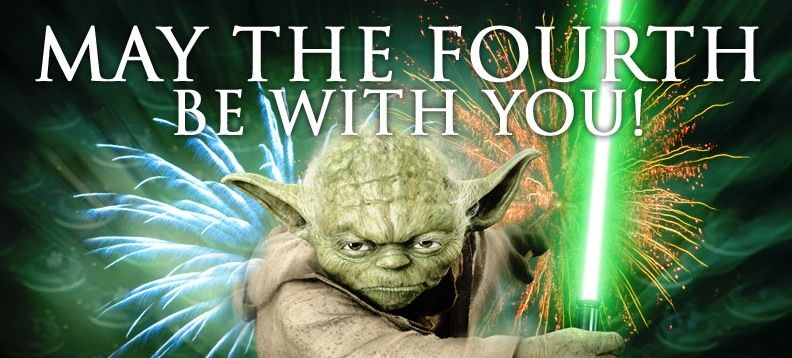
I first saw Star Wars on Beta. (Those of you born after 1985 are scratching your heads right now wondering what that is.) It was a bad, commercial-laden dub off the local TV station: the picture quality was dreadful, the sound was worse and the story was interrupted every five minutes to try and sell me pantyhose and dish detergent. Regardless, my young self was completely transfixed. Set aside the sheer whiz-bang factor of cool spaceships zipping around shooting lasers at each other; for a quiet, lonely kid who grew up looking at the stars and dreaming, Star Wars was that dream given shape – the idea that from the humblest beginnings could arise an adventure to span the galaxy. Star Wars and its every subtle quirk – characters with a half-second of screen time, unusual inflections on innocuous line readings – burned itself into the zeitgeist and became an instant allegory for our own troubled history. “May the Force be with you” was more than a secret sign between members of an exclusive cult; it evolved into a universal greeting of peace and goodwill.
Thirty-five years later, our post-Star Wars world is a far more cynical time, when the wide-eyed eagerness displayed by young Luke Skywalker is seen more as tragic naïveté than an admirable sense of hope and optimism. Thus, the enormous anticipation afforded to the prequel trilogy could not help but lead to an equally enormous letdown, a sense that despite all the ingredients being there, the recipe wasn’t gelling. One can waste gigabytes citing all the familiar criticisms: poor acting, dodgy writing, wooden characters, Jar Jar Binks. But it seems to me, as someone who admittedly experienced the same disappointment as The Phantom Menace unspooled, that what was missing from the equation was us. We didn’t have the same optimism, and we weren’t looking at the stars the way we used to.
It’s no surprise, then, that the newest iteration of Star Wars would fail to penetrate that jaded shell, erected by decades of frustration with the failures of our leaders, our increasing obsession with the banal, and a realignment of our values – towards the shallow, the material and the increasingly out of reach. How could even the most masterfully crafted Star Wars film compete against that? The clearest indicator of our cynicism, for me, was that in the months leading up to the release of Episode I in 1999, buzz centered largely not on the question of whether it would capture our imaginations and spark a cultural phenomenon the way the first movie did, but whether it would outgross Titanic – ironic in that Star Wars has always been a victim of its own success, and to examine it only in financial terms, as we seem to do with everything these days, is to miss its fundamental meaning.
Star Wars represented something that has gone somewhat astray amidst the background noise of our modern discourse, and deserves to be brought back in full vigor. That connection with the old stories, with the passions that have driven us since we first stood erect, and the myths we have handed down across generations almost as genetic souvenirs of what matters most to us about our collective human experience. It has endured, because it is the best of who we are and who we have ever been. Star Wars stokes the hunger to set out upon a journey and to emerge triumphantly at its end, not as a wealthier or more famous man, but simply a better one. To become more than what we are. That is what we are truly wishing each other when we say “May the Force be with you” – may your spirit be emboldened by the force it needs to achieve its greatest potential. Not a bad sentiment to express on May the Fourth – and something worth keeping in mind all year round.
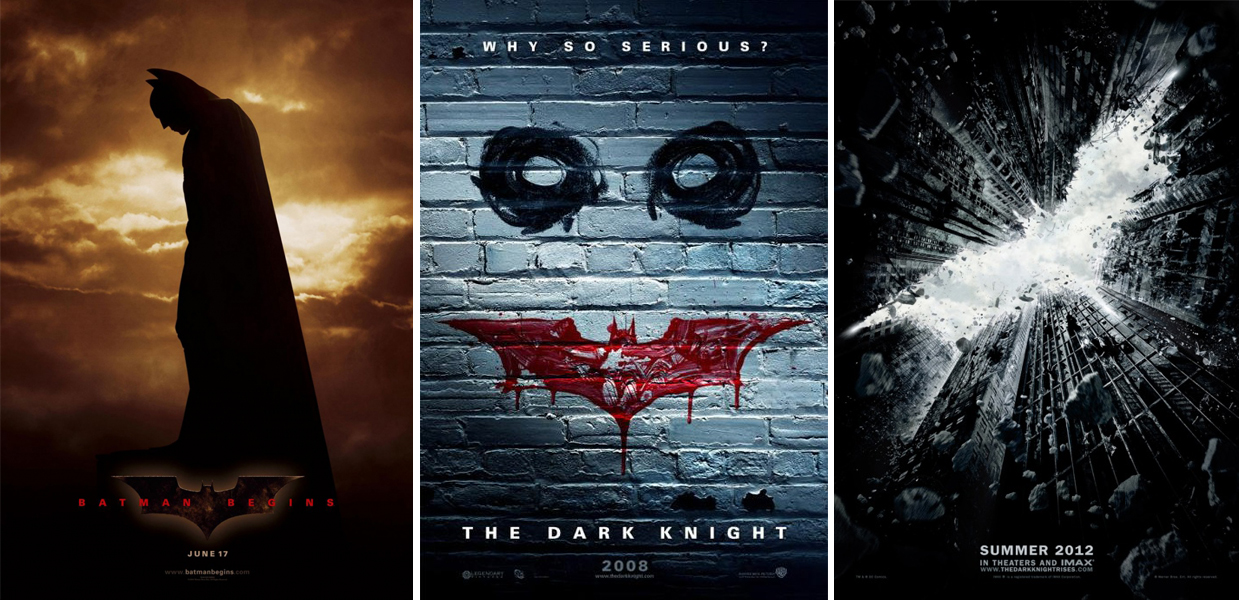
After groaning through a prehistoric glacier’s worth of ice puns in 1997’s Batman & Robin, I was done with the Caped Crusader. This was back in an era when I could usually find something positive to say about any movie I went to see, and my comment upon completing a slow funereal march out of the theater along with dozens of other disappointed audience members was, “That was $100 million that could have gone to feed starving children.” Batman & Robin was a two-hour sensory middle finger, stitched together to become less than the sum of its parts like some ungodly Frankenstein’s monster by accountants and focus groups. The old Adam West-Burt Ward TV show had been an after school ritual for me for many years, but the kitsch that worked so well in 22-minute installments in the late 60’s was excruciating when blown up for the multiplexes. What was fun and oddly sincere in one medium became insulting in another.
Since ’97, the theaters had been flooded with one superhero movie after another, some decent but most not, as studios plumbed their back catalogue to find some obscure character in a mask whom they could dress a star as and plug into basically the same script with a hip-hop soundtrack and thus secure a pre-sold blockbuster. Drubbed to death just as thoroughly around the same time was the concept of the prequel. “We’re going back to show you how it all happened.” It wasn’t enough to let a character exist with some mystery about their backstory; now it all had to be spelled out with each personality quirk given a deep, long-simmering Freudian rationale. (We can all admit that we thought Darth Vader was much cooler before we heard his boyhood self squeal “Yippee!” in The Phantom Menace.) So when I heard there was a new Batman movie coming out and that it was a prequel, my excitement level was roughly akin to what it would be if someone told me today’s special in our work cafeteria was a bowl of hot concrete.
The trailers for Batman Begins didn’t spur much enthusiasm either. Liam Neeson doing his Jedi mentor routine again. Bruce Wayne angst-ridden about his parents, even though we’d seen him coping with that in movies one through four. The only thing that seemed promising was the casting – heavyweights like Neeson, Michael Caine, Gary Oldman and Morgan Freeman, each of whom has the freedom to pick and choose and certainly wasn’t going to sign on for the same old same old. After Jack Nicholson stole the first Batman, successive films had tried to compete by doubling the number villains and cramming whatever A-lister was available into the roles, regardless of whether or not the story was served by it. Screenwriter William Goldman, when discussing working with Batman Forever‘s cowl-wearer Val Kilmer, commented on this pattern by observing that “Batman is and always has been a horrible part,” and that it existed solely for the more over-the-top villain roles to play off. The casting of Christian Bale in the lead this time, not an unknown but not exactly a seat-packing screen presence either, seemed to suggest that there were slim pickings in the ranks of volunteers to succeed Kilmer, George Clooney and Michael Keaton. The trailer scenes showed a very low-key approach to the storytelling as well, almost pleading “um, excuse me, if you don’t mind, that is, if you’re not busy, we kind of have a sort of new Batman movie for you.” The director, Christopher Nolan, had made the fascinating low-budget Memento, and the plodding higher-budget Insomnia. Truthfully, it all added up to a spectacular non-event.
Imagine one’s surprise when Batman Begins turned out to be merely spectacular.
The reasons why? Well, Christopher Nolan made one crucial decision in crafting his film. Aside from the usual reasons offered – treating the material seriously, dialing down the camp – he defied both expectation and tradition and deliberately made Batman/Bruce Wayne the most interesting character in the movie. Admittedly borrowing a lesson from the casting of the first Superman, where Oscar-winners and other screen legends surrounded the unknown-at-the-time Christopher Reeve, Nolan uses his stars to reflect their light onto the lead. The movie remains Batman’s story through and through; while there are villains, they are not given equal billing, nor is any significant screen time wasted on the complexity of their origins (the burden of all the Spider-Man movies). Like the best villains, they exist mainly as challenges for the hero to overcome – impediments to his growth as a human being. Even in The Dark Knight, the Joker comes out of nowhere and simply is, like a force of nature – he lies repeatedly about how he got his signature scars, in effect taking the piss out of the tired “villain’s motivation” trope. And there is a mystery to be solved; an actual plot to unravel piece by piece, instead of the bad guys running around trying to kill Batman for two hours. It keeps moving forward in so compelling a fashion that you forget you’re actually watching a character study, that happens to have some cool fight scenes in it.
In addition, Nolan created a complexity to Bruce Wayne heretofore unexplored on screen. He has three personas: Batman; the private, troubled Bruce Wayne; and the flamboyant, spoiled rich 1%-er Bruce Wayne – a new dimension to the man, unseen in his Keaton/Kilmer/Clooney iterations, where Wayne seemed to be just a decent guy who happened to be extraordinarily rich. Bale’s public Bruce is a trust fund brat, careless with his millions, the last guy you would ever expect to want to be Batman, let alone actually do it – which makes it even more logical that he would choose to act this way. Bale’s work is so good in the part that he’s actually more interesting as Wayne than he is in the Batsuit – which is just as well, because it’s over an hour into the movie before he finally puts it on. The Dark Knight continues this dichotomy: Bruce Wayne continues to act like a colossal entitled douchebag, deflecting all suspicion that he could possibly be the noble, driven soul determined to save Gotham City from itself. In Nolan’s Batman films, the true battles are not “Biff!” “Zap!” “KaPow!” but the ones going on inside these incredibly damaged people who are essentially representatives of the conflicts and contradictions inherent in all human beings. Batman isn’t just a token good guy – he’s us. He’s what we like to think we’d do, given the means, but more importantly, the will. And like us, he is a man who must overcome significant flaws and weaknesses to push himself beyond that limit.
The forthcoming conclusion to Nolan’s trilogy, The Dark Knight Rises, takes place nine years after Batman went on the lam, blamed for the murders of Harvey Dent and several police officers. It isn’t much of a spoiler to suggest that Bruce Wayne’s challenge in this movie may be to question whether he can truly leave the mantle of Batman behind, if the path of a hero is ultimately futile in that it has no end, no final triumph, way to know for certain whether the entire journey has been worth it. With apologies to William Goldman, Batman is no longer a horrible part. Truthfully, it never was – he just happened to end up in some horrible movies. Handled properly, he is an ideal vehicle for an exploration into the concepts of heroism, sacrifice and morality – the stuff of what the best stories are made. So go on and rise, Batman – we’re going to miss you when the last of the credits roll.
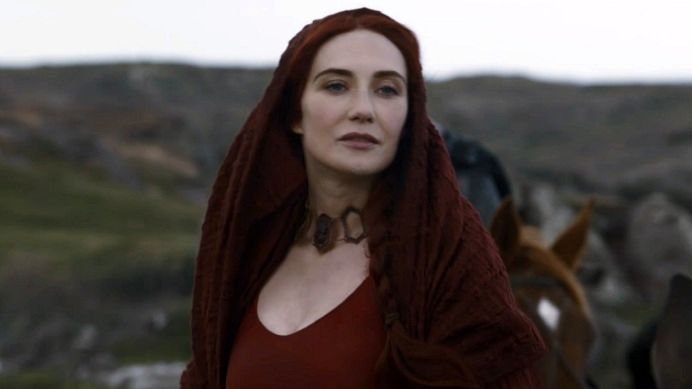
Carice van Houten as Melisandre, warning of darkness and horror and the return of the smoke monster from Lost.
Maiden, mother, crone; child, witch, whore; the meek and the bold, the submissive and the dominant, the loving and the cruel. The infinite and mesmerizing complexity of the feminine was embodied by the incredible women of Game of Thrones in this week’s episode, “Garden of Bones.” While the show can come off as a man’s world in which kings, knights, lords, gentlemen and brutes alike vie for power, “Garden of Bones” reminded the audience that even as they strut in their armor and proclaim their mastery of all they survey, the men are but pieces in this grand game, and that the women are holding the board up – with a flick of their elegant wrists this precarious world will collapse. That they have not yet done so speaks to the quiet bemusement with which they allow the boys to go about their manly and yet hollow pursuits.
That the men of Westeros are ultimately servants to the other half of the sky is evident in several scenes in the episode where men attempt to assert their dominance only to see their egos undercut by feminine power. The arrogant Littlefinger, his very moniker a comment on his masculine limitations, waltzes into Renly Baratheon’s camp, first confronting Margaery Tyrell about Renly’s love that dare not speak its name, then presenting his unrequited crush Catelyn with Ned’s remains and dangling a chance to reunite her with her captive daughters. In both instances the women will have none of it.
Margaery knows well that her marriage is a sham designed to secure a political alliance and is content to act her role, and Catelyn is not so naïve that a shameless appeal to her maternal instincts will excuse Littlefinger’s betrayal of her late husband. Robb Stark is struck speechless by the simple healer Talisa when his proud military victory is utterly diminished by her simple comments to him in the battle’s aftermath, as she accuses him of massacring a bunch of innocents and having no greater plan for the future of the Seven Kingdoms.
Where Littlefinger and Robb respond to their encounters with powerful women with silence, a more sinister path is taken by another profoundly insecure man attempting to assert his dominance over the female – in the skin-crawling scene where petulant King Joffrey commands one prostitute to beat another bloody. He cannot master them with his questionable masculinity, so he uses the coward’s fallback of fear and brutal violence instead. Joffrey’s understanding that he can never equal Robb Stark as a military commander, the more traditional masculine role, leads him to mistreat Sansa instead. Interestingly, while the delicate, virginal Sansa appears to be displaying battered woman syndrome in her continual proclamations of love for Joffrey despite his abuse, she is doing so not out of misplaced devotion but self-preservation – biding her time until she is freed of this monster. Her sister, Arya, utterly defeminised by circumstance (even commenting to Lord Tywin that being a boy made it easier) is likewise still a reserve of indomitable strength, going to sleep each night muttering, like a mantra, the name of each man she means to see dead.
Indeed, the only male character who seems not intimidated by the power of women (at least in this episode) is the one whose masculinity has always been dismissed by his fellow men: Tyrion Lannister. In fact, it is his knowledge of his cousin’s weakness for Queen Cersei’s feminine wiles and his ability to manipulate that awareness that allows him to gain a spy against his scheming sister.
The two sides of motherhood, giving nurturer and ferocious protector, are also on display with the “Mother of Dragons” Daenerys when she is petitioning for entrance to the desert city of Qarth, first pleading that a refusal to admit her people would condemn them to death, then threatening to use her dragons to burn the city to the ground when she is rebuffed. She is the mother of her clan of ragtag Dothraki as much as Catelyn finds herself mother and counselor not only to the Starks but to the men who would be King (treating the battling brothers Baratheon as if they were her own misbehaving children). Where her gilded sibling Viserys was an entitled prat cut from the same unearned royal cloth as Joffrey, Dany’s leadership qualities are being forged through fire.
And speaking of fire, there is Melisandre, the enchantress, trying to tempt grizzled old Davos Seaworth with the secrets beneath her robe. When he finally beholds her stunning (and very pregnant) naked self, the Onion Knight comes face to face with a depiction of the primal fear of all men, what they cannot understand and have never been able to control since the Garden of Eden: the magical temple of life and sexuality that is the woman’s reproductive system, from which emerges in a Freudian ecstasy of smoke and shadow the darkness and horror that Melisandre had cautioned Renly about earlier. To see this sheer force step forth and take shape as the sorceress smiles, at once incomprehensible and weirdly compelling, is the final affirmation in an episode already packed with revelations that the women have written the rules of the Game of Thrones, and they are its referees. For all the talk of the old gods, even Melisandre’s repeated comments about the “Lord of Light,” it is the Goddess, in all her magnificence, elegance, vulnerability, bravery, mystery and cruelty, all her many forms, young and old, beautiful and ugly, wise and foolish, who is running the show.
It’s Sean Bean’s birthday today – in my humble opinion, one of the coolest actors alive. For a couple of reasons: one, that he brings gravitas, dignity and believability to anything he’s in, regardless of the silliness of some of the lines he has to utter; two, that he is such a badass that he was once stabbed in a bar fight and instead of going for medical attention, went back in and ordered another drink; and three, that he happens to be a very nice and genuine person in the flesh. I met him briefly during the Toronto International Film Festival a few years ago, and even though I was some nobody interrupting him on the way back from his smoke break, he was warm, friendly and seemed interested in what I had to say (even if most of it was star-struck fanboy gushing). One thing you do notice when you do talk with him is how thick his natural Sheffield accent is, and how much he tempers it for his roles. I’m pretty good with deciphering British dialects and I was having a hard time catching everything when we were chatting. (Or, it could have just been the rather heavy cigarette breath.)
I have always found the experience of meeting celebrities a bit weird. You have a kind of ersatz relationship with them going in, a sense of who they are based on the characters you’ve seen them play, or how they’ve been in interviews you’ve watched; you become acutely aware of their quirks and this creates a sort of false familiarity that part of you expects to be reciprocated, even though you know they have no idea who you are, nor should they for any reason. Call it a substantially less-psychotic version of stalker syndrome, I suppose. It can be tremendously disappointing if the celebrity happens to be in a bad mood that day, if they are sullen and withdrawn, in contrast to the larger-than-life wisecracking persona they display in their work. Christopher Guest, of Spinal Tap and Best in Show fame (or the Six-Fingered Man in The Princess Bride), says that people are often shocked when they meet him and find that he is a very serious, somewhat humorless man offstage. For Guest, being funny is his job, not his personality. That dichotomy between the public persona and the private life is hard to reconcile when you’re a fan. I suppose a way to articulate how it must feel for the celebrity is to imagine you’re out shopping at the mall and a random individual approaches you and starts gushing about how much they loved your last PowerPoint presentation and how your reports are worded and what it must be like to work with your immediate supervisor – who you think is an absolute douche. Now try feigning interest in that.
Of the celebrities I’ve met, some have been terrific – Bean, Anthony Stewart Head (Giles on Buffy the Vampire Slayer and Uther on Merlin), Chase Masterson (Leeta on Star Trek: Deep Space Nine). Ray Park, who played Darth Maul in The Phantom Menace, was an incredibly nice bloke who seemed like he would have loved to have gone for a pint with us if there weren’t myriads more autographs to sign. I also have it on good authority that Hugh Jackman is a pretty amazing fellow. Others, for whatever reason – bad day, headache, any one of a thousand things that are none of our business – have been far less genial in my brief encounters with them: Terry Gilliam, William Shatner and most recently, Dean Stockwell. I met Mr. Stockwell this past weekend and immediately stuck my foot in my mouth when I asked him excitedly about Gentleman’s Agreement and what it was like to work with Gregory Peck (who played his father in the 1947 Best Picture winner). He became very quiet and muttered that Peck was cold, that he was one of those actors who did not enjoy working with children or animals. Stockwell then sort of looked away, conveying quite clearly that he was done with this conversation. I made my excuses and wandered off. I of course had no way of knowing that only a few days prior he had given this interview indicating how miserable an experience that movie and indeed much of his childhood was. Oops. Should have asked about Blue Velvet instead.
Celebrity worship is one of the strangest behavioural phenomena, and one suspects it derives largely from a sense of inadequacy and lack of fulfillment that many of us carry. Some are disappointed in how (relatively) little their lives have amounted to, and look up with awe at those who have achieved what they perceive as greatness. Yet greatness and renown are not necessarily the same thing. More often than not these days it seems that celebrity is achieved for all the wrong reasons – from national or worldwide embarrassment, or for utterly hollow pursuits. One wonders why we cannot simply appreciate the work being done without raising the person behind it to godlike heights. I’ve enjoyed Sean Bean’s performances, it was nice to have the opportunity to thank him for them, and that’s more than enough. To treat any of these people with the reverence accorded to kings is diminishing our own sense of self – they are, after all, simply human beings, and neither of us is fundamentally any different from the other. Just different ships sailing down the long and often stormy river of life, all equally vulnerable to the rocks and shoals.
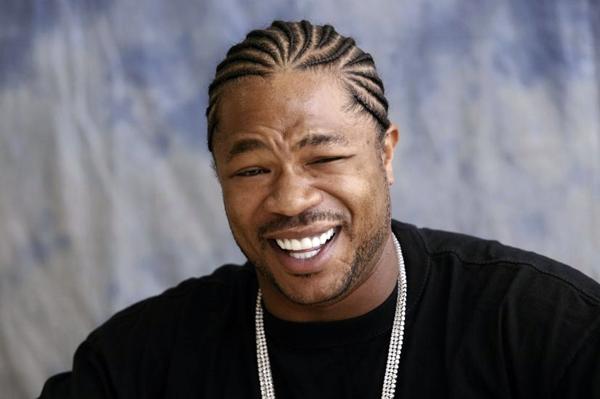
Xzibit, you are all too knowing. Memegenerator.net.
It’s been said that we live in an age of lowered expectations; schools expect less from students, audiences expect less from television, voters expect less from their leaders. But every time you think we’ve bottomed out at the nadir of what is meant to impress us, someone finds a way to dig further down and underwhelm even more. Recently, we’ve seen the rise of a new low in the aspirations of marketing, like a badly mixed soufflé sputtering to inflate itself in an oven with the fuse burnt out: the movie trailer trailer. And that’s not a message from the Department of Redundancy Department.
Yes, studios have decided now to capitalize on an audience’s hunger for any tidbit of information about an upcoming blockbuster by releasing trailers not for the movie itself, but for a more detailed trailer about the movie. Prometheus, Ridley Scott’s enigmatic sci-fi prequel to his 1979 classic Alien, got the ball rolling last month, and in the last few days we have had a trailer for the trailer of the unclamored-for remake of Total Recall. Honestly, if there was any more recycling going on they would have to pack film reels in blue boxes. Faced with an appalling glut of unoriginality, studio marketers have decided to double down by trying to create buzz not for the projects themselves, but for the very ads promoting the projects. There is a very popular Internet meme involving Xzibit and Pimp My Ride which comes to mind, an appropriate variation on which would be thus: “Yo dawg, I heard you like trailers so we made a trailer for a trailer that you can watch in your trailer while you wait for the new trailer.”
I suppose it might be forgivable if the advertisements being advertised (God, the mind implodes at that) were anything of substance. The complaint used to be that trailers gave away too much (Cast Away, I still haven’t forgiven you for giving away that Tom Hanks gets off the damn island!), now, they are a big pile of nothing. The Total Recall trailer trailer tries to entice you by showing everything you’ve seen before: Colin Farrell being strapped into the same machine Arnold Schwarzenegger was 22 years ago, Kate Beckinsale looking hot and carrying a gun, futuristic cars flying around, some stunt guy leaping out a window. Even worse than this is the teaser for Breaking Dawn – Part 2, the ultimate Seinfeld of a trailer whose big draw is a shot of Kristen Stewart wearing the same facial expression she’s used in the previous four Twilight movies, only this time with red eyes. Oooh. (Of course this movie is ad- and critic-proof as its legions of worshippers will show up at theatres even if the movie is just Stewart and Robert Pattinson staring at each other for two and a half hours – oh, wait, that’s exactly what it is!)
Naturally, we have only ourselves to blame. Collectively we’re like the kid shaking his presents three weeks before Christmas listening for the telltale rattle of the Lego set inside, in our obsessive need to know every last detail of a movie before it ever opens – who’s in it, what changes they made from the book, what the characters look like, what stars are actually dating off the set, the shape and substance of every major action sequence down to a beat-by-beat plot description and excerpts of dialogue. There is a theory among movie marketers, the people who actually cut the trailers together, that audiences won’t go to a movie unless they’ve already seen the best parts. But thanks to entertainment magazines and Internet gossip sites, we already have, before a frame of actual film crosses in front of our eyeballs. We know exactly what’s coming, because we don’t want to be surprised – the potential of a surprise carries with it the equal potential of disappointment, and who wants that on a summer night at the theatre? So the natural response by the people selling these things is to reassure you that you’re going to get exactly what you’re expecting, and it’s why they make trailers for trailers. It’s a mere taste of the pablum cooking on the stove before Mom spoons out an entire bowl for you; warm, comforting and utterly without flavour. There is no there there, so all they can sell is hype. And if you lap it up and buy a ticket to the movie anyway, two hours later that’s all you’re going to come away with.
We went to see The Hunger Games yesterday. I haven’t subscribed to the phenomenon of this newest teen read-turned-franchise (the premise of kids forced to kill each other for food strikes me as a tad dark for the age group it’s appealing to) but it’s good to see the emergence of a strong, brave and loyal heroine who isn’t whiny, unrealistically pretty or overly unfeminine, or dependent on the obsessive love of an emo vampire for her self-worth. With that in mind, bravo to Suzanne Collins’ Katniss Everdeen and the actress who plays her, Jennifer Lawrence. Bravo too to writer-director Gary Ross, who doesn’t make movies very often but never fails to craft a thought provoking tale when he does (Dave, Pleasantville). And indeed, healthy kudos to all involved in putting together an entertaining if surprisingly low-key adventure. My only major complaint is, did the camera have to be so damn shaky throughout the whole thing?
Th-th-the H-h-hun-ge-ge-ger G-g-ga-me-me-es.
Hand-held camera work has been popular among filmmakers for some time. I first became truly aware of it when NYPD Blue premiered in the early 90’s – couldn’t figure out why the camera work was so sloppy! From a critical standpoint, taking the camera off its mount and letting it bounce around invokes the realism of documentaries, placing the audience member right in the middle of gritty, cheap life and death and not in the safe, million-dollar air-conditioned artifice of a soundstage. “Shakycam” in the opening sequence of Saving Private Ryan helped to convey the rawness and bloodiness of the D-Day invasion the way the bolted-to-the-floor approach of the 60’s John Wayne war epics didn’t. And low-budget horror movies like The Blair Witch Project use shakycam to build tension so that those of us watching feel as unsettled as the characters wondering if the axe murderer is lurking beyond the doorway.
But there is a major difference between being creeped out by a movie and contracting motion sickness from it. I’m not sure if the shakycam work is becoming more intense these days or I’m just getting old, but the first hour of The Hunger Games had me longing for a barf bag – a reaction I’m certain wasn’t the intention of Gary Ross or his director of photography. (Luckily once Katniss and Peeta reach the Capitol the camera settles down a bit.) As much as I loved The Grey, I had the same problem with it. I could not watch at least half of The Bourne Ultimatum in the theatre; I remember sitting there staring at the back of the seat in front of me hoping my stomach would calm down. And Blair Witch made me so ill I had to walk out of the theatre twice – and I was 13 years younger then. As the sensory experience of movies intensifies, with surround sound, digital projection and 3-D, the more shakycam messes with our inner ears, and the more difficult it is to sit through a movie without tossing the candies you just scarfed down. My question is – the moviegoing experience has become miserable enough with smartphones going off and other audience members yakking at each other and at the screen, do we have to keep adding nausea to the reasons to stay home?
Shakycam has become so ubiquitous that it pops up in movies where it’s completely inappropriate. One of the worst recent offenders was Public Enemies, Michael Mann’s story of the pursuit of John Dillinger starring Johnny Depp and Christian Bale. Mann made the questionable artistic choice of shooting a 1930’s period piece on digital video with plenty of 2000’s shakycam, which pulled me out of the story. I never believed I was in the 1930’s – the camera work made me feel I was watching a reality show with a bunch of celebrities playing cops and gangsters. I can’t imagine actors are very fond of it either, particularly if they’re trying to convey nuanced emotional moments while the camera is zipping around their face like a drunken mosquito. One of the most beautiful elements of The King’s Speech was that the camera work was almost invisible, letting you focus on the words and actions and reactions of the characters. The anchor of a fixed camera immerses you in that world because you forget the camera is there. If the aim of a movie is to give the audience an escape, then directors should not erect barriers to losing oneself. Shakycam does exactly that, even if it doesn’t make you physically sick, by reminding you of the camera present in the room with these characters, and that whoever is operating it probably should have eaten more protein with his breakfast.
My friends and I made a no-budget, feature-length action comedy in our last year of high school, using my family’s video camera. Fortunately one of my pals was able to procure a tripod, which we considered a godsend, because the last thing we wanted for our little epic was the unprofessional look of an unsteady camera. Even in Hollywood, an unsteady camera used to be lambasted as the shoddy workmanship of a bad director; now, those same studio hacks jerk the camera around to up their artistic credibility and are summarily praised for their realistic approach. Personally, I’m tired of just hoping I’m going to make it to the end of the movie without my stomach leaping out through my mouth. I think it’s time we thanked the shakycam and packed it off to the realm of the intertitle and other cinematic techniques long since abandoned. Either that or start selling Gravol at the snack counter along with the Skittles.
The death this week of composer Robert B. Sherman at the age of 86, one half of the famed Sherman Brothers, is a tremendous loss for the world of music. The name might not immediately ring familiar, but his body of work certainly would. Beginning in 1961 with The Parent Trap, Sherman’s prolific collaboration with brother Richard was the soundtrack for millions of childhoods – films like The Jungle Book, Chitty Chitty Bang Bang, Bedknobs and Broomsticks and most famously, Mary Poppins. Kids learned Sherman Brothers songs along with “Mary Had a Little Lamb” and “Old MacDonald.” They were catchy, upbeat and relentlessly optimistic – songs that just made you feel good and want to learn all the words. This was all the more remarkable given Sherman’s service in World War II, and that he had led Allied forces into the Dachau concentration camp in 1945 shortly after it had been abandoned by the Germans. To have seen such horror and to come out the other side with one’s faith in humanity intact is simply remarkable – not to mention retaining the ability to communicate that faith through art.
It is perhaps that spirit of unflappable positivity that continues to endear Mary Poppins to one generation after another. To me, the secret of its appeal has always laid in its unsung hero, the man the story is truly about: uptight financier and family patriarch George Banks, played perfectly by David Tomlinson, an actor who never achieved movie star wattage, but was always highly regarded by his peers as a good and honourable soul – qualities that he brought to what is perhaps his iconic part. Mary is charming, Bert is a happy-go-lucky goofball (dodgy Cockney accent and all) and the kids are cute without being cloying, but the movie is George’s story through and through. George starts the movie as a man of business – Ebenezer Scrooge without the cruelty or sneering condescension at the less fortunate. He is a man locked into the machine, always dressed in black and white, very much accustomed to his place as one of the cogs that drives the British economy. And he has come to believe that this is how his family should operate as well – his opening number, “The Life I Lead,” details with clockwork precision how he wants his household to run; like a bank. He has truly put aside childish things and buried his imagination beneath his bowler hat. Indeed, he is a man for whom the audience feels great sympathy, because he is good and kind, but lost. His eventual triumph, when, after having been ritually sacked, he bursts into laughter at rediscovering the mirth inherent in life, is like watching pure joy unfold before your eyes. It’s a liberating reminder that things can indeed be “supercalifragilisticexpialidocious” – it’s all in how we choose to look at them. And we can find a Buddha-like tranquility and fulfillment in just going to fly a kite.
One has to wonder if the message would have resonated as strongly without the Sherman Brothers’ wonderful songs to deliver it. Something that has always perplexed me when it comes to criticism, whether it’s music, film or literature, is the seeming bias against work that conveys a positive message. Critics tend to go for bleak and raw, the ugliest emotions stripped to their very bone. Certainly there is merit in such work; we cannot present a fair and accurate portrait of humanity without acknowledging its inherent duality and contradictions, the best and the worst of us. But uplifting art is often dismissed as candy, as artifice of the most deceptive kind. No, Mary Poppins is not Taxi Driver, and the Sherman Brothers’ songs aren’t Radiohead. But ask yourself how you want to feel. Does anyone really enjoy being depressed? Do we not always crave the light? Is there perhaps more truth to be found in the songs of a man like Robert Sherman, who saw the worst of humanity and still found reason to celebrate life, than in those of a latter day pretender whose worst tribulation was that their high school crush didn’t return their affections? Would anyone’s needs be served by watching George Banks crashing and burning and leaving his family bereft? Pish posh, I say. Instead, we are lifted as he completes his journey and achieves enlightenment.
To me, art that appeals to our sense of hope is infinitely more valuable and truthful than that which wallows in the cesspool of despair. It’s easy and a cop out to be depressed at the state of the world. But let’s be honest – like the Mary Poppins Sherman Brothers song goes, we all still love to laugh. So I can close today with a quote from George Banks that never fails to make me smile:
My tastes in music have always been a bit of a joke among my closest friends. I was about five years late to the party buying a CD player, and my first CD purchase wasn’t the White Album, or any of the chart-topping or even lesser known indie bands at the time – it was the soundtrack from Kevin Costner’s Waterworld, not even a movie for which I had any particular affection. In fact, over the years I’ve probably purchased dozens of soundtracks from movies I didn’t like that much, swelling to a collection of hundreds. The sole reason? I loved the music.
Music and film have long been committed companions, from the beginnings of the silent era when a live musician would sit in the theatre and play piano to dramatize the grainy black-and-white images flickering across the screen. The coming of the talkies, thankfully, did not diminish the need for music to continue its cinematic journey. Early composers like Max Steiner, Erich Korngold, Alfred Newman and Miklos Rosza developed upon the traditions of the classical masters to fashion, together, a new musical language for the 20th Century’s most popular new art form, a tradition expanded upon by men like Bernard Herrmann, Maurice Jarre, Nino Rota to name but a very few. How many of the incredible movie moments have been etched into our collective memories in large part because of their music? Scarlett’s longing for the halls of Tara in Gone with the Wind. Janet Leigh’s shocking death in Psycho. The lonely trumpet that opens The Godfather. Robert Redford’s home run blast in The Natural. Rocky Balboa’s race up the Philadelphia steps. The mere glimpse of the photo above can conjure immediately the haunting John Williams motif of the yearning of the hero to set out on adventures bold, much as thoughts of sharks can summon his remarkably economical two-note overture for Jaws. The movie score is its emotional brush, painting the subtext of the characters’ deepest passions directly onto our hearts, uniting the audience in a shared experience of joy, pain, despair, and most endearingly, hope.
The 1990’s were a rough era for lovers of orchestral soundtracks. Madonna’s Music from and Inspired By Dick Tracy begat a misguided and disappointing era of music marketing whereby soundtracks were reconfigured as pop/rock/rap compilation albums that had little to do with the movie itself – maybe one or two songs at most were used in the film and the rest were chosen at random by committee. And yet some brilliant scores were flying beneath the radar. I’ve been listening a lot lately to American composer Thomas Newman’s work on 90’s epics like The Shawshank Redemption. Newman’s music isn’t as recognizable as someone like John Williams, who works very much, particularly in his Spielberg and Lucas collaborations, in the mode of leitmotif – assigning a specific theme to each character and recurring emotional beat. Newman’s music is always more subtle, relying on gentle piano, soft percussion and swaying strings, yet its emotional resonance is just as strong. His scores for American Beauty and Road to Perdition are a masterwork of forlorn and melancholy understatement, letting you peel layers from the characters and see directly into their wounds. American Beauty in particular is a movie that would not work with the more upfront, heroic style that Williams is so good at – as Wes Bentley’s character Ricky describes being overcome by the beauty he sees in the world, even in innocuous things like a plastic bag floating in the wind, Newman’s soft piano embraces both him and us, and just for a moment we can see through his eyes. In a sense, the music is that intangible, untouchable beauty, capturing the moment in a way that dialogue, performance and image cannot.
Joseph Campbell suggests that amidst our billions of stories, there is only one – the journey of the hero with the thousand faces. Cinematic scores likewise number in the thousands, some remarkable, some forgettable, but singular in their indispensability as storytellers. They can be our emotional anchor as we fly off into the strange new worlds of the imaginations of directors, writers and actors, and a truly magnificent score can come to define moments in our own lives as well as the ones we see on the screen. Truly, who hasn’t imagined the music swelling at our most heroic, and even our most despondent hours? Stories, like our emotions, are our universal connectors – and music goes with us on the journey as a narrator, speaking the truth in notes and phrases through all barriers to comprehension when words sometimes fall short.
Few can disagree that 2011 was a forgettable year for movies. One is reminded of the 1994 baseball season, which, owing to a crippling strike, was the first without a World Series. You almost wish that the Academy Awards could skip a year themselves. A rule change a few years ago expanded the field of Best Picture nominees from five to ten, and this past year, the Academy couldn’t even gather ten films worthy of the top honour – settling instead for nine. And none truly captured imaginations and inspired the affections of millions, or infected the zeitgeist like famous films gone by; the closest contender is The Artist, whose primary selling point is that it’s a silent movie done in the style of the 1920’s – an exercise in Hollywood nostalgia (or navel-gazing if one wants to be cynical about it), and appealing most to old show business insiders heartsick for the halcyon days of Irving Thalberg and Louis B. Mayer. As a prime example of how low 2011 set the bar, the highlights of one of the performances nominated for Best Supporting Actress (Melissa McCarthy in Bridesmaids) is the character defecating into a sink. The Simpsons has a great word to express the apex of being unimpressed: for lack of a term more in the mode of the Queen’s English, 2011 in film was simply meh.
But this isn’t the place to whinge about how Hollywood never makes anything good anymore, because I don’t believe that’s necessarily true. They just seemed like they were having an off year – maybe they were depressed after the triumph of the Tea Party in the mid-term elections. 2010 offered some fantastic entries, including two personal favourites – The Social Network and The King’s Speech. Both were masterfully written, impeccably acted and crisply directed, and both were essentially about a shy and retiring person finding his voice (metaphorically in the former, literally in the latter) and forcing the world to hear it. It remained an open question up until Oscar night which of the two would emerge on top – ultimately the Academy opted for the movie with the more endearing protagonist, and The King’s Speech was thus crowned (interesting trivia note, it was the second movie in a row to win Best Picture featuring a performance by Australian actor Guy Pearce, after The Hurt Locker in 2009, even though in that one he gets killed in the first five minutes).
Visually, The King’s Speech is not as interesting as The Social Network, with its digital trickery in the portrayal of the Winklevoss twins by a single actor and the use of tilt-shift photography in a regatta sequence. Many of the shots in The King’s Speech are quite simple – medium and close-ups of the characters, slightly off-centre to indicate their lack of comfort in their surroundings and with others. But you cannot take your eyes away from the screen, because the performances and the writing hold you like a vise. As much praise as Colin Firth deserves for his role as King George VI, with his commendable choice not to overact the King’s infamous stammer and thus render it cartoonish, for me the real joy in the movie is Geoffrey Rush as speech therapist Lionel Logue. I have decided that Rush is one of those actors I can watch in anything. As much as everyone raved about Johnny Depp in Pirates of the Caribbean, Rush was the unsung star of that film, creating a complex character despite a thin script with just the right smattering of Robert Newton thrown in. Rush can even elevate dreck like Mystery Men with his presence. Indeed, without Rush, The King’s Speech never would have been made – in a breach of protocol, the script was dropped off at his home without going through his agent first, but Rush loved what he read enough to get things moving.
As mentioned previously, The King’s Speech and The Social Network are both masterpieces of screenwriting (indeed, they both won Oscars for their writers), but for very different reasons. The Social Network is Aaron Sorkin through and through; the cadences and references used by each character belong to that unique universe of his creation. David Seidler’s dialogue in The King’s Speech is equally remarkable, but for a different reason – how understated it is. Although regular readers know I admire Sorkin greatly, sometimes it’s difficult to imagine any real person speaking the way he writes them – people aren’t that quick, witty, off-the-cuff or as complex in the iterations of their arguments. By contrast, there is wit and sharpness in the words of The King’s Speech, but amazing economy as well – the script is a mere 90 pages and very little was excised in the final cut. The wit and personality of the players seems more natural; there is less sense of the screenwriter typing the lines. Seidler is letting the characters speak, he is not forcing his words into their mouths. For a movie about finding one’s voice, this choice is not only appropriate but adds to the realism of the story and deepens its emotional resonance. They say as much as, and only, what is needed. And the richness of what they do say makes you want to go back and watch the movie again and again. If it happens to be airing on any given day, I am compelled to sit and watch the whole thing – and I still smile when dear Bertie pulls it off in the end.
So far, 2012 does look to hold more cinematic promise – we have The Dark Knight Rises, The Hobbit and Skyfall all due to hit screens before the year is out. Perhaps we can consider 2012 to be 2011’s mulligan, its do-over. I’m hopeful as always, every time I sit back in the theatre and the lights go down, that I’m about to see the greatest movie I’ve ever seen. Sometimes, like with The King’s Speech, I come pretty darned close to thinking just that.





 Graham's Crackers